Molex is a continuous, liquid-phase adsorptive separation process to recover normal paraffins
- Technology
- UOP MOLEX

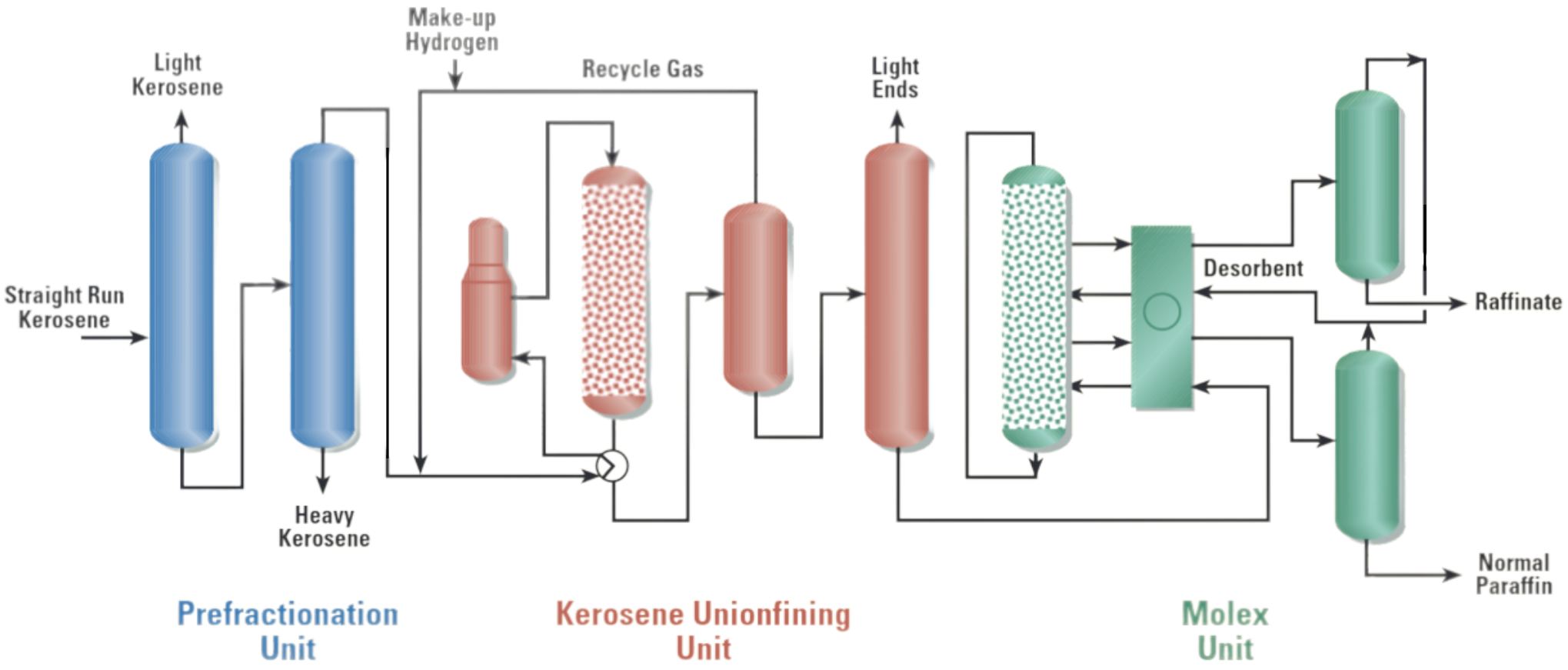
Molex complex, simplified block flow diagram (after UOP 4217-19)
Molex is a continuous, liquid-phase adsorptive separation process developed by UOP (Universal Oil Products; today Honeywell UOP) to recover normal (linear) paraffins from isoparaffins, cycloparaffins and aromatics. It applies the UOP Sorbex simulated-moving-bed (SMB) technique to a Ca2+-exchanged zeolite A (5A molecular sieve), whose pores admit linear molecules and exclude all branched and cyclic ones.
The process was announced in 1959 for gasoline-range feeds and extended in 1961 to kerosene and light gas oil, producing concentrates of up to 95% C10–C22 normal paraffins. Its principal application is the production of C10–C14 normal paraffins from straight-run kerosene as feedstock for linear alkylbenzene (LAB) and biodegradable detergents. A typical unit delivers about 99 wt% normal-paraffin purity at about 98 wt% recovery; product purity is typically above 99.5%. The raffinate returns to the refinery for jet-fuel blending.
As of July 2001, UOP lists 37 Molex units licensed in its Sorbex portfolio; product capacities of commissioned units range from 2,500 to 155,000 t/y. Documented reference sites include Cepsa Química Puente Mayorga (Spain; Molex I and II) and Farabi Petrochemicals (Yanbu, Saudi Arabia).
Continue reading here.
#molex #honeywell #normalparaffins #linearalkylbenzene #lab #adsorptionseparation #molecularsieve #petrochemicals #refining #processtechnology #chemicalengineering #lubricants #detergents