Molecular sieve adsorption is a family of shape- and equilibrium-selective separation technologies
- Technology Type
- Molecular Sieve Adsorption for Hydrocarbon Separation

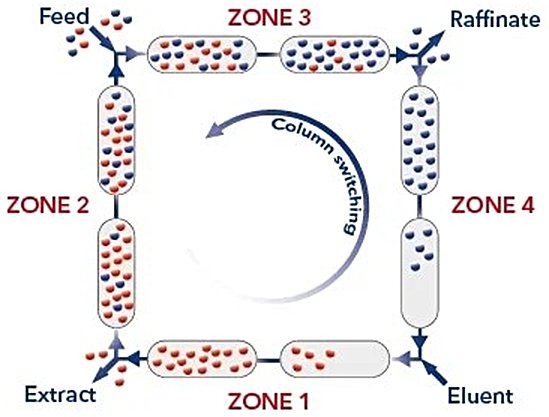
Schematic showing the interactions, and mode of purification, in SMB Chromatography | Source: C. Benkhäuser, KNAUER Wissenschaftliche Geräte GmbH Materials, AZO Materials (Nov 23, 2017)
Molecular sieve adsorption is a family of shape- and equilibrium-selective separation technologies used across refining and petrochemicals wherever conventional distillation cannot resolve a mixture because the components are too close-boiling or structurally too similar. Two distinct mechanisms are in commercial use, serving two very different separation problems:
- Shape-selective (kinetic) separation — small-pore zeolites (notably type 5A) that physically admit linear paraffins/olefins while excluding bulkier branched and cyclic isomers. Applied to n-paraffin extraction (detergent feedstock, diesel/kerosene cetane improvement) and light olefin splits (e.g. n-butenes from isobutene).
- Equilibrium-selective separation — larger-pore faujasite-type zeolites that do not exclude molecules by size but preferentially adsorb one isomer over near-identical ones based on subtle differences in adsorption strength. Applied to paraxylene recovery from mixed C8 aromatics, where paraxylene, metaxylene, orthoxylene and ethylbenzene are essentially indistinguishable by boiling point.
Both mechanisms are commercialized almost exclusively via continuous simulated moving bed (SMB) technology, which mimics true countercurrent contact between a stationary adsorbent and a flowing liquid using a rotating (or valve-switched) multi-bed arrangement. This profile covers the generic engineering principles common to both separation classes.
Continue reading this technology review here.
#Petrochemicals #Refining #ProcessTechnology #Paraxylene #ButeneIsomers #LinearParaffins #SelectiveAdsorption #MolecularSieve #Zeolite