Dangote's Lamu Refinery: A Bid to End East Africa's Fuel Import Dependency

- Entity
- Dangote Industries Limited
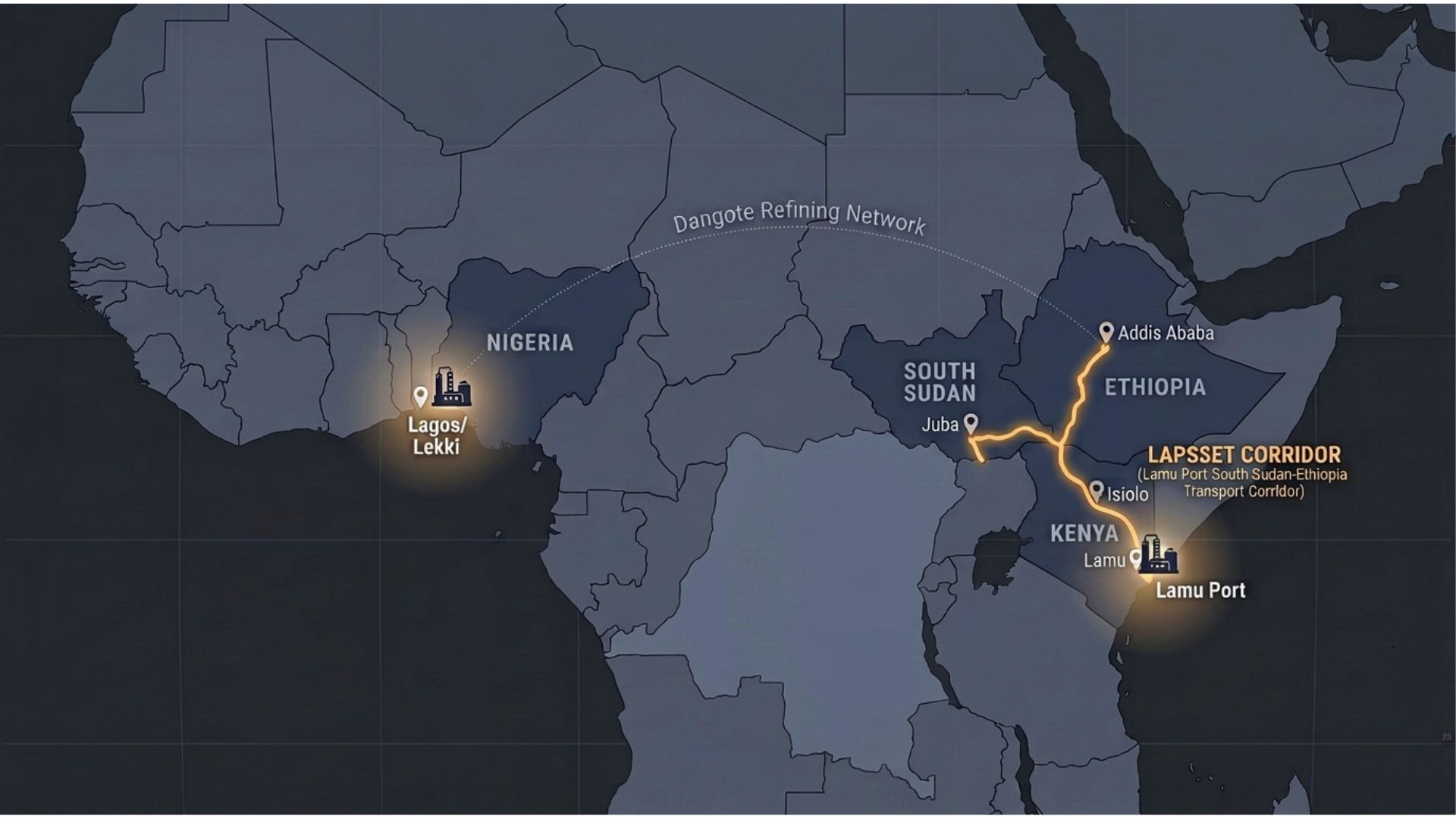
LAPSSET corridor (Lamu Port to South Sudan and Ethiopia) and the Dangote Refining Network
Market Insights | ppPLUS Intelligence Series • Refining & Petrochemicals | July 2026
From One Refinery to a Continental Machine
Nigeria was the proof of concept. Kenya is the scale-up. With the Lekki refinery already the world's largest single-train facility and expanding toward 1.4 million barrels per day, Dangote is not simply building a second plant — he is architecting a transcontinental refining network stretching from the Gulf of Guinea to the Indian Ocean. Combined, the two hubs would give a single privately controlled group 2.1 million barrels per day of refining capacity — a volume that would rank Dangote among the largest private refiners on Earth, standing shoulder to shoulder with state oil giants rather than other African industrialists.
Choosing Lamu: A Calculated Bet on Geography
After circling Mombasa and even a joint venture in Tanga, Tanzania, Dangote settled on Lamu Island — a strategic choice that says as much about ambition as about logistics. Lamu is not just a refining site; it is the maritime gateway to the LAPSSET corridor, the long-dormant Kenyan mega-infrastructure vision linking Lamu Port to South Sudan and Ethiopia. By anchoring his refinery there, Dangote is positioning himself to revive a stalled regional integration project and become its indispensable commercial engine.
The Prize: Ending East Africa's $20 Billion Fuel Addiction
The scale of the opportunity is staggering. East Africa currently spends an estimated $20 billion every year importing fuel that could, in theory, be refined closer to home. A single 700,000 bpd facility at Lamu would be large enough to supply not just Kenya, but Tanzania, Uganda, and South Sudan — turning a fragmented, import-dependent region into a zone served by domestic refining capacity for the first time in generations. This is the same playbook Dangote ran in Nigeria: identify a continent-sized import dependency, and build the single asset large enough to break it.
A Project Still in Its Early Stages
Behind the headlines, the project remains at a preliminary phase. No dedicated legal entity has yet been established for the Kenya refinery — it currently sits as a commitment under the parent group, Dangote Industries Limited, rather than as a standalone company. A feasibility study was still ongoing as of May 2026, and while some initial site works have started, full construction has not yet begun. This is consistent with how large infrastructure projects typically unfold — strategic intent is often communicated well ahead of execution. The coming months, particularly entity incorporation and the feasibility study's conclusion, will be the clearer indicators of the project's actual progress.
Why This Matters Beyond Kenya
If Dangote successfully replicates the Nigerian model in East Africa, he will have demonstrated something no other African industrialist has proven at this scale — that a single private group can identify, finance, and execute mega-refining projects on two separate coasts of the continent within a single decade. That would not just make Dangote Africa's richest man; it would make him the architect of the continent's post-colonial energy independence, one refinery at a time.
What ppPLUS Is Watching
-
Entity incorporation — the moment a dedicated Kenyan legal entity appears will signal the project has moved from concept to construction-ready
-
LAPSSET alignment — how closely Dangote's refinery timeline syncs with Kenya's broader corridor infrastructure ambitions
-
Regional demand capture — whether Tanzania, Uganda, and South Sudan formalise offtake arrangements, validating the "single refinery, four countries" thesis
-
Government equity talks — whether Kenya secures a stake similar to NNPC's historic role in the Nigerian project
-
Groundbreaking date — the true starting gun for a three-year construction clock
Note: The strategic assessments, risk framing, and forward-looking analysis in this brief reflect ppPLUS's own independent intelligence judgment. Factual details draw on the following sources: Reuters, The East African, BusinessDay NG, Business Daily Africa, Financial Times (via Accra Street Journal and Africa Business Insider), Zawya, Khusoko, Punch NG, Africa Energy, and Bloomberg.