ENEOS Acquires Chevron's Asia-Pacific Downstream Portfolio for $2.17 Billion

- Entity
- ENEOS Holdings Inc

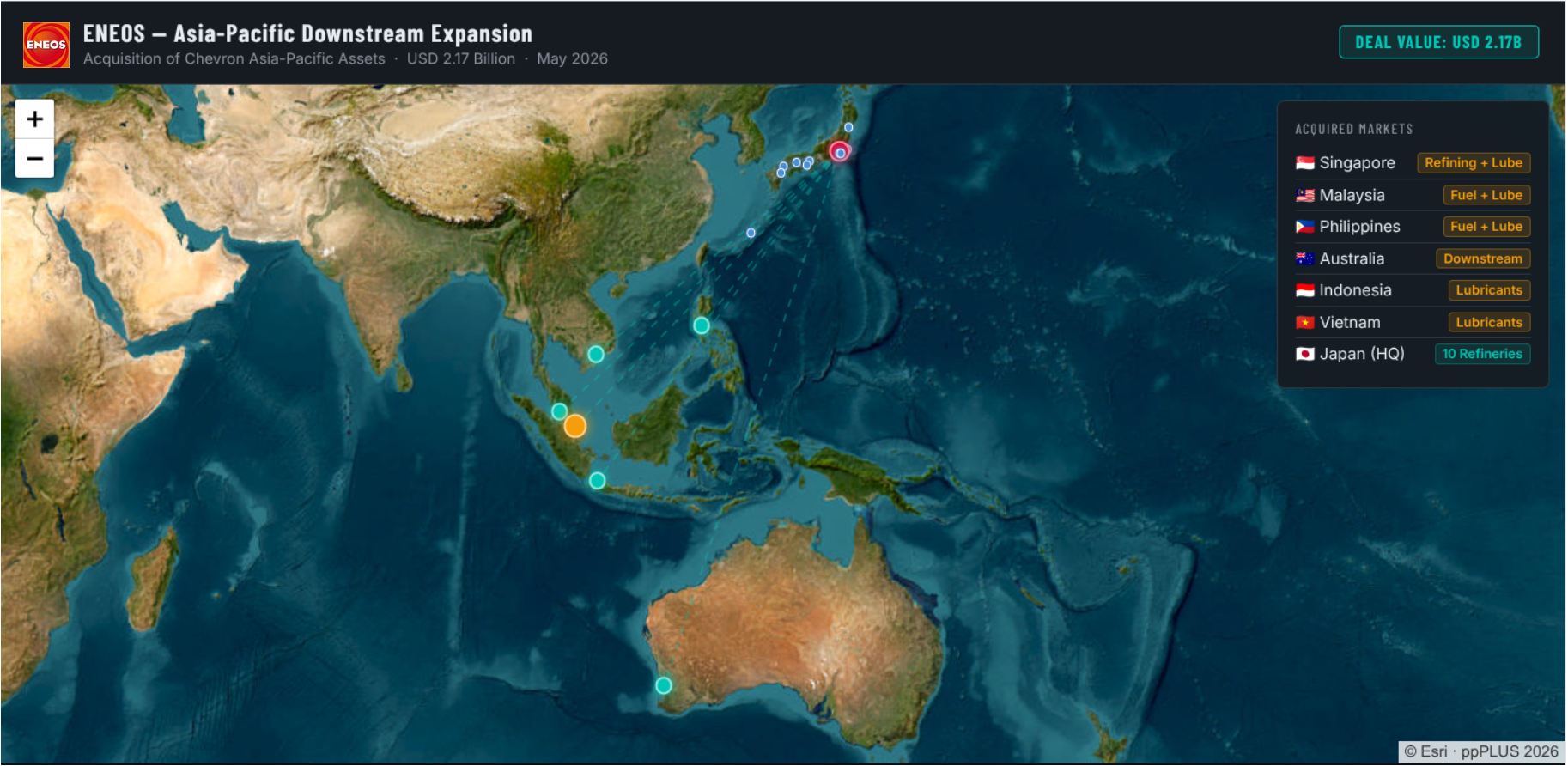
Japan's largest refiner makes its first cross-border refining move, absorbing Chevron's regional downstream footprint in a landmark divestment deal
TOKYO / SINGAPORE, 14 May 2026 — ENEOS Holdings Inc., Japan's dominant downstream energy group, has signed share purchase agreements to acquire Chevron Corporation's downstream fuels and lubricants operations across six Asia-Pacific markets for approximately $2.17 billion in cash — marking the company's first refining venture outside Japanese borders.
The transaction is structured through a Singapore-based special purpose vehicle (SPV) established by ENEOS, and is expected to close in 2027, subject to regulatory approvals and customary closing conditions.
The Singapore Refining Company at the Core
The centerpiece of the deal is Chevron's 50% non-operated stake in Singapore Refining Company (SRC), one of Singapore's major crude processing installations. The acquisition also encompasses the Chevron Penjuru terminal and lubricants facility in Singapore — assets with significant logistical value in one of Asia's most strategically important refining and trading hubs.
A Regional Portfolio Spanning Six Markets
Beyond Singapore, ENEOS will take full ownership of Chevron's downstream subsidiaries across:
- Malaysia — Chevron Malaysia Limited
- Philippines — Chevron Philippines Inc.
- Australia — Chevron Australia Downstream Holdings Pty Ltd
- Indonesia — PT Chevron Oil Products Indonesia (including lubricants)
- Vietnam — lubricant operations under Chevron Singapore Pte. Ltd.
The combined scope gives ENEOS an immediate retail fuels and lubricants presence across ASEAN's largest consumer economies and the Australian market — geographies where it previously had no operational footprint.
Chevron's Strategic Retreat from Downstream Asia
For Chevron, the divestment is consistent with a broader capital reallocation strategy — narrowing its global footprint and exiting non-core downstream assets to concentrate resources on higher-margin upstream positions, particularly in the Permian Basin and deepwater portfolios. The sale had been anticipated by industry observers since late 2025, with ENEOS emerging as the frontrunner from a competitive bidding process.
ENEOS: Financing and Strategic Rationale
ENEOS CFO Soichiro Tanaka confirmed at a Tokyo press briefing — coinciding with the company's full-year earnings announcement — that the acquisition will be funded from existing cash reserves, with no new debt issuance planned. The move signals a clear pivot toward inorganic regional growth as Japan's domestic fuel demand continues its structural decline, driven by fleet electrification and demographic contraction.
By absorbing SRC's processing capacity alongside a pan-regional retail and lubricants distribution network, ENEOS positions itself as a leading non-national downstream operator in Southeast Asia — a space increasingly vacated by Western oil majors rationalizing their Asian exposure.
ppPLUS Analyst Note: The SRC stake carries particular strategic weight. Singapore remains Asia's price-setting refining benchmark, and a 50% share in SRC — even non-operated — grants ENEOS direct exposure to regional refinery margins, feedstock arbitrage flows, and product placement into the broader Singapore trading ecosystem. Watch for follow-on moves by ENEOS to consolidate operational control or expand SRC throughput capacity post-close.
#eneos #chevron #singaporerefiningcompany #singaporerefinery #lubricants #japan #asiapacific #fueldistributionnetwork