Ras Laffan LNG helium plants capacities, commissioning dates and product form

- Site
- Ras Laffan LNG Site
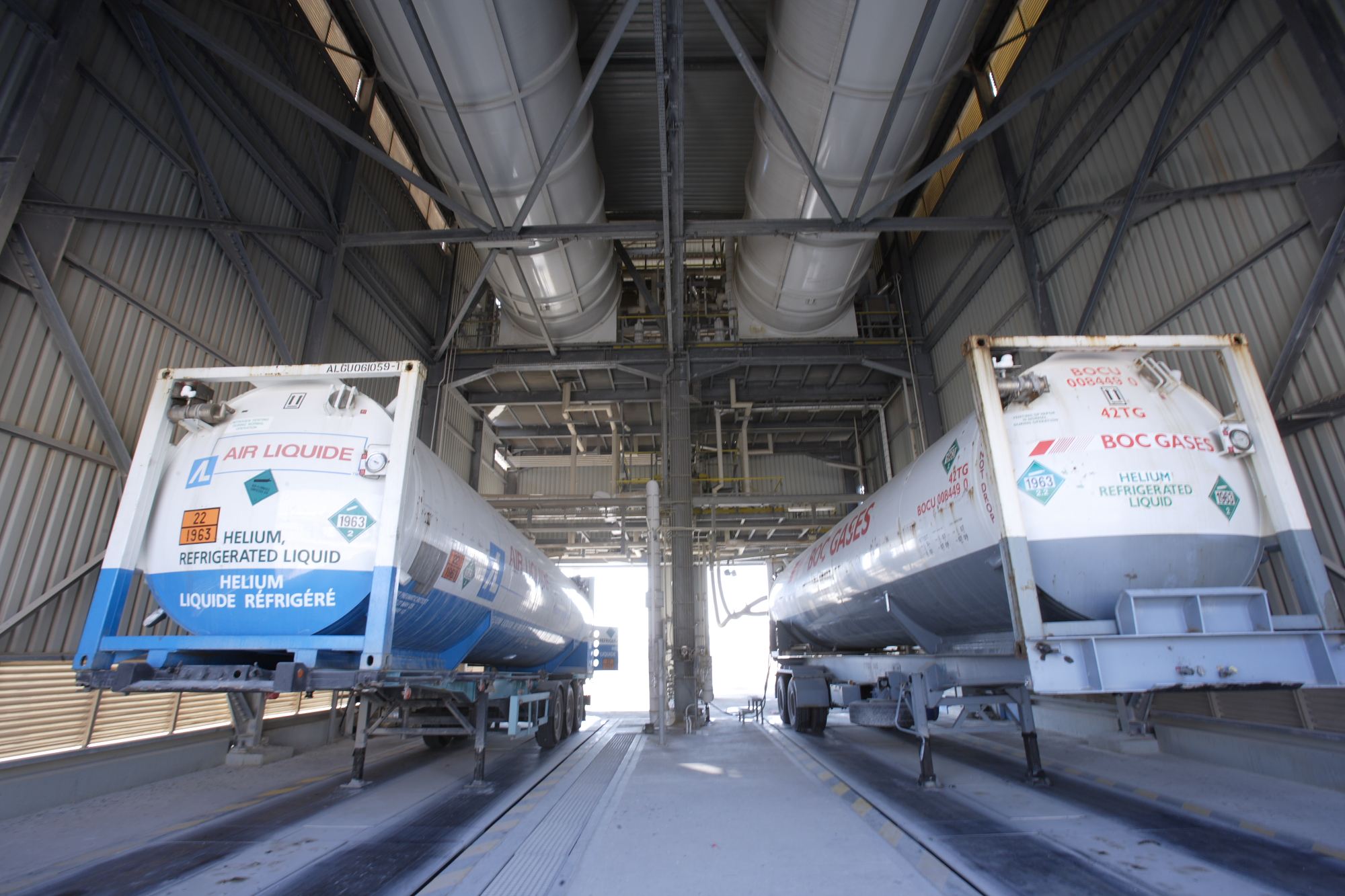
Ras Laffan helium storage tanks | Source: QatarEnergy LNG
Commissioning Dates
| Plant | Start Date |
| Helium 1 | September 2005 |
| Helium 2 | July 8, 2013 |
| Helium 3 | Early 2021* |
*construction completed; operational Q1 2021
Regarding Helium 3 specifically: the EPC contract was awarded to Chiyoda AlMana in late 2015, with an original target of early 2018. However, the 2017 Gulf blockade against Qatar disrupted operations and the project timeline. According to the USGS Mineral Industry of Qatar report, construction was completed and operations commenced in early 2021.
Individual Helium Plant Capacities
|
Plant |
Capacity (Mm³/yr) |
Capacity (bscf/yr) |
Capacity (MMscf/yr) |
Capacity |
|
Helium 1 |
19.8 |
0.700 |
70 |
~3,540 |
|
Helium 2 |
36.8–38 |
1.300–1.570 |
1,300–1,57 |
~6,630–6,790 |
|
Helium 3 |
11.3 |
0.400 |
400 |
~2,020 |
|
Combined |
~68–70 |
~2.40–2.47 |
2,400–2,470 |
~12,190–12,350 |
*Tonnes calculated at STP density of helium gas: 0.1786 kg/m³
Precise References per Plant
Helium 1 — 700 MMscf/yr (19.8 Mm³/yr):
- Gasworld (2016): "The plant commenced production in 2005 and has a designed production capacity of 700 million standard cubic feet (MMcf) per year."
- Wikipedia/RasGas: "Helium 1 produces 660 million cubic feet per year (19 million cubic metres per year)" — a slight discrepancy reflecting different reference conditions (standard vs. normal)
Helium 2 — 1,300–1,570 MMscf/yr (36.8–38 Mm³/yr):
- MEES (July 2013): "The Helium 2 unit has a capacity of 38mn cu ms/y"
- The Edge (2014): "annual production capacity of 1.3 billion standard cubic feet (Bscf)"
- The Peninsula Qatar (2017): "reached 100 percent annual production capacity of 1,570 MMscf" — this higher figure reflects actual demonstrated production vs. nameplate design
Helium 3 — 0.400 bscf/yr (11.3 Mm³/yr):
- Oil Review Middle East (2015): "expected to produce up to 11.3mn cu/m of helium gas"
- Gulf Times (2015): "produce up to 0.4bn standard cubic feet of liquid helium per annum"
- METenders: "capacity to produce approximately 0.4 billion standard cubic feet of liquid helium per annum"
Note: The slight variance between Mm³ and bscf figures across sources reflects different reference conditions used (0°C vs. 15°C, and standard vs. normal cubic metres). The figures are consistent and mutually confirmatory across independent sources.
Product Form: Liquid Helium Only
All three plants produce exclusively liquid helium (LHe) — not compressed gaseous helium. The plants incorporate full liquefaction trains (Claude-cycle cryogenic refrigeration) that bring helium down to −269°C (4.2 K), and the product is stored at Ras Laffan in cryogenic tanks before being loaded into ISO containers (11,000-US-gallon vacuum-insulated vessels) for global distribution by sea. This is the defining characteristic of Ras Laffan as a hub: it ships liquid helium globally in bulk ISO containers, from which customers either use it as LHe directly or re-vaporize it for gaseous applications.
Note on Helium 4
A fourth plant (Helium 4) with a capacity of approximately 1.2 bscf/yr (~34 Mm³/yr) was announced by QatarEnergy as part of the North Field LNG expansion, which would bring total Qatari capacity to approximately 108 Mm³/yr — roughly 60% of current global production.
References
- Andrieu F., Tsevery J.M., & Schmitt N. (Jul 17, 2006). The Ras Laffan helium purification unit. International Institute of Refrigeration (IRR)
- Cold Facts (May 3, 2012). Cryo Diffusion to provide helium equipment for RasLaffan project in Qatar
- PR Newswire (Jul 9, 2013). RasGas' Helium 2 Plant Starts Production
- mees (Jul 2013). RasGas Launches World’s Largest Helium Plant
- ColdFacts (May 3, 2012). Cryo Diffusion to provide helium equipment for RasLaffan project in Qatar
- The Peninsula (May 15, 2017). RasGas celebrates milestone for Helium 2 plant
- The Edge (Dec 15, 2013). Qatar’s Helium 2 plant opening makes it world’s largest exporter
- The Peninsula (Now 3, 2021). RasGas awards two major deals for Helium 3 project
- Oil Review (Oct 29, 2015). RasGas awards two contracts for Helium 3 plant in Qatar
- Gulf Times (Oct 29, 2015). RasGas awards two major contracts for Helium 3 Project
- expatnetwor (Oct 30, 2015). RasGas awards EPC contracts to Chiyoda
- Chiyoda Corporation (Nov 2, 2015). Press Release: RasGas has awarded Chiyoda Almana Engineering LLC, the EPC Contract for RasGas Helium 3 Project in Qatar
- ZAWYA (Feb 23, 2016). RasGas Reaches Milestone with 5,000th Cargo Delivery in Helium 1 plant
- Szczesniak P.A. (Nov 2024). The Mineral Industry of Qatar. 2020–2021 Minerals Yearbook, QATAR [ADVANCE RELEASE]. U.S. Department of the Interior, U.S. Geological Survey (USGS)
- Wikipedia. RasGas (Page version: Dec 18, 2025)
- METenders. Helium Plant 3 Project (Accessed Mar 16, 2026)
- Edison Investment Research (May 5, 2021). Global helium market update: Market shifting to oversupply by mid2020s