Setting up a Grassroots Complex Maximizing Advanced Petrochemicals in Eastern India Dhamra- Part I

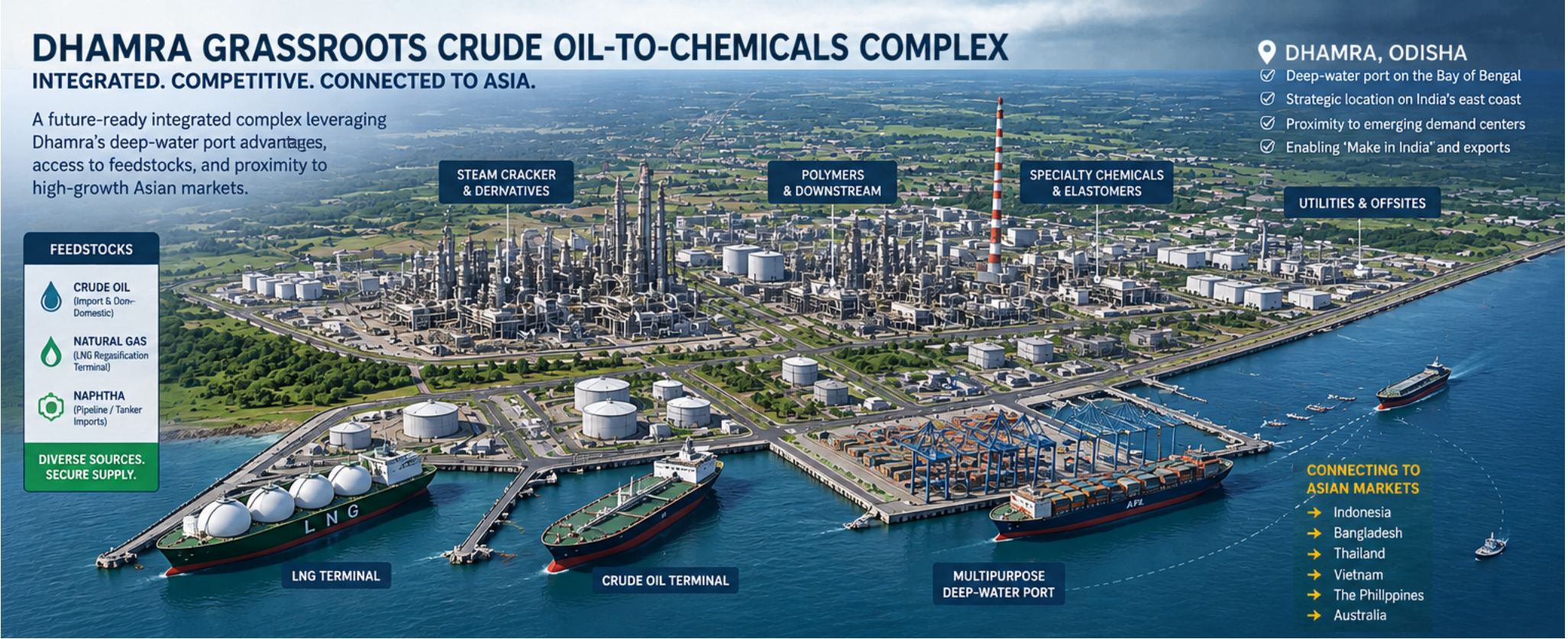
This article is divided in multiple parts. This first part covers the background and perspective of a location where a grassroots Integrated petrochemical complex can be set up in Eastern India to maximize production of advanced plastics and Elastomers. A brief insight on the processes and technologies associated with niche products is touched herein in part II. Part III will deal with the complex configuration and establish the viability of the complex, which would intend to minimize the Petrochemical import and also establish strategic export of niche products.
Overview
The Hydrocarbon Sector remains one of the most critical Industries around which the Energy Security of the Nation is perched. Given the global connotation associated with the sector everything associated with it poses challenges which are inextricably linked with geopolitical considerations and alignments. The problem becomes more intricate for those nations which are dependent on import of energy to support their economic growth. This puts nations to a precarious predicament of sorts. On the one hand, there is need to serve the economic up-lift-ment of the nation, on the other, is the lack of resources to meet such burgeoning needs. Countries have therefore to contend between sustaining imports, or create a mechanism through which, indigenous facilities could be created to meet domestic requirements along with nominal and strategic exports. For a large country like India, the Hydrocarbon sector poses a challenge. The country requires enormous quantities of energy, but the indigenous availability of Hydrocarbons is limited, which prompts huge imports of crude oil, natural gas, petrochemicals and fertilizers to support the country’s development agenda.
Over the years India has created a lot of refining capacity, while it continues to import copious quantities of crude oil to not only cater to its own distillate requirements, but also export fairly substantial quantities. This gives the nation a distinction of emerging as a refining hub. Similarly, since gas too is also in deficit, the country continues to source a lot of LNG to cater to its domestic requirements of serving its requirements. This trend continues unabated. Alongside, with economic growth and improvement in the quality of life of personnel, the requirement of petrochemicals has also grown substantially. To support the rising demand, a lot of petrochemical capacity has been consistently added in the country to bridge some of the gaps, however the import of Petrochemicals remains high, particularly in the niche segment where technology has been guarded and not much capacity has been created indigenously.
Of late a lot of petrochemical capacity has been created as part of horizontal integration in refineries, the latest trend is to orient the configuration of grassroots and brown field initiatives to increase crude to chemical conversion to add more and more flexibility and variety to project configurations. As the country marches ahead, there is good reason to conceive new complexes which address very significant conversion of crude to chemicals as high as 50% of throughput, while diversifying the downstream facilities to a niche portfolio, such that significant current imports of petrochemicals is substantially rationalized. This compels one to ponder to consider large complexes in the country with focus on niche petrochemicals. This paper indulges in conceiving one such complex, with the intent to not only achieving significant petrochemical capacity but to envisage setting up those facilities, where the import content of the country is high. This would in several ways add significant value to the Hydrocarbon Segment of the country by reducing the import of petrochemicals, besides also enabling strategic exports for increased high value market share in adjoining geographies.
As the Honorable PM has been emphasizing, if the country has to grow to pursue the Viksit Bharat objective, its important that Eastern India is developed with propensity similar to Western and Southern India. States of West Bengal—Odisha and Bihar—in this connection are of significance where the demand is high, growth potential is also high, while the current installed capacity is somewhat imited. In perspective of the same Dhamra in Odisha emerges as a potentially favoured location for setting up a large complex, which incidentally is the entry point where imported liquefied natural gas (LNG) is received, regasified, and pumped into the eastern gas grid.
Dhamra is located just north of Mahanadi river and offers potential pockets where vast tracts of contiguous land banks could be available to set up a large complex. Dhamra, located on the Eastern coastline of India along the Bay of Bengal, in the Bhadrak district of Odisha, serves as the maritime gateway and import terminal for the gas pipeline network, and is therefore significant as it is. Dhamra is located approximately 122 kilometres away from Paradip and both Dhamra and Paradeep are deep-water coastal ports separated by Mahanadi and Brahmani river deltas. This makes the location important for its coastal maritime connect for import of crude and evacuation of bulk products.
Why a Crude to Chemicals facility at Dhamra?
Building a standalone Crude-to-Chemicals (COTC) complex directly in Dhamra is considered logical from an economic, geographic, and strategic standpoint. A complex at Dhamra could serve as a highly structured, complementary asset within Odisha's emerging coastal energy corridor.
Paradip is a fuels Refining facility and houses Indian Oil Corporation's (IOCL) 15 MMTPA refinery, a dual-feed Naphtha Cracker unit, and a sprawling Petroleum, Chemicals, and Petrochemicals Investment Region (PCPIR). Its infrastructure is built heavily around traditional liquid crude refining and downstream plastics/polymers.
A modern COTC complex at Dhamra could be envisaged bypassing traditional diesel and petrol production to convert crude directly into high-value chemical building blocks (olefins, aromatics). Dhamra’s LNG gasification capabilities could offer access to methane and ethane feedstocks, making it the perfect site for an advanced, highly efficient, hybrid gas-and-crude chemical manufacturing cluster.
Deep-Draft Logistics and Maritime Advantage
A COTC complex requires immense volumes of imported crude. Dhamra is an all-weather, deep-draft port capable of handling Ultra Large Crude Carriers (ULCCs). This will drastically lower transport bottlenecks and the landed cost of crude and also allow facilities to be created for marine transport of large volumes. Dhamra could be developed as a specialized chemical handling, bulk processing, and integrated chemical manufacturing hub. Advantage of utilizing existing pipeline networks like the Pradhan Mantri Urja Ganga grid, can also be solicited if required. In addition the proximity of Bihar and Bengal as important rising domestic Industrial zones, as well as the proximity to ASEAN countries and Australian subcontinent as potential Export destinations could be of Interest.
Export Gateway to Southeast Asia
While the domestic market in Eastern India is growing rapidly,the ultimate prize for a major petrochemical manufacturer could be the export market. Positioned on the northern shoulder of the Bay of Bengal, Dhamra provides a direct maritime trade corridor to Southeast Asian and East Asian markets. The Infrastructure advantage of Deepwater Port + Major 5 MMTPA LNG Terminal, Direct Crude-to-Chemicals (Olefins, Aromatics) complex, High Crude volumes for conversion and availability of massive domestic and export market can be exploited fully.
Care has to be taken that a mega COTC complex at Dhamra is not a duplication of Paradip,instead, it ought to complete a unified coastal chemical belt that mirrors a massive industrial scale found on India's western coast. The petrochemical demand and supply scenario in India shows a structural imbalance: India is a net importer of petrochemical intermediates, relying on foreign sources for roughly 45% of its domestic supply. Within this national framework, Eastern India—specifically Bihar, Odisha, and West Bengal—represents one of the fastest-growing consumption pockets, fueled by rapid infrastructure development and a massive consumer base.
Regional Product Demand Profile
Bihar: Agricultural and Consumer-Led Demand - Bihar features low localized production but is a massive consumer market, relying entirely on inflows from neighboring states. For Polypropylene Woven Sacks demand is highly cyclic, tied to agricultural crop cycles. Sacks are required for packing grains, sugar, and fertilizers. HDPE/LLDPE (Polyethylene): Driven heavily by food-grade flexible packaging, fast-moving consumer goods (FMCG), and the expansion of rural drinking water pipelines. Polyvinyl Chloride widely consumed for agricultural pump sets, boring pipes, and residential construction channels.
West Bengal: The Traditional Industrial Processing Hub - West Bengal acts as the primary plastic processing and distribution powerhouse for the northeast and eastern borders. Automotive & Technical Polymers: Demand for specialized injection-molding polymers such as Polypropylene (PP) compounds, ABS is heavily sustained by regional engineering clusters and electronics manufacturing. Rigid Packaging HDPE/PET : Driven by major cosmetics, chemical manufacturing, and beverage processing units located around Hooghly and Howrah.
Odisha: Heavy Engineering and Infrastructure-Linked Demand -- Odisha has transformed into an energy and metallurgy hub, translating directly into high-volume infrastructure petrochemical demand. Industrial and CGD Pipes (MDPE/HDPE): Large volumes of High-Density Polyethylene (PE) resins are consumed for City Gas Distribution (CGD) line roll outs and specialized water conveyance projects. BOPP & Polyester Intermediates: Driven by industrial packaging demands arising from its massive metallurgy, steel, and aluminum plants.
India Petrochemicals Market 2026
The market is projected to reach USD 130.8 billion by 2034, representing a 8.0% CAGR from value of USD 70.6 Bn in 2026. Polyolefin Consumption Figures (PE, PP, & PVC) across India, polymer packaging consumes roughly 41.6% of all polymer demand, equivalent to nearly 10 million tons annually. Rather than operating as isolated industrial points, Paradip, Dhamra, and Haldia are integrated via highly structured maritime, pipeline, and rail corridors that turn Eastern India into a consolidated coastal chemical belt.
Export Potential
India’s national chemical export is targeting a massive $81 billion in shipments by 2030. A Dhamra complex enjoys a sharp logistics advantage over landlocked or western Indian plants when servicing Southeast Asia (ASEAN) and Australia. The geographic positioning of Dhamra creates a highly competitive maritime supply chain.The ASEAN Advantage: Markets like Vietnam, Indonesia, Thailand, and Malaysia are major global manufacturing hubs for textiles, electronics, and automotive parts. However, they run a structural deficit in primary chemical monomers and engineering plastics. Shipping from Dhamra to Singapore or Ho Chi Minh City takes only 5 to 7 days, bypassing the longer, more congested routes from the Middle East. The Australia Pivot: Australia relies heavily on chemical imports for its water-treatment infrastructure, massive agricultural sector, and mining-reagent supply lines. India’s active Economic Cooperation and Trade Agreement (ECTA) with Australia eliminates or sharply lowers tariff barriers, making Indian petrochemicals significantly cheaper than those sourced from countries without a trade agreement.
High-Potential Export Product Matrix
By configuring a COTC complex to minimize transport fuels and move straight into specialized value chains, several specific chemical groups stand out with exceptional export potential:
The Acrylates Chain (Acrylic Acid, Butyl Acrylate) - The global market for Acrylic Acid is expanding rapidly, projected to surpass 8.5 million tons. There is an acute global supply gap for specialty intermediates, with prices hovering around $1,300–$1,400 per Metric Tonne globally. Propylene produced in the complex via high-severity cracking can be oxidized on-site into Acrylic Acid and Acrylate Esters. Australia and Vietnam are massive buyers of acrylic formulations for water-borne architectural coatings, low-VOC paints, and high-performance industrial adhesives.
The Polyester Chain (PX ➔ PTA ➔ PET) - A COTC complex maximizes aromatics, converting heavy naphtha into Para-xylene (PX), which is processed into Purified Terephthalic Acid (PTA) and Polyethylene Terephthalate (PET). This could feed directly into the massive, high-margin textile and consumer packaging sectors of Asia. Indonesia, Bangladesh, and Thailand are primary textile processing markets. Additionally, food-grade PET resin pellets enjoy continuous, rigid demand in Australia for consumer packaging and beverage bottling.
Elastomers & Acrylonitrile (NBR, ABS) - As global automotive and electronics supply chains shift their manufacturing footprints into Southeast Asia, the demand for performance materials is surging. An on-site Butadiene extraction loop can easily be combined with a Styrene or Acrylonitrile unit to manufacture Acrylonitrile Butadiene Styrene (ABS) and Nitrile Rubber (NBR). Vietnam and Malaysia, require massive volumes of engineering plastics for electronics casings, electrical components, and industrial gloves.
A Dhamra COTC complex does not need to limit its business model to the localized markets of Odisha, Bihar, and West Bengal. By focusing heavily on Acrylates, Polyesters, and Engineering Plastics, Dhamra can establish itself as a dominant supply node for the entire Indo-Pacific corridor, directly capturing market share from traditional Middle Eastern and East Asian suppliers. Evaluating a large-scale Crude-to-Chemicals (COTC) facility at Dhamra requires balancing the demands of the ASEAN region with the economics of highly integrated chemical value chains. The Southeast Asian manufacturing ecosystem is shifting from basic processing to high-value consumer electronics, packaging, and automotive supply chains.
- Engineering and Performance Plastics (ABS, SAN, Polycarbonates): Heavily consumed by Vietnam, Thailand, and Malaysia to fuel their massive consumer electronics assembly industries (smartphones, home appliances) and automotive components.
- Polyester Resin & Film Grades (PET): Driven by rapid consumer packaging transformation, beverage bottling, and textile manufacturing expansions in Indonesia, the Philippines, and Vietnam.
- Polyolefins (HDPE, LLDPE, PP): Continuously demanded across the region for agricultural films, e-commerce flexible packaging, and infrastructure pipes.
Current Global and Regional Pricing Snapshot
Most of the Petrochemical Derivatives mentioned above are high value added facilities and though it will require substantial investment to set up the facilities , they will more than pay off on account of sustained rising demand and high priced portfolio. The Petrochemical pricing is influenced by global feedstock costs though and and regional energy flows. However a properly designed large scale COTC facility can yield significant dividents. The structural pricing baseline across the Asian maritime corridors currently indicates the following ranges as of 2026:
Description Price range - Per Metric Ton
- ABS $1,850 to $1,950
- NBR (Nitrile Rubber): $2,350 to $2,650
- Para-xylene (PX): $1,200 to $1,280
- Purified Terephthalic Acid (PTA): $745 to $780
- Monoethylene Glycol (MEG): $550 to $580
- Polyethylene Terephthalate (PET Resin): $910 to $1,020
- Styrene Monomer (SM) $1,390 – $1,460
- SBR Rubber (eSBR 1502) $2,390– $ 2,450
- EPDM $2,450 to $2,750
- LDPE $1,480 – $1,530
- PVC $ 850-$950 per
- Liquid Caustic Soda $450 to $550
Existing Infrastructure in the proximity of Dhamra
The Gas Trunk - Pradhan Mantri Urja Ganga Pipeline (JHBDPL): With over 3,315 km operational, it transports regasified LNG originating directly from the 5 MMTPA Dhamra LNG terminal inland. It hits Dobhi Junction in Bihar, where it forks north to supply fertilizer plants and city gas grids in Bihar, and east to feed the petrochemical downstream industries of West Bengal. The Liquid - Paradip-Haldia Crude Pipeline (PHCPL): A dedicated 30-inch, 170 km crude line transports up to 11 million cubic meters of crude oil annually from Paradip’s deep-water storage tanks directly up the coast to Haldia refinery units. Paradip-Haldia-Durgapur LPG Pipeline: To maximize supply-chain efficiency, IOCL routes secondary LPG and liquid feed stocks along this same shared Right-of-Way (RoW) corridor, injecting feed stocks directly into West Bengal’s chemical manufacturing heartland. Maritime and Rail Integration - Both Paradip and Dhamra feature deep drafts (up to 18.5 meters), allowing large vessels to dock. Liquid feedstocks can be barged or shipped between Paradip and Haldia at exceptionally low logistics margins. Rail Networks: Heavy automated container loading and wagon-loading silos at Dhamra and Paradip ensure that solid polymer granules (PE/PP) can be distributed directly to industrial processing blocks across inland Bihar and Jharkhand within hours.
Petrochemical Pointers
Beyond basic polyolefins (PP, PE, PVC), India is experiencing a structural surge in demand for petrochemical intermediates, engineering plastics, and synthetic elastomers. The nation's specialty chemicals market is projected to reach $93.4 billion by 2034. This explosive growth presents highly promising prospects for alternative petrochemical value chains, which a Crude-to-Chemicals (COTC) complex at Dhamra would be ideally positioned to exploit.
- Styrene Monomer & its Derivatives (PS, SAN, ABS) - Styrene is a major missing link in India's chemical self-reliance; the country imports virtually all of its styrene monomer requirements. However, domestic demand is projected to scale remarkably to 1.40 million tonnes. Acrylonitrile Butadiene Styrene (ABS): Driven heavily by the domestic electronics manufacturing push and the automotive sector for lightweight components. Polystyrene (PS): Crucial for the refrigeration industry (inner liners) and specialized rigid packaging.
- Synthetic Rubbers / Elastomers (SBR, PBR, EPDM) - As the world’s largest producer of two-wheelers and a major automotive hub, India consumes vast quantities of synthetic elastomers, yet continues to rely on heavy imports. Styrene-Butadiene Rubber (SBR) & Polybutadiene Rubber (PBR): Vital for tyre manufacturing. India imports over ₹5,000 crore worth of synthetic rubber annually. Ethylene Propylene Diene Monomer (EPDM): Growing rapidly alongside India's infrastructure boom for weather-sealants, glass roofing, and automotive gaskets.
- Phenol and Acetone - Driven by infrastructure and housing expansion in states like West Bengal and Bihar, the demand for phenolics is rising at a steady compound annual growth rate. The large facility recently commissioned at Haldia will bridge these gaps substantially. Phenol and Acetone are the core building blocks for Polycarbonates, Phenolic Resins, and Bisphenol-A (BPA).These feed directly into manufacturing of laminates, plywood adhesives, paints, and high-clarity engineering plastics.
- Ethylene Oxide & Glycols (EO / MEG) - While heavily tied to textile industry via Polyester (PET) fiber manufacturing, the focus is shifting toward specialized chemical formulations. Essential for the packaging industry (PET bottles) and synthetic polyester yarns. Ethoxylates & Glycol Ethers: High-growth prospects in the agrochemical formulation sector and home/personal care products (surfactants).
Import Substitution Potential
The scale of India's annual net imports for non-polyolefin intermediates is significant. Synthetic Rubber (SBR, PBR, EVA) - ₹10,800 Crore annual Imports serving Automotive Tyres, Footwear, Industrial Seals. Organic Intermediates (Styrene, Phenol) - ₹54,500 Crore annual Imports serving Consumer Electronics, Paints, Adhesives, Agrochemicals. Synthetic Fibres & Yarn - significant trade deficit serving Apparel, Geotextiles, Industrial Packaging.
Traditional refineries struggle to adjust their output to maximize these products because they are structurally designed to produce diesel and petrol. A specialized facility can bypass fuel markets significantly to produce Aromatics (Benzene, Toluene, Xylene) and Light Olefins. This provides the precise molecular foundation required to build out India's missing specialty chemical and engineering plastic ecosystems. Because India is structurally short on domestic natural gas and has a highly protective domestic market for transport fuels, maximizing petrochemical intensity requires shifting the focus toward light-end liquid configurations (Naphtha, LPG, and Light Kerosene/ATF fractions).
Maximizing Petrochemical Intermediates
- Steam Cracking Optimization - Kerosene, Naphtha & LPG - Instead of relying on ethane gas which is not avaiable domestically , a modern Indian complex must design its steam crackers to handle flexible, liquid-heavy feeds. High-Severity Liquid Cracking: Operating steam crackers at maximum severity optimizes the conversion of full-range naphtha and kerosene into high-value light olefins (ethylene and propylene) rather than pyrolysis gasoline. Co-cracking LPG: Integrating refinery-sourced LPG (propane and butane) into the steam cracker feed loop significantly shifts the product slate toward propylene, bridging deficits.
- Catalytic Pyrolysis & Advanced FCC Configurations - Traditional Fluid Catalytic Cracking (FCC) units are designed to maximize gasoline. To maximize chemicals, refineries must pivot to specialty configurations. High-Severity FCC (Petro-FCC): Utilizing specialized catalysts (like ZSM-5 additives) and operating at higher temperatures transforms low-value heavy naphtha and gas oils directly into light olefins (propylene and butylenes) instead of transport fuels. Direct Naphtha-to-Olefins : Implementing catalytic cracking technologies specifically designed for light and heavy naphtha cuts allows for higher propylene-to-ethylene ratios than traditional steam cracking, matching India's market demands perfectly.
- Maximizing the Aromatics Chain (Heavy Naphtha) - Light-end liquids are excellent precursors for the aromatics value chain (Benzene, Toluene, Xylene), which forms the bedrock of engineering plastics and synthetic fibers. Diverting heavy naphtha cuts away from gasoline blending and into high-severity CCR units maximizes the production of Para-xylene (PX) and Benzene. This directly feeds the Purified Terephthalic Acid (PTA) plants driving India’s massive textile and polyester sectors.
- Light Kerosene Dehydrogenation: Light kerosene fractions can be routed to specialized units to extract linear alkylbenzene (LAB) precursors, which are essential for the domestic detergent and surfactant industries.
- Integrating Gasification island - While natural gas is scarce, the COTC complex can be designed to produce heavy refinery residues for Syngas Generation to recover hydrogen, steam and power for the complex. This allows a refinery to turn its dirtiest bottom-of-the-barrel waste into the exact high-value chemical building blocks usually derived from natural gas.
By combining flexible liquid steam cracking with a Petro-FCC and residue gasification, a coastal facility like Dhamra can push its petrochemical intensity well beyond 40–50% without needing an abundant domestic natural gas source. This is what may perhaps make it unique. When a refinery optimizes conventional hardware (flexible steam cracking + advanced Petro-FCC + CCR aromatics platforming), it hits a ceiling right around 45% to 50% petrochemical yield. Importantly, the complex must address the need of elastomers and PET to add to the diversified prtrochemical portfolio.
Minimization of Diesel
This is a multi-billion-dollar hurdle of any ultra-high-intensity Crude-to-Chemicals (COTC) configuration. Because of the fixed molecular structure of oil, crude core naturally yields a heavy, complex fraction of middle distillates (Diesel/Gas Oil). Even if you run a Mild Hydrocracker (MHC) to turn 35-40% of it into light naphtha, one is still left with intimidating quantities of merchant diesel that drag down the cash margins. To push past this barrier and eliminate diesel from the merchant fuel market the complex can employ following configurations to break down and monetize diesel fractions into high-value chemical feedstocks. Upgrade MHC to Full-Conversion Hydrocracker - This is the most direct way to eliminate diesel to replace the Mild Hydrocracker with a High-Pressure, Full-Conversion Hydrocracker (HP-HC) running at pressures exceeding 160 to 180 bar. This upgrade pushes the middle distillate conversion efficiency from a modest 35% to over 95%. It systematically destroys the diesel pool, transforming it directly into ultra-clean, paraffinic Heavy Naphtha and LPG/Light Ends which could feed the Mixed-Feed Steam Cracker.
- Deep Catalytic Cracking of Light Cycle Oil - If a portion of the heavy diesel fraction bypasses the hydrocracker, it exits as low-value Light Cycle Oil (LCO). Instead of blending this into the commercial diesel pool, it can be routed to High-Severity Petro-FCC unit (PFCCU) for production of propylene and cycle naphtha.
- Heavy Diesel Bottoms to Residue Gasifier - Any remaining heavy, un-crackable diesel fractions can be blended directly with vacuum residue for being routed to gasifier. The diesel components act as an excellent slurry fluidizer, increasing the efficiency of the gasifier nozzles. This step cracks the heavy oil chains down to basic elements, converting them into pure Synthesis Gas (CO + H₂).
- Minimizing the diesel pool completes the engineering logic of the entire project. Operating a traditional refinery that dumps 5 million tonnes of transport fuel onto the local market exposes the bottom line to volatile retail pricing and shifting fuel regulations. By minimizing diesel pool the complex will operate as a true, high-intensity chemical fortress—converting raw crude oil straight into premium, solid ABS, PVC, LDPE, PET, and Synthetic Rubbers, securing complete market dominance and maximizing margins across the entire Indo-Pacific trade corridor.
- Mild Hydrocracking: To completely break open and saturate the stable, aromatic rings found in cracked middle distillates and light cycle oils, the unit must operate at extreme pressures (150 to 180 bar) and consumes an immense amount of hydrogen. In a traditional refinery, buying or generating that much hydrogen purely to make low-margin naphtha destroys the unit's economic viability. However a 120 bar MHC Partial Conversion Beats Full Conversion as the hydrogen penalty is reduced. The capex reduces too. The 60% Unconverted Yield is not low-value merchant diesel. Because it has passed through the 120 bar MHC catalyst bed, it is completely hydrotreated, desulfurized, and saturated. This premium, low-sulfur unconverted oil serves as the single best feedstock to High-Severity RFCCU. When this clean stream hits the RFCCU riser, it cracks with maximum efficiency, driving the propylene yield past the >20% target and providing a rich butadiene pool. A good way would be to split the MHC bottoms with the flexibility of being routed to PFCCU as well as to diesel pool in a split percentage .
From the foregoing it is evident that the proposed complex will maximize the Petrochemical Building Blocks such as Benzene, Paraxylene, Ethylene, Propylene, Butadiene to enable a variety of Petrochemical downstream units to be installed including the ones in the niche domain, besides the conventional Polyethylenes and Polypropylenes. The portfolio may therefore include:
- Conventional - LLDPE/HDPE, HDPE, LDPE, PP
- Advanced Monomers and Building blocks - Styrene, ACN, MEG
- Elastomers - ABS, SBR, NBR, PBR, PS
- Advanced - EPDM, VCM/PVC, PMMA
- Aromatic- PX- PTA- PET
- Acrylates, PO/PG