Venezuela May or May Not Have the World's Largest Oil Reserves. Does It Really Matter?

Executive summary
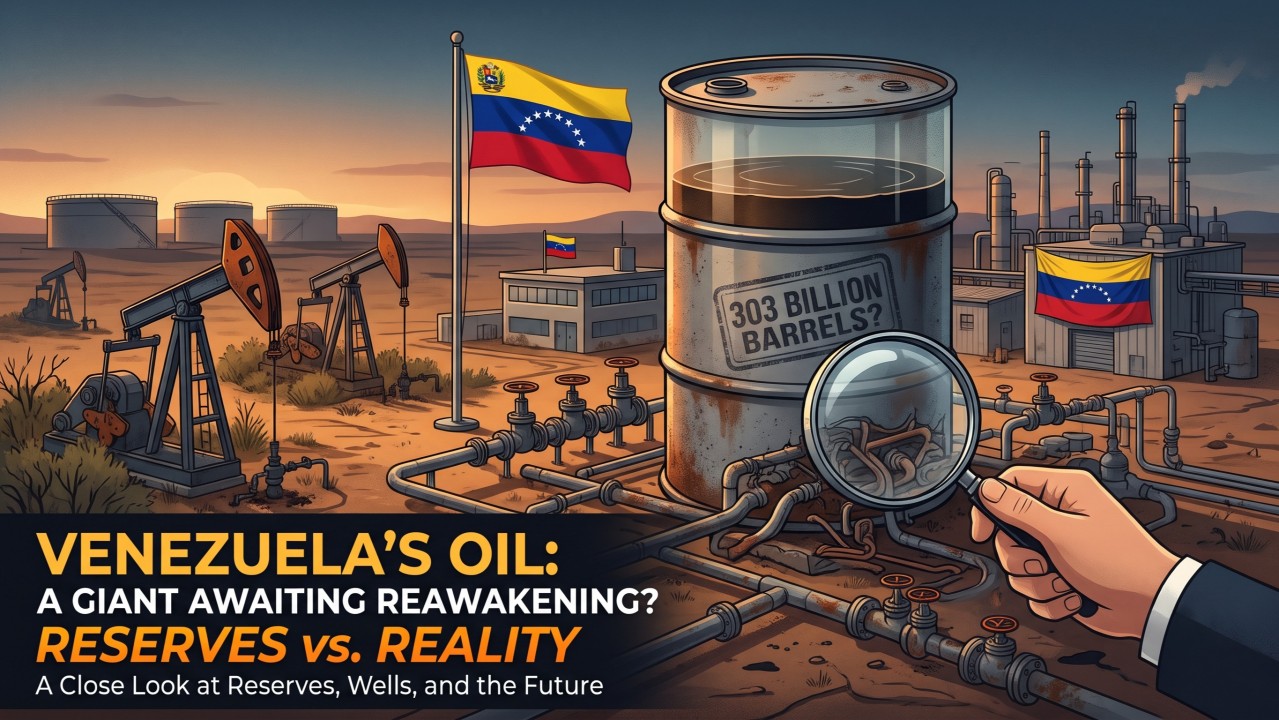
Venezuela reports 303 billion barrels of proven oil, more than any other country. Independent experts believe the oil that can actually be produced at a profit is far less. For the next five years, that gap hardly matters. What limits Venezuela's output is not the oil in the ground. It is the wells, power, diluent and money needed to produce it.
• The headline is official, not audited. OPEC publishes what member governments report. Venezuela's figure jumped about 40% in one year (2010) when Orinoco extra-heavy oil was booked using a 20% recovery factor, more than double what has actually been achieved.
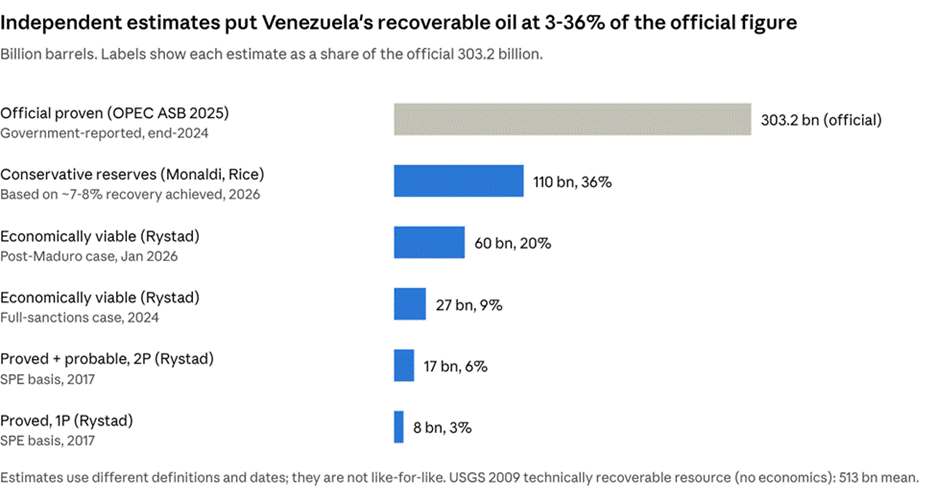
• Independent estimates are far lower. Rice University's Francisco Monaldi puts a conservative reserve figure near 110 billion barrels. Rystad Energy's January 2026 estimate of economically viable volume is about 60 billion barrels, roughly one-fifth of the official number.
• Even the low case is large. 60 billion barrels supports 3 million b/d for decades. Reserves are not the bottleneck.
• The near-term opportunity is brownfield. Venezuela has 30,722 existing wells (Venezuelan Petroleum Chamber, April 2026), but only 8,491 were producing. Reactivating existing wells, tied into existing gathering lines and export terminals, is the cheapest and quickest way to add Venezuelan barrels, and why Venezuela could be the fastest-growing producer of the next few years.
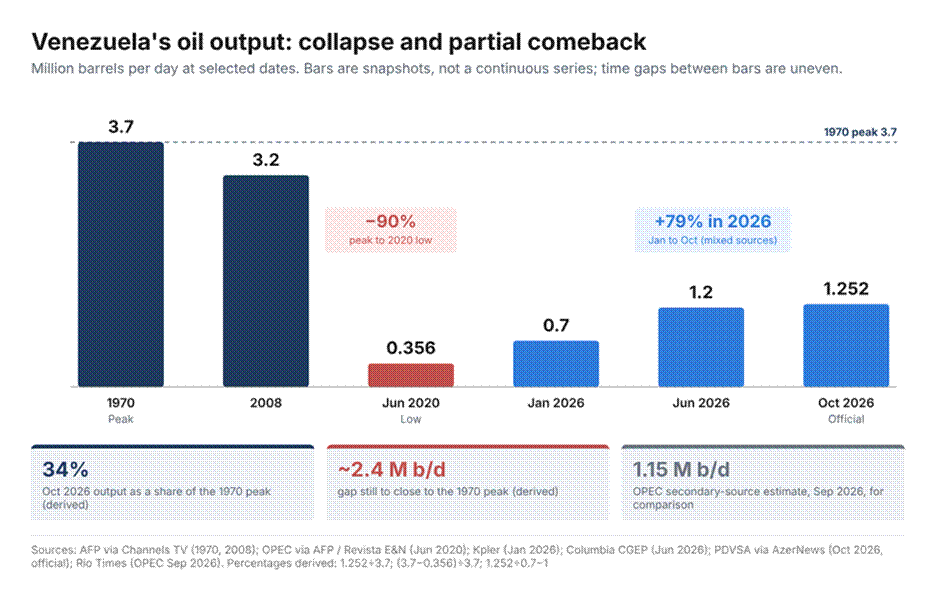
• Recovery is real but uneven. Output rose from about 1.0 million b/d in Q1 2026 to about 1.2 million b/d by mid-year, then flattened. The official daily figure reached 1.252 million b/d in late October 2026.
How to read this paper: figures are sourced in the text and listed at the end. Where I draw my own conclusion or run my own arithmetic, it is labelled as interpretation or derived.
Is Venezuela really number one?
By the official count, yes. OPEC's Annual Statistical Bulletin 2025 lists Venezuela at 303.2 billion barrels at end-2024, ahead of Saudi Arabia (267.2) and Iran (208.6) (OGJ). The 2026 edition puts Venezuela at 303.7 billion barrels at end-2025, up 480 million barrels in the year, and still first (BB.LV, citing OPEC ASB 2026).
The number is recent. For most of the 20th century Venezuela's reported reserves were small, and the big steps came in two waves:
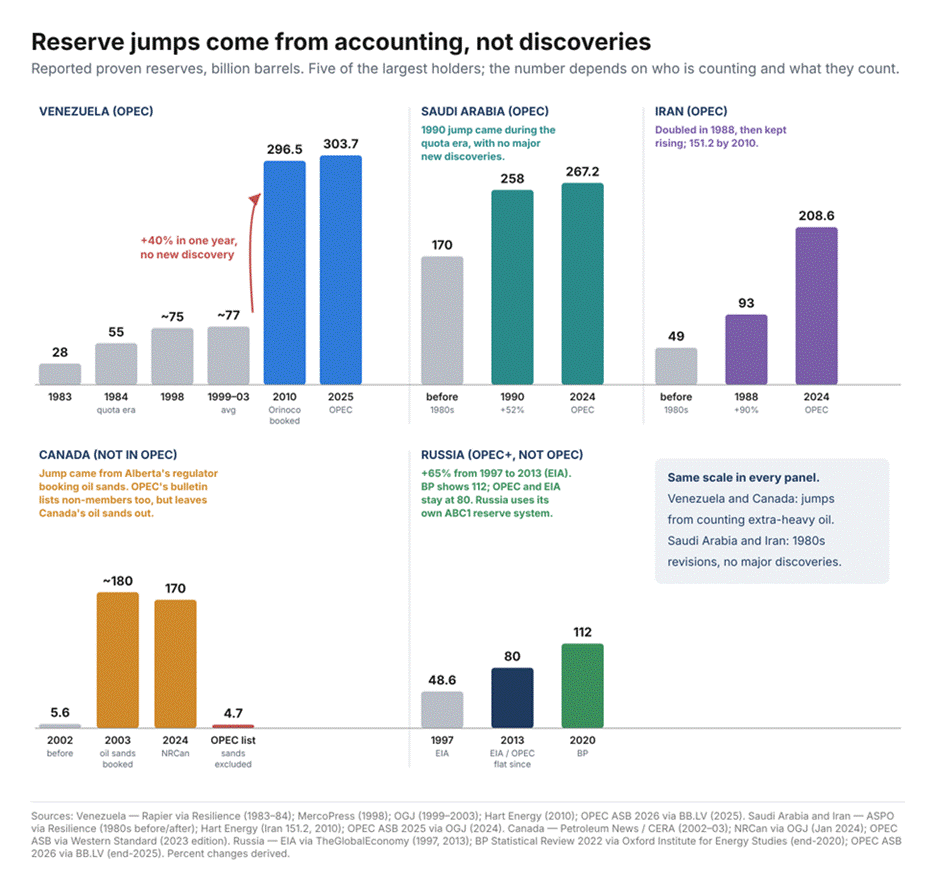
Two things stand out. First, the 2010 jump came from reclassification, not new discoveries: Orinoco oil that had long been treated as bitumen was moved into the proven category under PDVSA's Magna Reserva certification programme. Second, the figure has barely moved since 2010, even though Venezuela has produced several billion barrels in that time. A reserve figure that does not decline with production is a sign it is not being updated on a field-by-field basis (interpretation, consistent with the OGJ observation above).
Venezuela is not unique. In the 1980s Kuwait, the UAE, Iran, Iraq and Saudi Arabia all reported large jumps with no major discoveries, widely linked to OPEC quotas (Transport Geography).
Saudi Arabia, Iran, Canada and Russia: the same accounting question
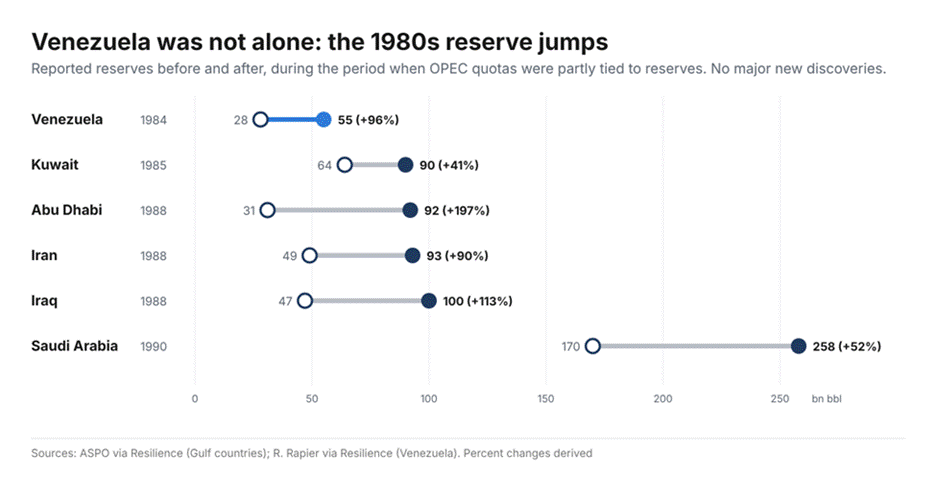
The chart above sets Venezuela beside four other large holders on the same scale.
Saudi Arabia and Iran both made their big jumps during OPEC's quota era. Saudi Arabia went from 170 to 258 billion barrels in 1990, and Iran from 49 to 93 billion in 1988, with no major new discoveries in either case (ASPO via Resilience). Iran was upgraded again to 151.2 billion barrels in 2010 (Hart Energy). OPEC now lists Saudi Arabia at 267.2 billion and Iran at 208.6 billion barrels at end-2024 (OGJ). Their figures, like Venezuela's, are government-reported and not independently audited.
Canada's reserve jump did happen, just not in OPEC's table. In 2002–03, after Alberta's regulator booked about 174 billion barrels of oil sands as established reserves, Oil & Gas Journal and CERA began counting them, and Canada rose from about 5.6 billion to about 180 billion barrels (Petroleum News; OGJ). Natural Resources Canada put Canada at 170 billion barrels as of January 2024 (OGJ).
Canada is not an OPEC member, but OPEC's Annual Statistical Bulletin lists every major producing country, members and non-members alike. That bulletin, the source of the "Venezuela is number one" headline, excludes oil sands and has shown Canada at only about 4.7 billion barrels (Western Standard, on the 2023 edition).
Russia had its own jump. The EIA's figure for Russia rose from 48.6 billion barrels in 1997 to 80 billion by 2013, about 65% (derived), and has stayed at 80 since (TheGlobalEconomy, EIA data). OPEC also lists Russia at 80 billion barrels, unchanged in 2025 (BB.LV, citing OPEC ASB 2026). BP's Statistical Review went further, to 112 billion barrels at end-2020 (Oxford Institute for Energy Studies). Russia uses its own ABC1 classification, which puts more weight on technical recoverability than on economics, so outside estimates vary widely: in 2006 they ranged from 60 billion (OGJ) to 120 billion (Wood Mackenzie) (Wikipedia, compiling sources). Russia is part of the OPEC+ alliance, not a full OPEC member.
Was it because of OPEC? In one sense, yes: the ranking most people quote is OPEC's, and that table counts Venezuela's extra-heavy Orinoco oil in full while leaving out Canada's similar oil sands bitumen. I found no published OPEC explanation for that difference, so I cannot say why it was made. What the record does show is that Canada's jump was not quota-driven: as a non-member, Canada had no OPEC quota to protect, and its increase came from a provincial regulator's reclassification, later adopted by OGJ, CERA and the EIA. On a like-for-like basis Canada, at about 170 billion barrels, would rank fourth, behind Venezuela, Saudi Arabia and Iran (derived from the figures above). Rystad's view is that most of both Canada's oil sands and Venezuela's Orinoco should not count as proved under standard industry rules (OilPrice). The ranking depends on the accounting rule.
Can we trust any of these numbers?
Not equally. The useful test is not which country is honest, but whose number someone outside the government can check.
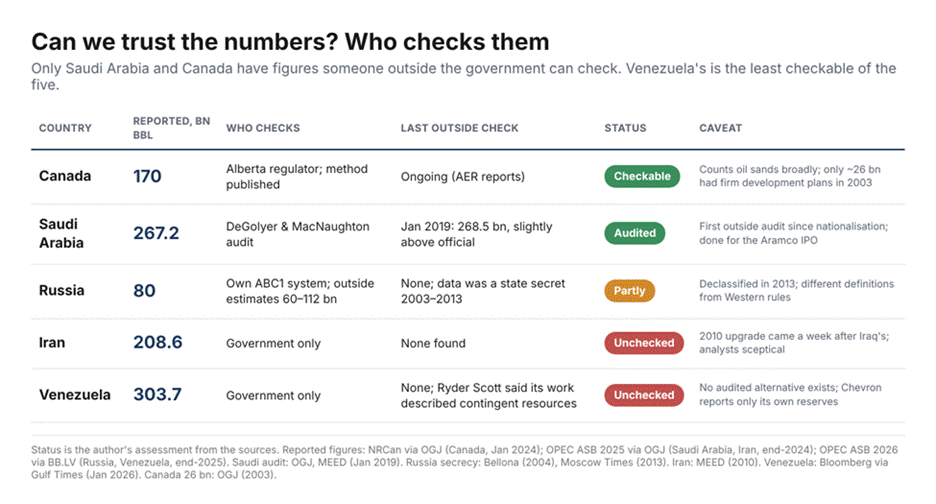
• Saudi Arabia is the surprise. In January 2019 the Dallas consultancy DeGolyer & MacNaughton put Saudi reserves at 268.5 billion barrels, slightly above the 266.3 billion the government had published. It was the first outside audit since the kingdom nationalised Aramco, and it was done ahead of the Aramco share listing (OGJ; MEED). The 1990 jump still looks like quota-era accounting, but today's figure has outside backing.
• Canada is the most transparent, but generous. Alberta's regulator publishes its method and updates it, so the number can be checked. But the headline counts oil sands broadly: in 2003 only about 26 billion barrels of oil sands were under development or had firm development plans (OGJ). Rystad's view is that most oil sands, like most of the Orinoco, should not be classed as proved under standard rules.
• Russia hid its numbers for a decade. In 2003 Russia made oil reserve data a state secret (Bellona) and declassified it in July 2013 (Moscow Times). It also uses its own ABC1 system, which is why outside estimates have ranged from 60 to 112 billion barrels.
• Iran is unchecked. Its 2010 upgrade to about 150 billion barrels came a week after Iraq raised its own figure by 24%, and analysts were sceptical (MEED). I found no independent audit.
• Venezuela is the least checkable. There is no audited national alternative, and Ryder Scott publicly said its Orinoco work described contingent resources, not reserves (Bloomberg via Gulf Times).
More broadly, the US Government Accountability Office has noted that OPEC members' reserves are not verified by independent auditors (CS Monitor). So the honest version of the claim is not "only Canada is real". It is that only Saudi Arabia and Canada have figures outsiders can check, and Venezuela's 303 billion is the least checkable of the five (interpretation, medium-high confidence).
Reserves versus recoverable oil
The official figure and the oil that can be produced at a profit are very different numbers. Independent estimates put Venezuela's economically recoverable crude at between 3% and 36% of the official 303 billion barrels.
Three terms get mixed up in most coverage:
• Oil in place: everything in the reservoir. PDVSA estimated 1.3 trillion barrels for the Orinoco in 2006, within a range of 0.9–1.4 trillion (OGJ).
• Technically recoverable resource: what current technology could extract, ignoring cost. The USGS put the Orinoco at a mean of 513 billion barrels (range 380–652) and explicitly made no estimate of what is economically recoverable (USGS).
• Proven (1P) reserves: what can be produced with reasonable certainty at current prices, costs, technology and regulations. Under the SPE's Petroleum Resources Management System (PRMS) and SEC rules, booking requires a development plan and commercial viability, and reserves are reduced as they are produced.
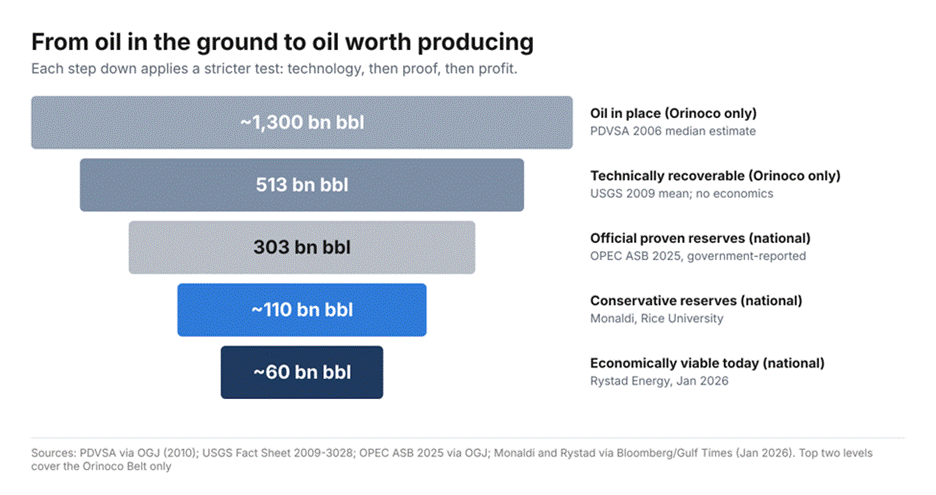
Venezuela's 303 billion sits much closer to a technical resource than to an audited 1P figure. Monaldi's point is blunt: Venezuela audited the resources in place, not the reserves (Yahoo Finance). The consultancy Ryder Scott, which assessed the Orinoco for PDVSA between 2008 and 2011, issued public clarifications that its numbers described contingent resources, and said some figures attributed to it did not match its own work (Bloomberg via Gulf Times).
The recovery factor does most of the work
The official booking applied a recovery factor of about 20% to the Orinoco's oil in place. Monaldi says Venezuela has actually achieved about 7–8%. The arithmetic (derived, using the ~1,360 billion barrel oil-in-place figure cited for the Magna Reserva project):
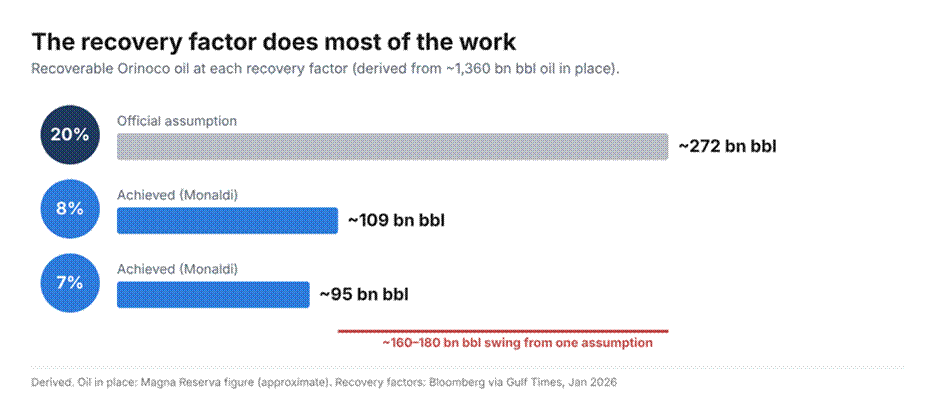
That single assumption moves the answer by about 160–180 billion barrels, and it explains why Monaldi's conservative estimate lands near 100–110 billion. The 1,360 figure comes from an industry commentary on the Magna Reserva project (Energy Central) and should be treated as approximate.
Why national reserves get overstated
• No independent audit. OPEC publishes member-reported figures; no audited national alternative exists. Chevron reports only its own Venezuelan reserves.
• Quotas and financing. In the 1980s OPEC quotas were partly linked to reserves. More recently, experts quoted by Bloomberg say the Magna Reserva figure helped Venezuela access financing.
• No depletion. Figures that stay flat for years while billions of barrels are produced have not been updated field by field.
• Price-blind booking. Rystad says more than two-thirds of the official volume needs oil above $100 a barrel to be viable. Under SEC-style rules those barrels would not be proven at today's prices.
Does the reserve number matter?
For the next decade, mostly no. Venezuela produces about 1.2 million b/d, or about 0.44 billion barrels a year (derived: 1.2 × 365). At that rate:
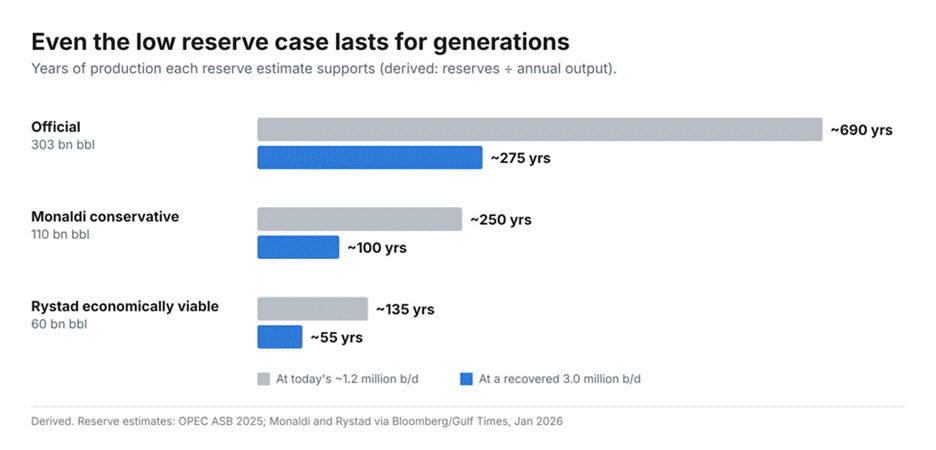
Every row is far beyond any investment horizon. Luis Pacheco, a former senior PDVSA executive, makes the same point: he calls the reserve debate a "red herring" for investors, because even 50 billion barrels would support 3 million b/d for about 45 years (Bloomberg via Gulf Times). Rystad similarly argues the 300-billion figure is almost irrelevant, since almost no global energy scenario needs all of it produced (Yahoo Finance).
Where the number does matter:
• Financing and sovereign narrative. Experts quoted by Bloomberg say the Magna Reserva claim helped Venezuela access more financing. Lenders and governments still quote 303 billion. An investor who prices assets off that figure will overpay.
• Asset-level valuation. Investors are not buying a country's reserves. They are buying a field, a contract and a fiscal regime. What counts is audited 1P/2P reserves per block, and those are much smaller.
• Cost and quality. Rystad says more than two-thirds of the official volume would need prices above $100 a barrel to be viable. Most of it is extra-heavy Orinoco crude that must be blended with diluent or upgraded before export. Of the four upgraders built in the 1990s, only one, run by Chevron, operates today.
• Long-term strategy. Whether the true figure is 60 or 300 billion barrels changes the ceiling on Venezuelan output in 2040. It does not change what can be done in 2027.
Why Venezuela could be the fastest-growing producer
Venezuela's advantage is not the size of its reserves. It is that the wells, pipelines, flow stations and export terminals already exist, and most of them are idle. Bringing a shut-in well back is a workover, not an exploration programme.
The idle base is very large:
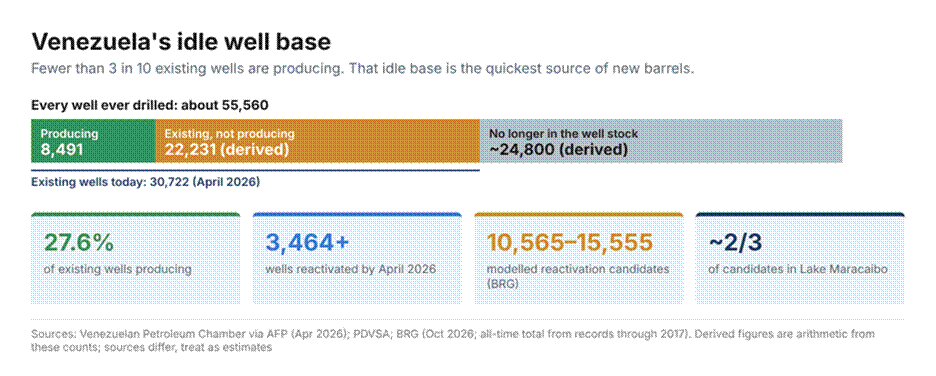
The two totals measure different things. The 55,560 is every well drilled in Venezuela's history, including many since plugged or abandoned. The 30,722 is the current well stock counted in April 2026. The sources also do not agree on the active count. BRG models 9,141–15,846 active wells, which overlaps with but runs well above the Chamber's 8,491. Treat all well counts as estimates.
That leaves about 24,800 wells outside today's stock (derived: 55,560 minus 30,722), most likely plugged, abandoned or dropped from the count. The two figures come from different sources and dates, so treat the gap as approximate. Few of these wells are quick restarts: re-entering a properly plugged well is rarely worth it. Their value is the reservoir data they left behind and the oil still around them, which new wells, sidetracks and infill drilling can reach (interpretation, based on general industry practice).
The evidence that this works is already visible in 2026:
• Q2 2026: national output rose about 150,000 b/d in a single quarter, to about 1.2 million b/d (Columbia CGEP).
• Delta and Cabimas blocks: Pacific Coast Energy reactivated more than 50 wells, went from zero to four rigs, and expects to double output from 19,300 b/d within six months under a 900-well reactivation programme (OGJ).
• Petrozamora (Zulia): a record 115,000 b/d on 23 October 2026, with 120,000 b/d targeted by year-end (AzerNews).
• Chevron: its joint ventures produce about 250,000 b/d, about a quarter of national output, with room to grow on existing infrastructure (African Energy Chamber).
• Rystad: expects most growth through 2028 to come from existing producing assets, not new discoveries (Venezuela Energy Week). Rystad's Schreiner Parker estimates about 300,000 b/d could be added at a break-even well below current prices.
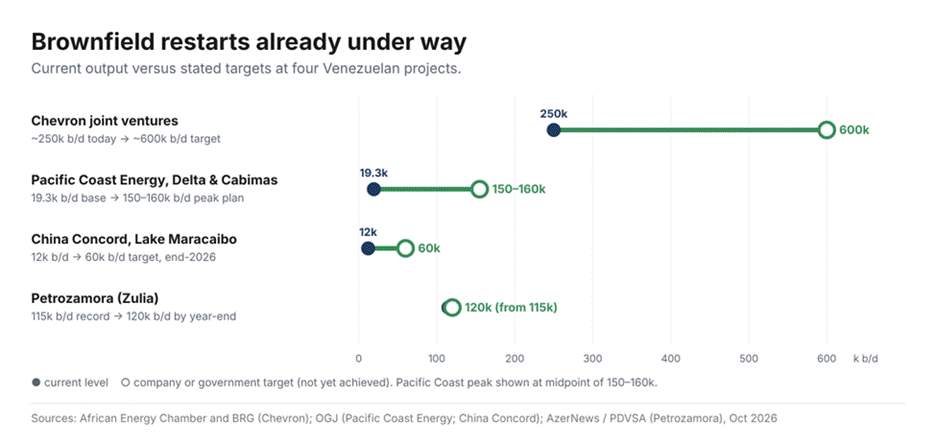
Why brownfield beats greenfield on speed (interpretation): a reactivation uses an existing wellbore, a known reservoir and existing surface tie-ins. A new offshore or frontier development needs seismic, appraisal, sanction and construction before first oil, typically measured in years. In Venezuela the first barrels from a workover can come in months.
Could Venezuela be the fastest-growing producer of the next few years? It could. Venezuela has about 30,700 existing wells, of which only about 8,500 are producing, known reservoirs and export routes already in place, so each new barrel takes less time and capital than a frontier barrel. This is a thesis, not a measured ranking: I have not benchmarked growth against Guyana, Brazil or US shale like for like, and the pace depends on rigs, power, diluent and politics. What is supportable today: among large resource holders, Venezuela has an unusually large pool of short-cycle, low-capex barrels sitting behind existing infrastructure.
What could slow it down
The idle-well story has limits. Output growth flattened after mid-2026: OPEC's secondary-source estimate was 1.15 million b/d in September, while the government reported 1.206 million b/d to OPEC (Rio Times). The gap between official and independent figures is itself a risk.
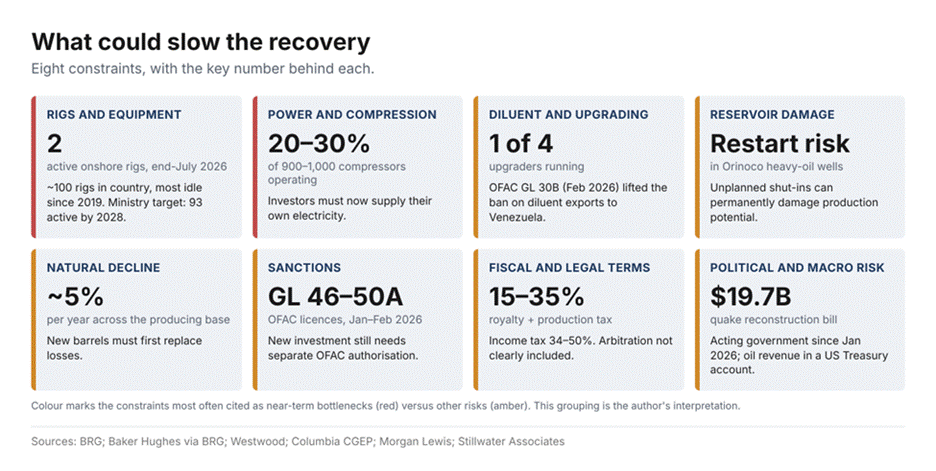
On reservoir damage, the observed recovery factors in Venezuela's better conventional fields are a reminder of what good management achieves: El Furrial has recovered 3.4 billion barrels at a 41% recovery factor, Guafita 42% (OGJ). The Orinoco is a different reservoir with far lower recovery to date.
How fast, and at what cost
The most detailed public bottom-up view is BRG's October 2026 framework, which builds from the well inventory to rigs, crews and capital. Its unconstrained scenarios:
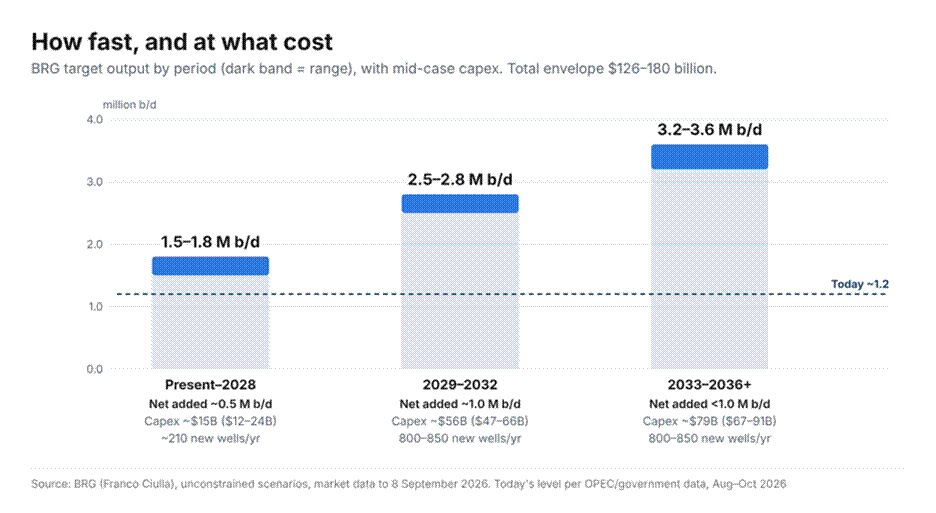
The pattern matters more than the totals. The first half-million barrels a day is the cheapest: about $15 billion, mostly workovers, artificial lift and modest drilling. Per barrel a day added, the first tranche costs about $30,000; the second about $56,000; the third more than $79,000, because later barrels need new wells, surface facilities and upgrading (derived from the mid-case figures above).
Other estimates line up with this shape:
• PDVSA targeted 18% growth in 2026, to roughly 1.3 million b/d (Atlas Institute).
• Stillwater Associates sees 1.0 to 1.3 million b/d possible in 2026 as idle wells restart, but doubling within three years as unlikely.
• Monaldi estimates around $100 billion and at least a decade to return above 2 million b/d; Rystad puts a return to 3 million b/d at about $183 billion (Yahoo Finance, citing both).
• Chevron plans more than $7 billion over five years, aiming at about 600,000 b/d (BRG, citing Chevron).
My reading (interpretation, medium confidence): 1.4–1.6 million b/d by end-2027 is achievable if rigs, power and diluent keep pace, because those barrels come mainly from wells that already exist. Above about 2 million b/d, the story changes from reactivation to new Orinoco development, and the reserve debate starts to matter again.
What Venezuela means for oil futures and development
In the near term, Venezuela barely moves Brent or WTI futures. Its real market impact is on heavy crude prices and on who supplies US Gulf Coast refineries. Its effect on benchmark prices is a story for the end of the decade.
Benchmark prices: small next to the Middle East
The oil market in 2026 has been driven by the Strait of Hormuz, not Venezuela. Flows through the strait fell from 21.6 million b/d in Q4 2025 to 4.9 million b/d in Q2 2026 (EIA via OGJ). Venezuela's whole 2026 gain, a few hundred thousand barrels a day, is small against swings of that size.
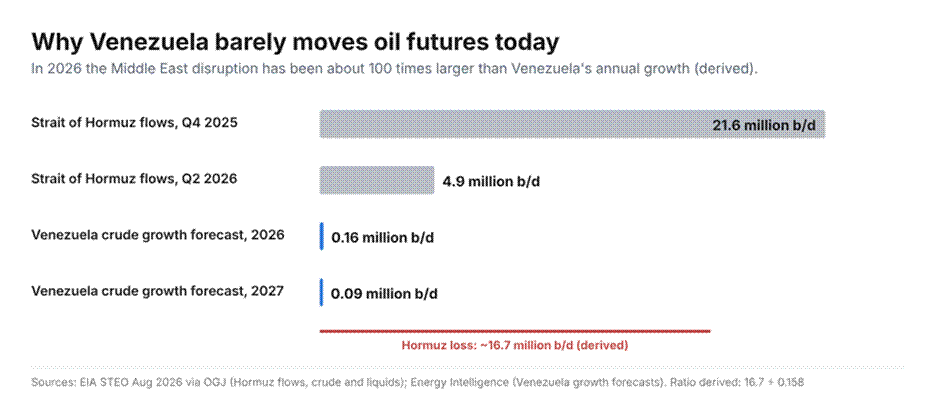
• Growth forecasts are modest. Energy Intelligence expects Venezuelan crude output to grow about 158,000 b/d in 2026 and 87,000 b/d in 2027 (Energy Intelligence). Kpler sees about 1.4 million b/d by late 2027, with larger capacity gains not before the end of the decade (Kpler).
• Analysts see little immediate price effect. Kpler called the near-term impact of the US–Venezuela deal on crude prices neutral, but expects a successful ramp-up to put persistent downward pressure on prices over the longer term (Al Jazeera).
• Price forecasts are driven by inventories and Hormuz. The EIA's August outlook has Brent at $78 in Q4 2026 and $69 average in 2027; Rabobank is higher at $86 for 2027 (Hellenic Shipping News). Neither forecast rests on Venezuela.
My reading of the futures curve (interpretation, medium-low confidence): the front of the curve will keep trading on Middle East supply and inventories. Venezuela matters more for the back of the curve, 2028 onward, as a credible source of new supply that is not bound by OPEC quotas. If the ramp-up stays on track, it adds to the case for lower long-dated prices.
Heavy crude: where the impact is real
Venezuela's crude is heavy and sour. US Gulf Coast refineries with cokers were built for it, and that is where most of the barrels go.
• US Gulf Coast imports from Venezuela reached record highs of more than 700,000 b/d (Kpler via Hellenic Shipping News).
• Rystad expects heavy and extra-heavy crude and bitumen to make up about three-quarters of Venezuelan output through 2028, increasing competition with Canadian and other heavy grades (OilPrice).
• The likely losers are Canadian heavy producers and fuel oil suppliers, who lose pricing power as Venezuelan heavy barrels return (ADI Analytics). Some Canadian heavy could shift from the Gulf to Asia via Vancouver, widening its discount to WTI (Stillwater Associates).
• There is a ceiling. US refining capacity has fallen, including on the Gulf Coast, which limits how much more heavy crude the US can absorb (Energy Intelligence).
OPEC
Venezuela is exempt from OPEC+ quotas because its output has been far below any ceiling. Bloomberg reported on 27 August 2026 that Caracas is examining leaving OPEC, with no decision announced (Rio Times). Kpler's view is that an exit is structurally likely but not urgent: at about 1.4 million b/d by late 2027, Venezuela stays inside its exemption for at least two to three years. An exit would free no barrels today. It matters later, if output climbs toward 2 million b/d and beyond.
Development: price decides which barrels get developed
The oil price sets which Venezuelan projects go ahead (interpretation, based on the cost evidence in this paper):
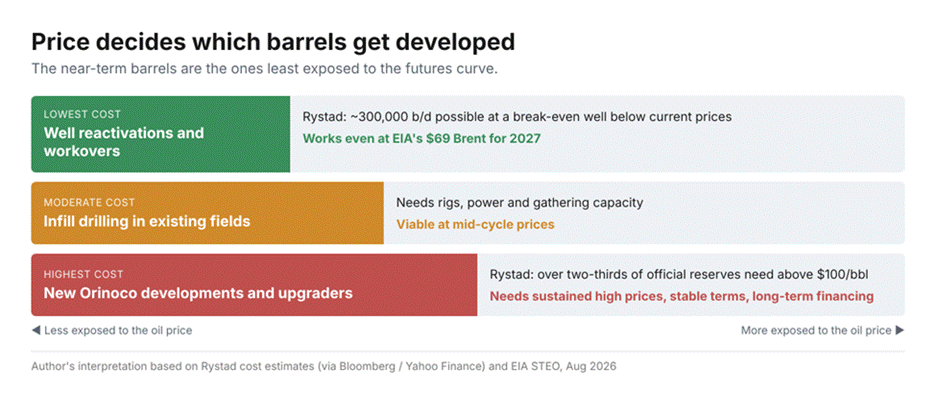
The implication: a lower price environment in 2027 would slow the big Orinoco projects, but not the brownfield restart. That supports the main argument of this paper. The near-term Venezuelan barrels are the ones least exposed to the futures curve.
Conclusion: stop arguing about the reserve, start counting the wells
Venezuela's 303 billion barrels is an official number built on a generous recovery assumption, and it should not be used to value anything. Independent estimates of 60–110 billion barrels are more defensible. Even the lowest of those is more oil than Venezuela can produce in the lifetime of any contract signed today.
The real question for the next five years is how many of the more than 22,000 inactive wells (30,722 counted minus 8,491 active) can be brought back, knowing many never will, and how quickly the rigs, power, compression and diluent can follow. That is a brownfield execution problem. It favours operators and service companies that can mobilise equipment, run workover and artificial-lift campaigns, restore power and gas handling, and move crude through existing terminals.
What this means in practice:
• For operators: value blocks on audited 1P/2P per field and on the reactivation inventory, not on the national figure.
• For service and marine companies: the first wave of demand is workover rigs, ESPs and artificial lift, compression, power generation, wireline, and logistics for diluent and crude. BRG's model alone calls for about 96 workover rigs and 36 wireline units in the short term.
• For everyone: contract terms, sanctions licences and political stability will decide how much of this happens. The geology is not the binding constraint.
Confidence: high that the official figure overstates economically recoverable oil; high that near-term growth comes from existing wells; medium on the pace, which depends on factors outside the oil field.
Final word
Venezuela may not hold the world's largest oil reserves, and for now that does not matter. What matters is that thousands of existing wells, pipelines and terminals are waiting to be brought back into service. Those barrels are generally cheaper and quicker to produce than barrels from new developments, and they are the reason Venezuela could be one of the fastest-growing producers of the next few years. The opportunity is real, but it will go to those who understand the fields, the contracts and the risks.
If you are interested in discussing investment in Venezuela or the economics of its oil sector, please contact me directly here on LinkedIn.
Sources
Pages consulted for this paper (search results and pages opened, October 2026):
• USGS Fact Sheet 2009-3028, Orinoco Oil Belt recoverable resources
• OGJ: USGS pegs Orinoco's recoverable figure at 513 billion bbl
• OGJ: global oil and gas reserves survey (OPEC ASB 2025 figures)
• StatRanker: OPEC ASB 2026 ranking, end-2025
• Hart Energy: Venezuela's reserves top OPEC list thanks to Orinoco
• MercoPress: Venezuela claims world's largest proven reserves (2011)
• Bloomberg via Gulf Times: Venezuela's questionable oil figures (22 Jan 2026)
• Yahoo Finance: Venezuela's reserves, making them viable is another problem
• S&P Global: Venezuela's oil reserves kick into reverse (Rystad, 2017)
• OGJ: Market gives OPEC opportunity to improve oil reserves data
• Transport Geography: OPEC reserves 1980–1991
• Resilience: How much oil is left in the world? (R. Rapier)
• Resilience: ASPO, further reflections on Middle East reserves
• BRG: Venezuela's Oil Rebuild, a bottom-up view (Oct 2026)
• Columbia CGEP: New Venezuelan oil regulations (27 Jul 2026)
• AFP via BSS: Less than 30% of oil wells active (28 Apr 2026)
• AFP via Revista E&N: Venezuela output falls to 1934 levels (Jul 2020)
• AFP via Channels TV: Venezuela's oil production sinks to lowest output in 77 years (2020)
• OGJ: Venezuela offers silverfield production opportunities
• OGJ: PDVSA lets contracts for Delta, Cabimas blocks
• OGJ: All about Orinoco (2010)
• Energy Central: The paradox of 300 billion barrels
• Westwood Insight: Venezuela's onshore reawakening
• Venezuela Energy Week: idle wells offer a fast track
• African Energy Chamber: Venezuela's 2026 recovery curve
• Stillwater Associates: how much Venezuelan oil can return short term
• Rio Times: Venezuela oil output holds near 1.2 million (Oct 2026)
• AzerNews: production reaches 1.252 million b/d (24 Oct 2026)
• Rigzone/Bloomberg: Pentagon's Venezuelan oil partner boosts output (26 Oct 2026)
• Yahoo Finance: Venezuela's oil production grows at a crucial time
• Atlas Institute: Ownership without control
• Morgan Lewis: OFAC general licenses and FAQs (Feb 2026)
• EIA STEO via OGJ: Brent forecast and Strait of Hormuz flows (Aug 2026)
• Hellenic Shipping News: EIA and Rabobank forecasts
• Energy Intelligence: Can US downstream absorb more Venezuelan heavy crude?
• Kpler: Venezuela's OPEC exit (31 Aug 2026)
• Kpler via Hellenic Shipping News
• Al Jazeera: will Venezuelan oil lower fuel prices? (2 Sep 2026)
• OilPrice: why more Venezuelan oil won't solve America's gasoline problem
• ADI Analytics: Venezuela and oil markets
• Rio Times: Venezuela weighs OPEC exit
• BB.LV: OPEC reports increase in global reserves (ASB 2026, May 2026)
• Petroleum News: Alberta oil sands boost North American reserves (Feb 2003)
• OGJ: Worldwide reserves grow; oil production climbs in 2003
• Western Standard: OPEC's statistical data excludes Canada's oil sands (2023)
• OGJ: Saudi Arabia reports post-audit reserves of 268.5 billion bbl (Jan 2019)
• MEED: Saudi Arabia boosts oil reserves after audit (Jan 2019)
• OGJ: Heavy hydrocarbons playing key role in peak-oil debate (2003)
• Bellona: Russia classifies oil reserves (2004)
• Moscow Times: Government declassifies oil reserves (Jul 2013)
• MEED: Iran announces new Gulf oil discovery (2010)
• CS Monitor: Does OPEC really have 80 percent of the world's oil? (2012)
• TheGlobalEconomy: Russia oil reserves (EIA data, 1997–2021)
• Oxford Institute for Energy Studies: Russian oil output in 2022 (BP reserves figure)
• Wikipedia: Oil reserves in Russia (compiled estimates)
• OilPrice: What's wrong with Rystad Energy's global oil reserve estimate
Evidence notes: Venezuela's official reserves are not independently audited. Production figures differ between government reports and OPEC secondary sources; both are shown where they diverge. Figures marked "derived" are my own arithmetic from the cited numbers.
#chevron #pdvsa #orinoco #crudeoil #bitumen #oilreserves #opec #heavycrude #venezuela #oilrecovery