Maximize Petrochemicals through an Integrated Propane Terminal at Hazira

Overview
India’s petrochemical growth has been strong and has consistently indicated a strong CAGR of upwards of 7-8 %. The trouble however has been, that the country imports above 85% of its crude and over 50% of its gas, which in a way, makes it difficult for domestic petrochemical feedstock to be generated to meet the rising demand of Petrochemicals. While the process of enhancing indigenous production of Petrochemicals has been initiated, feedstock such as light and heavy naphtha, light kerosene, off-gases with higher Hydrocarbon molecules in the refineries are being diverted to Petrochemical complexes to produce Olefin and Aromatic led Petrochemical chains. This has become more and more exclusive as the distillate demand is moderating somewhat.
Of late, a new trend in the refineries has started wherein Olefin and Aromatic complexes are being integrated in the refineries from the initial stages itself, to maximize Petrochemical production. This has been possible as the demand for Gasoline and ATF is capped and that of diesel is moderating. It is appreciated that liquid feedstock to Olefin plants generate Intermediates for Petrochemicals, which are relatively more expensive as compared to gaseous feedstock. However, the country is encountered with Hobson’s choice, as gas and Crude both are sourced from abroad. Since India is a refining hub, therefore liquid feedstock to petrochemical plants remains more common in India. The other problem is that the country is unable to divert Refinery LPG as petrochemical feedstock, as LPG remains the main cooking fuel. It may take a while before natural gas is able to displace LPG as cooking fuel, for its diversion for Petrochemical production. It is in the backdrop of the above that country is constrained to import petrochemicals too, to the tune of $80- $100B annually.
One of the major Petrochemical, whose demand has been increasing significantly is Polypropylene. This is more so as fillip is provided to Automobile industry. While a lot of PP capacity has been installed in the refineries through Petro-FCC route, the deficit remains large and indicates a strong growth trend of 7-10% CAGR.
It may be worthy of attention though, that given the strong demand of LPG, the country imports a lot of LPG too, to meet the country’s cooking fuel requirements. As much as 33 million tonnes of LPG is required per annum, of which more than 50% is imported. While this trend will take some time to phase off, it may be worthwhile to consider a propane terminal of large capacity located strategically to support Feedstock requirements of existing Olefin complex, as well as enable significant PP capacity to be created through PDH route. The idea would be to create maximum Petrochemical capacity at optimal costs by utilizing the existing Infrastructure to the extent possible.
Proposed location for Propane terminal
Hazira is a strategic location, which receives gases from Bombay High /South Bassien and transports the same through the HVJ pipeline up North to support LPG, Olefin and Fertiliser complexes. The terminal recovers part LPG at Hazira and at several other locations en-route to Vijaipur. Vijaipur houses a gas processing facility meant to recover C2/C3 from the gases and re-inject the same in the HVJ pipeline while the lighter natural gas is routed through spur lines to Delhi and around. The C2/C3 in the pipeline after sweetening is recovered at Pata - Auryia to support a Gas Cracker facility of 900 KTPA built in phases. Over a period since the Mumbai High/South Bassein gas composition has depleted and become leaner, the LPG plant at Usar was shut down and a PDH facility of 500 KTPA capacity was installed there.
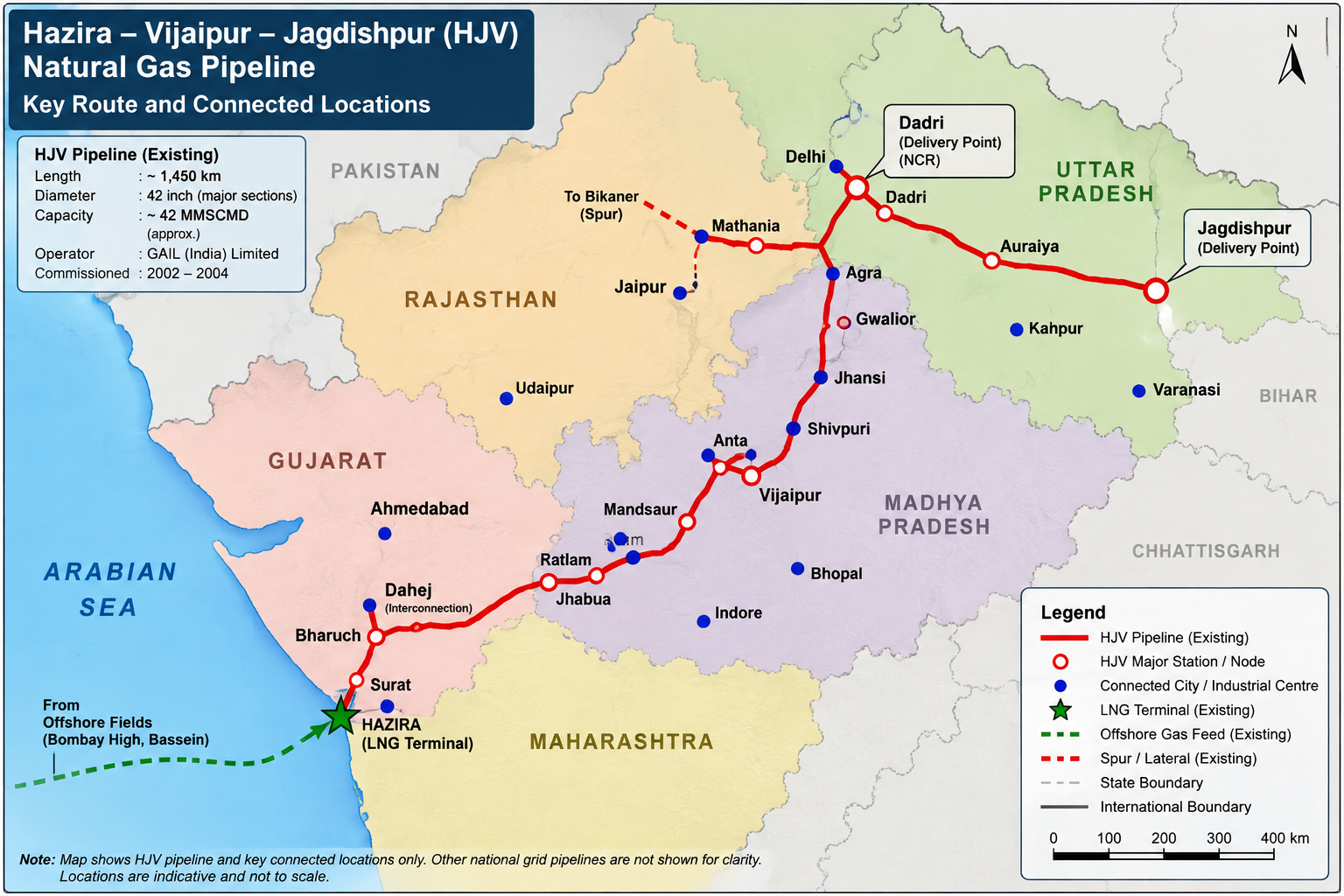
Another important aspect with Hazira location is the fact that the OPAL complex at Dahej is about 120 km away. In case an additional Pipeline is installed to connect Hazira to Opal at least 500 KTPA of Propane could be routed to OPAL complex, for upgrading the Olefin production capacity commensurate with that while adding another Cracking Furnace in OPAL complex. This will improve the complex feedstock diet and increase the corresponding Ethylene and Propylene production to support additional PC capacity through a virgin plant or debottlenecking of existing facilities.
The proposed propane terminal at Hazira can therefore be a critical facility to integrate the OPAL and Vijaipur Complexes through the existing HVJ pipeline, besides the Hazira terminal itself could become an important hub to create additional facilities.
Propane Terminal and Project facilities
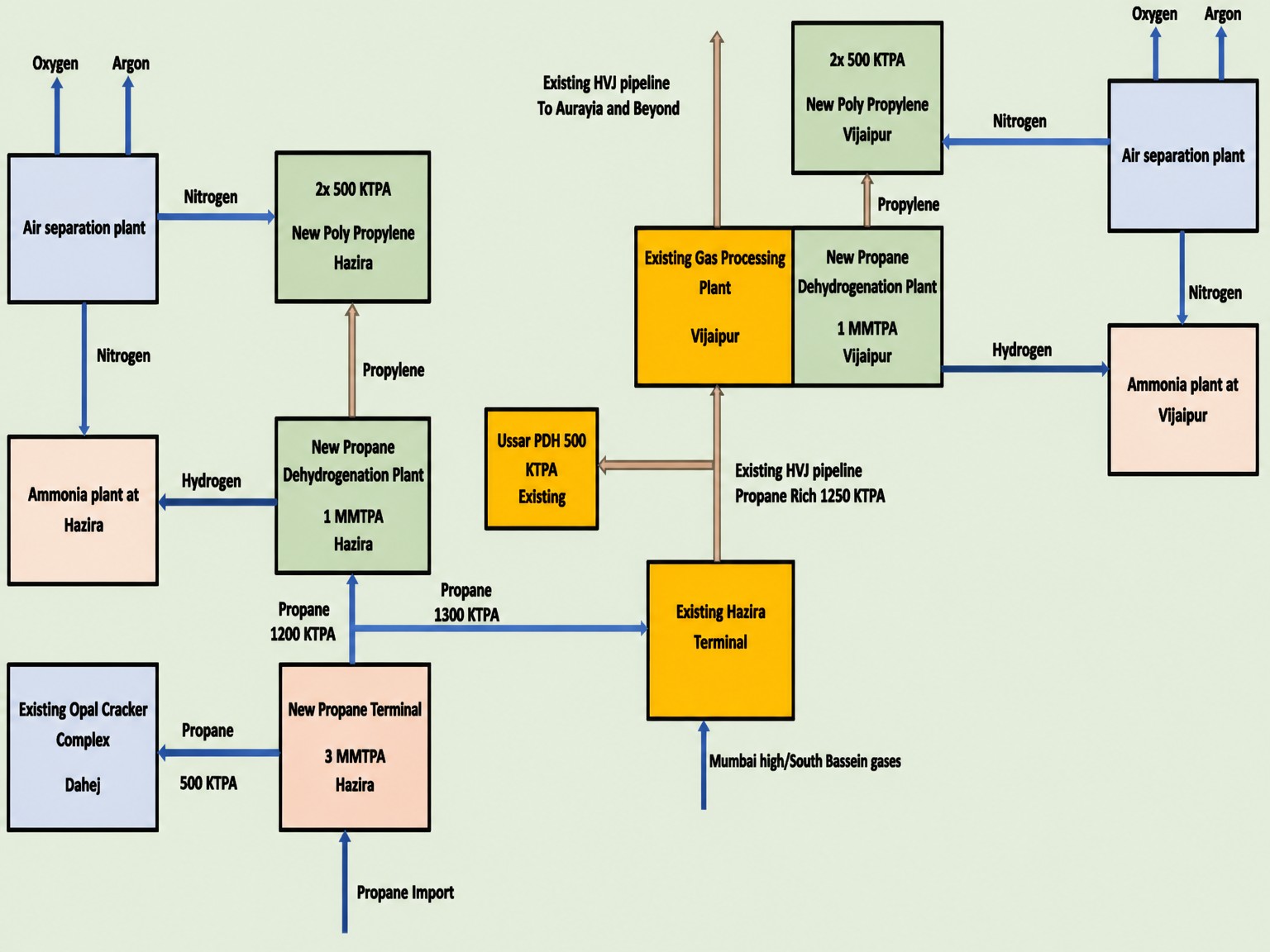
As mentioned above, the intention would be to install a large terminal to route at least 500 KTPA of propane to Opal and 2500 KTPA of propane to two PDH complexes, one located at Hazira and another at Vijaipur, to produce 1000 KTPA of PP respectively from each of the complexes. The Hydrogen produced from the PDH complexes being significant, would be utilized to make Ammonia both at Hazira and Vijaipur. Even at Ussar the Hydrogen produced in the PDH facility can be converted to Ammonia. Additionally, from the Air Separation Plants meant to support the complexes, Oxygen and Argon would be recovered as products for improving plant economics. The overall schematic of the proposed complex could be as below:
Propane Integration to Existing Complexes abd Additional Propylene Capacity
New Propane Terminal
The proposal entails an integrated, multi-site mega-petrochemical complex anchored by a 3.0 MMTPA Cryogenic Propane Terminal at Hazira. The facility leverages deep-water import capabilities to supply propane feedstock to twin Propane Dehydrogenation (PDH) complexes located at Hazira and Vijaipur, as well as providing propane integration with the OPaL complex via a cross-country pipeline network. The project incorporates downstream valorization into Polypropylene (PP), Polyethylene (PE), and an Air Separation Unit (ASU) / Haber-Bosch Ammonia Loop to capture high-margin industrial gas and fertilizer intermediate streams.
Material & Product Balance
3,000,000 MT/year (3.0 MMTPA) of Cryogenic Propane is expected to be delivered at the Propane terminal utilizing sub-zero unloading arms with automated Boil-Off Gas (BOG) re-liquefaction compressor trains at the terminal, to maintain near-zero routine flaring. A 20 km Pipe-in-Pipe Line High-vacuum insulated cryogenic transfer line is envisaged to connect the jetty to Hazira terminal tank farm. 4×Low-Temperature Carbon Steel (LTCS) full-containment cryogenic storage tanks with a concrete external wall would be installed on naturally ventilated piled foundations.
Propane from the central Terminal proposed at Hazira to the tune of 500 KTPA shall be pumped to Opal Petrochemical complex, and 1,250 KTPA of propane shall be routed to the PDH facility at Hazira. Another 1250 KTPA shall be routed to Vijaipur through the existing compression systems along the HVJ pipeline.
Four numbers of four full Containment Tanks of about 51,000 MT of liquid propane per tank are envisaged at the terminal along with all associated facilities. The inner tank may be of Low Temperature while the outer tank could be Reinforced Pre-stressed Concrete Wall designed for full secondary containment and blast impact resistance. The inner tank may be about 72.5 M diameter with maximum liquid fill height of 18 m.
In-Tank Primary Pumps (Low Head / High Flow) submerged; multi-stage vertical canned cryogenic motor pumps installed inside stilling columns suspended from the tank roof rated to deliver cold liquid propane at 4–6 bar (g) suction head to the suction header of the outboard booster pumps are envisaged. The Outboard High-Pressure Booster Pumps shall be Horizontal or Vertical Can-type Multi-Stage Centrifugal Pumps to feed the respective destinations with suitable vaporizers will be provided.
Tank Foundation
The tank foundation design shall utilize an elevated piled pier structure with elevated concrete Raft on Piled Piers. This prevents thermal conduction from freezing the underlying subsoil and eliminates frost risks, without needing electrical bottom heating cables. Deep bored cast-in-situ concrete piles shall be anchored directly into stiff clay or dense sand strata to support the tank foundations.
Hazira 1,250 KTPA PDH Unit
About 1,250 KTPA of propane is routed to PDH plant at Hazira to produce 1,000 KTPA of Propylene, which in turn would be close coupled to a PP complex comprising of two trains of PP of 500 KTPA each. About 83−85 wt% conversion efficiency yielding 1,000 KTPA of Polymer-Grade Propylene and high-value H2 off gas can be anticipated from PDH complex. The special features of the design may include:
- Reactor Effluent Compressor Drive: Driven directly by a Gas Turbine (GT) (natural gas/plant fuel gas fired).
- Steam Generation & Heat Pump Drive: The hot exhaust from the Gas Turbine passes through a Heat Recovery Steam Generator (HRSG) combined with the reactor waste heat boilers to produce High-Pressure (HP) steam (41 bar (g), 400C). This steam would drive the Steam Turbine for Heat Pump Compressor of the C3 Splitter.
- C3 Splitter could be a single column design equipped with advanced trays.
- About 44 KTPA of pure hydrogen would be produced from the plant.
- To convert the entire 44 KTPA of high-purity Hydrogen produced from PDH plant into Ammonia (NH3), the Ammonia Synthesis Loop could be coupled with cryogenic Air Separation Unit (ASU).
- Ammonia Production to the tune of 245 KTPA is estimated to be produced. Additionally, from the ASP about 60 KTPA of Oxygen and about 3 KTPA of Argon can also be produced.
PP complex at Hazira
To expand the Hazira petrochemical complex, 1,000 KTPA of Polymer-Grade Propylene from the C3 Splitter shall be routed directly to an integrated Polypropylene (PP) Complex. This will eliminate liquid propylene storage/chilling overheads. The PP facility could be configured considering two parallel 500 KTPA trains. A common warehouse for a 15-day storage shall be provided. An Automated Storage and Retrieval System (ASRS) with high-density double-deep rack bays may be considered to minimize the warehouse footprint and therefore saving civil costs. The approximate dimensions of the warehouse may be 175.0 m (Length) × 80.0 m (Width) × 22.0 m (Height).
Integrated Utilities and offsite for Propane terminal and PDH/PP complex.
About 100 MW of power may be required for the Hazira Complex, which could be sourced from the Grid. The plant is expected to be self-sufficient in steam. Cooling water to the tune of 28,000 m3/hr, Instrument air to the tune of 10,000 Nm3/hr may be required. The Nitrogen would be provided from ASP. An integrated wastewater treatment plant would be provided with ZLD facilities.
The PDH/PP/ Ammonia/ASP facilities provided at Hazira shall be duplicated at Vijaipur. Also a 120 Km pipeline connecting Hazira to Opal to transport 500 KTPA of propane shall be included in the project. Additional Ethylene and Propylene shall be produced at Opal.
Capex and Financials
For all the facilities envisage as above a total investment of about $ 6.3- 6.5 B i.e. 60,000 – 65,000 odd crores is estimated. For a Propane – Propylene crack of $ 650- $ 700, the pretax IRR of the facility could be around 20%, with payback period around 5.5 years and EBITDA margin of about 30%. These numbers are indicative and directional and the economics can be improved upon optimization of process scheme.
The above configuration suggests that prima facie there is a good case of integrating the existing complexes and adding additional petrochemical capacity based on imported propane. More so, as the piped gas integration picks up, and more and more LPG is displaced, perhaps the imported LPG itself can be routed to the proposed terminal to support the Petrochemical strategy!
|
Venugopal, B.V.
9/29/2026 2:41 PM
Very nice Sir. Regards |