Approach to licensor Selection – Dream Refinery Project

|
|
|
The Integrated Dream Refinery Project (DRP), conceived for a 20 MMTPA throughput bears a complex configuration, which is widely integrated. As highlighted in the discussions, the Complex envisages a higher degree of integration to polymers, niche petrochemicals, chemicals and an integrated utilities and offsite.
One can appreciate that the technology selection for such a Project could pose serious challenges, as the number of technologies required are plenty. The problem is compounded by the fact, that there are no licensor’s who can offer all the technologies under one roof. This is therefore always a challenge and licensor selection consequently becomes a time consuming exercise. In India, typically in the Public Sector Undertaking (PSU) set up, each technology is selected on a standalone basis, and the Consultant/PMC is often entrusted with the task of configuration optimization and design of open art units and other facilities. This process has its own merits, as the owner could stand to benefit by selecting the best technology for each facility. However, the process is tortuous, time consuming and perhaps does not allow a very high level of standardization and stream integration / optimization, to maximize the returns for the Owner.
An alternative method, which is widely popular with major Private sector players, is the Managing licensor (ML) route. Under this process the Owner Nominates a Managing licensor who himself would be in a position to provide about 70-80% of the technologies. For the technologies, which ML does not provide the owner may have to facilitate licensor selection and enable ML to integrate the same in the configuration, for overall optimization of the configuration? This approach can enable a vertical takeoff to the project and provide a head start to a significant portion of the plant process design, thereby enabling a lot of schedule advantage in the overall execution cycle. In addition, since a large part of technology and process design per se is to be sourced through ML, advantages of standardization, stream routing optimization, critical savings in utilities by reducing margins and assumptions can be realized. Another critical benefit is, that the Consultant retained for implementation of the Project can concurrently commence with utility and offsite process design to finalize vital documents such as Plot Plan, Utilities and offsite design packages and Unit Equipment layouts at a much brisk pace. All these are vital documents to provide a head start to detailed engineering of Underground (UG) piping and Civil/ Structural engineering. Worked upon strategically, the exercise can lead to significant schedule savings, particularly when EPCM mode of implementation is adopted.
However, there is a significant catch in the approach. An ML approach perhaps can be considered for the Refinery process units only, where at least two or three licensors are able to provide a wide variety of process technologies, significant among them being UOP, Technip/Axens and Chevron Lummus Global (CLG). UOP and Technip/Axens, in fact, have considerable experience of implementing projects on ML route. The trouble arises when one begins to examine the basket of petrochemicals, chemicals and niche technologies. These technologies generally cannot be basketed as no licensor can provide the technology for two or three process units at best. Therefore, one conclusion that one can draw from this is that ML route can be adopted only for the Refinery component of the project. For the other process units in Polymers, petrochemicals, niche petrochemicals and chemical plants, technology selection will have to be carried out on a standalone basis.
For the conceived Dream Project the broad blocks from Process design considerations could be divided into the following categories:
1. Refinery Core
2. Petrochemicals (PC) core and Polymers
3. Niche Petrochemicals and Chemicals including Fertilizers
4. Open Art Designs
5. Build-Own-Operate (BOO) facilities
As discussed above, the Refinery core is the one for which an ML route can be considered. The Open Art facilities comprising predominantly of Utilities and Offsite facilities, could be carried out by the consultant. The BOO facilities identified of-course would be on a single point basis and carried out by agencies with proven track-record. The technologies for Petrochemicals, Polymers, Niche Petrochemicals/Chemicals plants though, will have to be carried out on standalone basis.
From project implementation considerations and Front End Design, therefore the following will have to be accounted for:
1. Refinery Core, Open art facilities and BOO facilities: The designs for these facilities could be initiated in advance as compared to the PC block.
2. The PC block will have a phasing with the Refinery core, as the technology details for the same will follow, after a gap. This will essentially influence the sizing of the common utilities, unless front-end design is carried out based on technology selection proposal data + informed margins. This will be the severest test of experience to ensure that utility design for the complex is carried out early. Sizing utility systems early is the key to successful implementation.
3. Out of the Petrochemical Block, the Olefin complex and the K-COT facility process design is vital as it has a direct interface with multiple refinery streams. The K-COT decision is simpler as this is a single licensor case and the owner can quickly invite the process of technology selection to ensure quick selection and award. The Private companies can even negotiate quick lining of technology, so that the process design for the same can be implemented with the Refinery core process block.
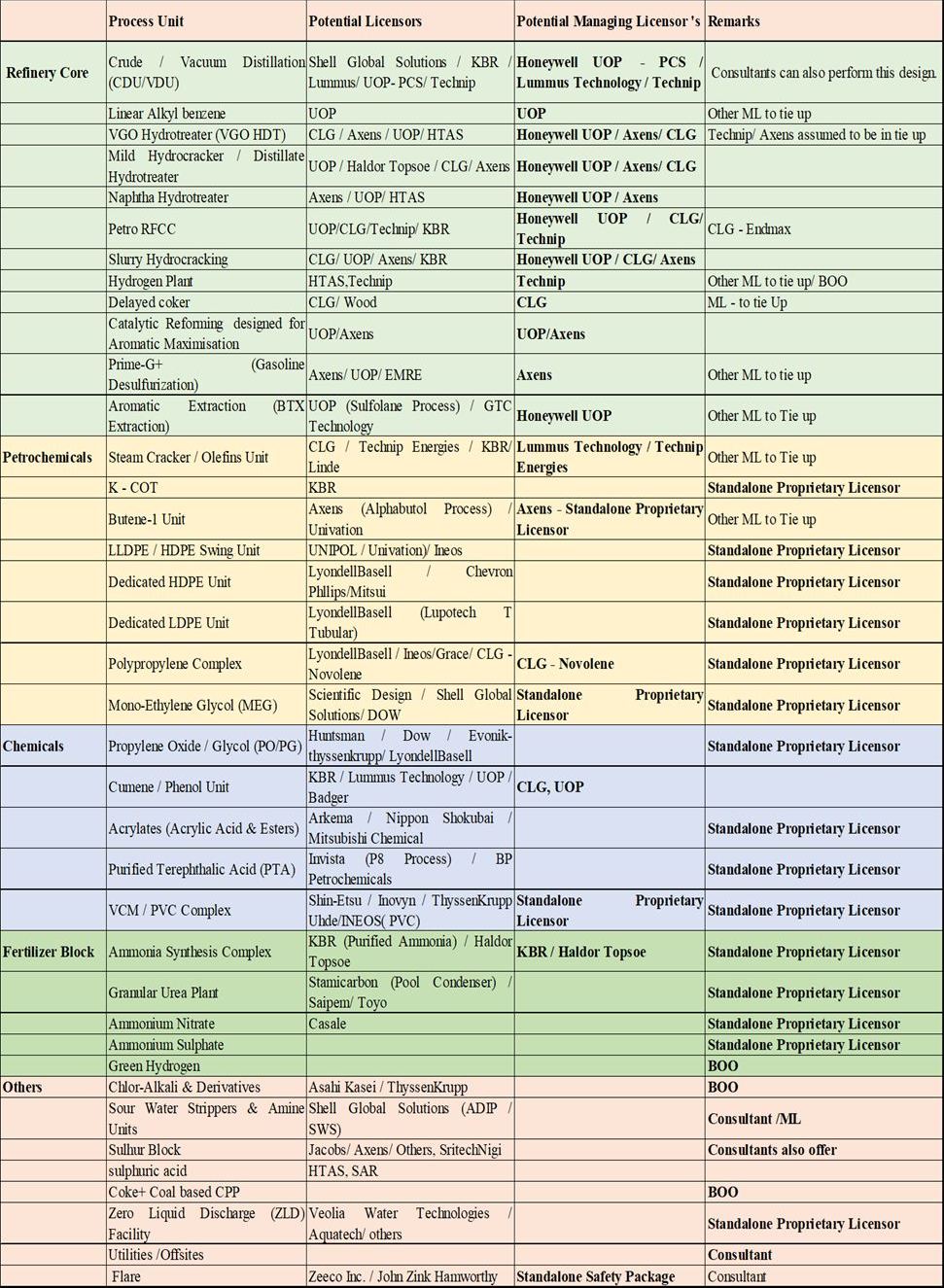
4. The Olefin complex technology finalization is the key block. The prominent licensors for Olefins are CLG, Technip/Axens, KBR, and Linde. The competition often boils down between CLG and Technip as KBR and Linde actually are not very active in India. In case Technip or CLG is selected as ML, there is no issue. However, UOP is one of the major ML and therefore, in case UOP is retained as ML, there is little choice but to retain Olefin as a proprietary standalone technology, which will have to go through the conventional licensor selection process. This will hold the key. Alternatively, in case UOP can tie up with one of the Olefin licensors other than CLG and Technip, the subject would open up. This though may not be acceptable to the owner, as not going through a licensor selection process to keep CLG or Technip out of the race would be impractical. Fast tracking of licensor selection for the Olefin complex perhaps, would not have a substitute.
Refinery Core – ML
1. CDU/VDU, NHT, VGO HDT, DHDT, SHCU, Petro FCC, could form part of the core Refinery Block.
2. For CCR, CLG perhaps does not have a technology. This may prompt the decision to restrict the ML completion between UOP and Axens only or Owner will have to select the technology for ML to integrate.
3. For LAB, only UOP will be offering technology and would therefore be a challenge for completion.
4. For Prime G – Only Axens has technology. The other licensors UOP and CLG will have to seek a backup. UOP does have a technology but probably references for the same is an issue.
5. For Aromatic Extraction owner may have to select technology from Sulzer (GTC) etc; for integration by ML.
6. Hydrogen plant can be implemented on BOO basis.
7. Owner for integration by ML could line up K-COT.
Petrochemicals, Polymers, Niche Petrochemicals and Chemicals
1. All technologies to be selected on standalone basis.
2. Strategy for lining up the Olefin plant Licensor quickly would be the key.
Utilities, Offsite and BOO
1. All can go on concurrently with Refinery core along with a defined strategy to size the integrated utilities, including the PC block
As is evident from the above, licensor selection for integrated complexes is a massive change, and requires a lot of proactive action. Readers may like to offer comments to update the potential licensors column. We could recall only the licensors listed herein!
All queries are welcome! Click the 'Add COmment / Reply' button here below 👇 👇 👇
#refinery#petrochemicals #licensors #masterlicensor #projectmanagement #dreamrefinery #epcm