Technology History
Sugarcane-based ethanol production represents one of the oldest and most established bioethanol technologies globally. The process has been commercially practiced for decades across tropical and subtropical regions, with major production centers in Brazil (world's largest producer), India, Thailand, Pakistan, China, and several African nations.
The technology gained significant commercial momentum during the 1970s oil crisis, particularly in Brazil's Proálcool program, but has since expanded worldwide. By 2023, global sugarcane ethanol production exceeded 30 billion liters annually, with Brazil alone producing over 26 billion liters. Thailand produced approximately 1.5 billion liters primarily from sugarcane in 2023, while India reached 4.5 billion liters as part of its 20% ethanol blending target.
Technology Summary and Chemistry
Sugarcane ethanol production is distinguished by its direct fermentation pathway – unlike starch-based feedstocks (corn, wheat, cassava), sugarcane juice contains readily fermentable sugars that require no enzymatic saccharification. This fundamental difference results in simpler process configuration, lower capital costs, and reduced energy consumption.
Core Chemistry
The process exploits sugarcane's natural composition: 10-20% total sugars (sucrose, glucose, fructose) in extracted juice. The primary biochemical reactions are:
Sucrose Hydrolysis (by yeast invertase):
C₁₂H₂₂O₁₁ + H₂O → C₆H₁₂O₆ (glucose) + C₆H₁₂O₆ (fructose)
Alcoholic Fermentation (anaerobic):
C₆H₁₂O₆ → 2 C₂H₅OH + 2 CO₂ + heat (ΔH = -234 kJ/mol glucose)
Stoichiometric Yield
- Theoretical: 0.511 kg ethanol per kg sugar (Gay-Lussac equation)
- Industrial practice: 0.48-0.51 kg ethanol per kg sugar
- From sugarcane: 85-90 liters ethanol per tonne sugarcane
Detailed Process Configuration
Stage 1: Feedstock Preparation and Juice Extraction
Sugarcane Reception and Cleaning:
- Harvested sugarcane (12-18 month crop cycle) delivered to mill within 24-48 hours to minimize sucrose deterioration
- Washing removes field dirt and debris
- Cane cutting and shredding prepares material for milling
Juice Extraction Methods: Two primary technologies exist:
- Milling (Most Common):
- Series of 4-7 heavy-duty roller mills applying pressure up to 250-300 kg/cm²
- Imbibition water (hot water recycled from process) added between mills to improve extraction
- Extraction efficiency: 94-97% of available sucrose
- Produces: Mixed juice (10-16% sugars) + Bagasse (fibrous residue, 47-52% moisture)
- Diffusion (Alternative):
- Counter-current extraction using hot water (70-80°C) in diffuser vessels
- Higher extraction efficiency (97-98%) but higher capital cost
- Produces drier bagasse (suitable for power generation)
Juice Clarification:
- Heating to 105-115°C with lime (Ca(OH)₂) addition (pH adjustment to 6.8-7.2)
- Flocculation and settling removes suspended solids, waxes, gums
- Produces: Clarified juice (clear, amber liquid) + Filter cake (mud, returned to fields as fertilizer)
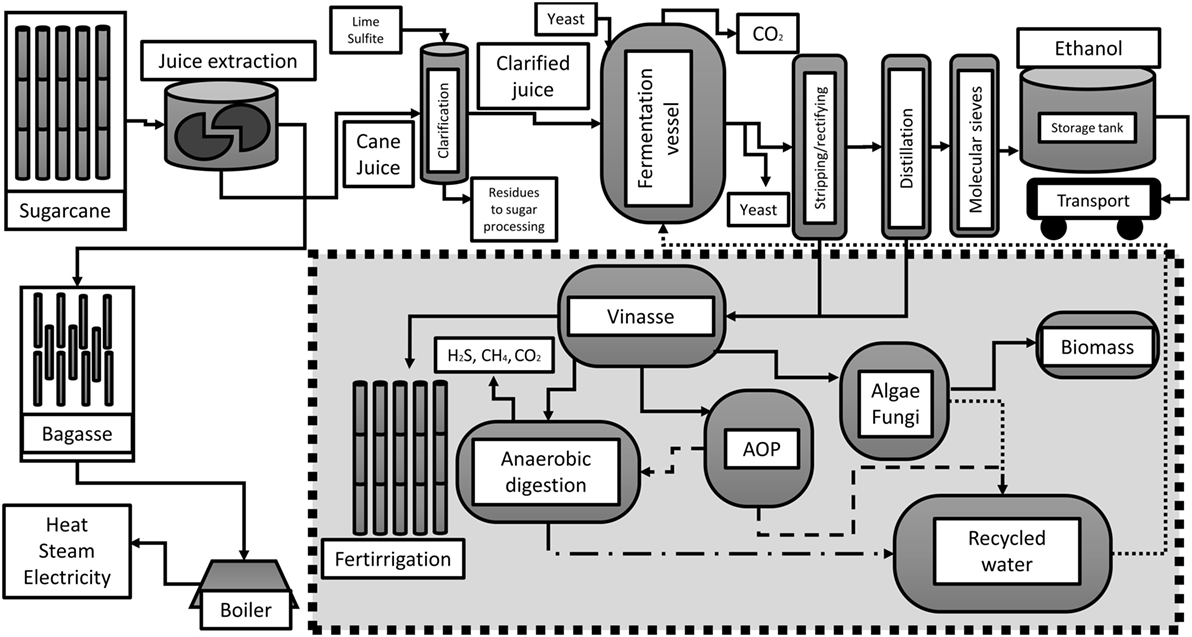
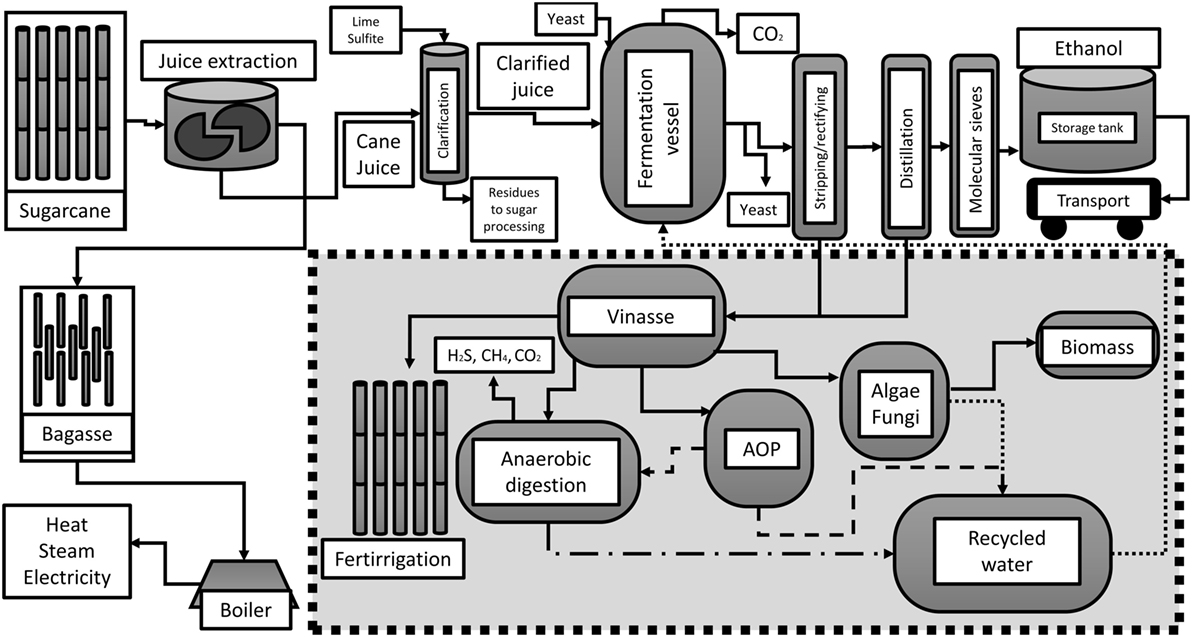
Simplified sugarcane-to-ethanol process with potential modifications in vinasse management
Stage 2: Fermentation
Fermentation System Design: Modern plants employ continuous fermentation with yeast recycle:
- Fermenter configuration: 3-5 vessels in series (cascade arrangement)
- Individual vessel size: 500,000 to 2,000,000 liters capacity
- Total fermentation time: 8-12 hours (with high-density yeast culture and recycle)
- Batch fermentation (older plants): 24-40 hours cycle time
Yeast Culture Management:
- Organism: Saccharomyces cerevisiae (industrial strains selected for ethanol tolerance, flocculation, temperature resistance)
- Yeast concentration: 8-12% v/v (with recycling systems)
- Yeast recovery: Hydrocyclone or centrifuge separates yeast from fermented broth
- Yeast treatment: Acid washing (pH 2.0-2.5, H₂SO₄) between cycles kills bacterial contaminants
- Propagation vessels: 9-12 smaller fermenters regenerate yeast culture with nutrients before returning to main fermenters
Operating Parameters:
- Temperature: 28-35°C optimal; modern strains tolerate up to 40-45°C
- pH: 4.0-5.5 optimal range (yeast growth); 4.5-5.0 maximum ethanol productivity
- Sugar concentration (feed): 12-20% total reducing sugars
- Ethanol concentration (product): 7-12% v/v ("beer" or "wine")
- Cooling requirement: Fermentation is exothermic; continuous cooling via external heat exchangers maintains optimal temperature
Fermentation Efficiency:
- Sugar conversion: 90-93% of theoretical yield
- Fermentation time vs. ethanol: Faster cycles (8-10 hours) achieve 8-9% ethanol; slower cycles (24+ hours) reach 10-12%
Stage 3: Distillation and Dehydration
Distillation System: Multi-column continuous distillation separates ethanol from water and solids:
- Beer/Wine heater: Preheats fermented broth using waste heat from distillation
- Stripping column (Beer column): Removes ethanol vapor from solids and most water; produces vinasse (stillage) bottom product
- Rectification column: Concentrates ethanol to 95-96% (azeotropic composition)
- Aldehydes concentration column: Removes volatile impurities (acetaldehyde, fusel oils)
Operating Conditions:
- Steam consumption: 2.5-3.5 kg steam per liter ethanol (varies with system design and heat integration)
- Pressure: Near-atmospheric to slight vacuum in some columns
- Temperature gradient: 78°C (ethanol boiling point) at rectification column top to 105-115°C at stripper base
Dehydration to Anhydrous Ethanol (99.5+%): Two modern technologies:
- Molecular Sieve Adsorption (Most Common):
- Packed columns containing zeolite (3A molecular sieve) or corn meal selectively adsorb water molecules
- Two-column system: one adsorbing while other regenerating (drying) at 250-300°C
- Energy consumption: 0.5-1.0 kg steam per liter anhydrous ethanol
- Produces: 99.5-99.8% ethanol purity
- Azeotropic Distillation (Legacy Technology):
- Adds benzene or cyclohexane to break ethanol-water azeotrope
- Extra distillation column required
- Higher steam consumption (4-5 kg steam per liter ethanol total)
- Environmental concerns with benzene handling
Denaturing:
- Addition of 2-5% gasoline, bittern, or other denaturant renders ethanol unfit for human consumption
Stage 4: Co-Products and Byproduct Management
Major Co-Products
1. Bagasse (Fibrous Residue):
- Yield: 250-300 kg per tonne sugarcane crushed (at 47-52% moisture)
- Energy content: ~7.5-9.0 MJ/kg (dry basis)
- Primary use: Fuel for steam boilers and cogeneration (combined heat and power - CHP)
- Electricity potential: 0.45 MWh per tonne bagasse with traditional boilers; up to 0.8-1.0 MWh with modern high-pressure boilers and condensing-extraction turbines
- Energy self-sufficiency: Bagasse combustion provides 100% of process steam and electricity needs; modern plants export surplus electricity to grid
2. Vinasse (Stillage):
- Yield: 10-15 liters per liter ethanol produced
- Characteristics: Dark brown liquid, rich in potassium, nitrogen, organic matter; pH 4.0-4.5
- Primary use: Fertigation (applied to sugarcane fields as liquid fertilizer)
- Application rate: 100-300 m³ per hectare per year (regulated to prevent soil/water contamination)
- Alternative uses: Biogas production (anaerobic digestion), concentration to solid fertilizer
3. Carbon Dioxide (CO₂):
- Yield: ~900-950 kg CO₂ per tonne ethanol produced (stoichiometric from fermentation)
- Recovery: Washing towers remove ethanol vapors from CO₂ stream
- Uses: Food/beverage carbonation, dry ice production, greenhouse enrichment, urea production
4. Filter Cake (Press Mud):
- Yield: 30-40 kg per tonne sugarcane
- Composition: Organic matter, waxes, phosphorus, calcium
- Use: Composted and returned to fields as organic fertilizer
Technology Efficiency
Energy Balance
- Energy output (ethanol): 85-90 liters ethanol per tonne sugarcane × 21.1 MJ/liter = 1,794-1,899 MJ/tonne cane
- Energy input (fossil fuels): Primarily diesel for harvest/transport and chemicals (fertilizers): approximately 200-300 MJ/tonne cane
- Energy ratio: 9-12:1 (energy out / fossil energy in) – one of highest among all biofuel pathways
- Net energy gain: Highly positive due to bagasse-based energy self-sufficiency
GHG Mitigation
- Lifecycle GHG reduction vs. gasoline: 70-90% reduction
- Carbon balance: Sugarcane ethanol achieves 70-90% lifecycle GHG reduction compared to gasoline, avoiding approximately 1.5-2.0 tons CO₂eq per ton of ethanol produced when used as transportation fuel
Land Productivity
- Ethanol yield: 6,000-8,000 liters per hectare per year (tropical conditions, 12-month cycle)
- Energy yield: 120-170 GJ per hectare per year (ethanol + bagasse electricity)
- Comparison: 2-3× higher than corn ethanol on per-hectare basis
Water Consumption
- Irrigation: Most sugarcane is rainfed; irrigation used only in semi-arid regions
- Process water: 1-2 m³ water per tonne sugarcane processed (modern plants with water recycling)
- Water recycling: 80-90% of process water recycled (cooling towers, condensate recovery)
Commercial Experience
Typical Plant Scale and Economics*
Standard Commercial Plant:
- Capacity: 100,000-400,000 liters ethanol per day
- Annual production: 30-120 million liters—assuming 300-330 operating days per crushing season
- Sugarcane requirement: 2.0-2.5 million tonnes per year—for 200,000 L/day plant
- Feedstock supply area: 25,000-40,000 hectares within 50-70 km radius
- Capital cost:
- $26-50 million for 200,000 L/day greenfield plant—2018 Sudan feasibility study
- $465.9 million for 487,000 L/day integrated plant—2011 Costa Rica basis
- Scale factor: ~$500-1,450 per ton annual capacity—depending on brownfield vs. greenfield, economies of scale
- Operating period: 200-300 days per year—seasonal, during sugarcane harvest
Production Economics:
- Feedstock cost: 60-70% of total production cost—2022-2025 industry analysis
- Ethanol from molasses: 69.4 gallons (263 L) per tonne molasses
- Production cost:
- Sugarcane: $0.30-0.50 per liter—general range cited by multiple sources for multiple time periods, varying by region, feedstock price, plant efficiency
- Molasses: Lower than direct juice fermentation as molasses is byproduct of sugar production
- Note: Production costs are highly dependent on feedstock prices, which vary by region and year
- Payback period: 3-5 years based on Sudan feasibility study for 200,000 L/day plant
*All costs should be inflated to current year (2025) using chemical engineering cost indices for proper comparison:
CEPCI 2011: ~585 (Inflation factor from 2011 to 2025: ~1.45×), CEPCI 2018: ~603 (Inflation factor from 2018 to 2025: ~1.41×), CEPCI 2025: ~850 (estimated)
Global Commercial Operations
Major Producing Countries (2023 data)
- Brazil: 400+ distilleries; 26+ billion liters annual capacity
- India: 450+ distilleries; 4.5 billion liters production (2022); targeting 10+ billion by 2025
- Thailand: ~30 ethanol facilities; 1.5 billion liters production
- Pakistan: Multiple facilities; expanding capacity for E10 blending program
- China: Significant producer but focusing on food-grade and industrial ethanol
- African nations: Kenya, Sudan, South Africa, Zimbabwe operate sugarcane ethanol plants
Plant Performance Benchmarks
- Uptime: 85-95% during crushing season (with planned maintenance windows)
- Ethanol recovery: 90-92% of theoretical yield from sugarcane sugars
- Bagasse utilization: 95-100% used for energy (steam + electricity generation)
- Labor productivity: 1,000-2,000 tonne sugarcane processed per employee per year
Technology Suppliers and Engineering Firms
Major technology providers and EPC contractors for sugarcane ethanol plants include:
- Dedini (Brazil): Complete distillery equipment and turnkey plants
- Zanini (Brazil): Fermentation and distillation systems
- GEA (Germany/International): Separation, distillation equipment
- Alfa Laval (Sweden): Heat exchangers, separation systems
- Praj Industries (India): Complete ethanol plant solutions
- Vogelbusch (Austria): Process technology licensing, particularly for continuous fermentation
Integration Opportunities
Flex Mills (Sugar-Ethanol): Many modern facilities operate as flexible plants that can adjust production between sugar and ethanol based on market prices. Typical configuration:
- 60-70% of juice to sugar crystallization during high sugar prices
- 100% of juice to ethanol during high ethanol/low sugar price periods
- All molasses (byproduct from sugar) to ethanol fermentation
Cogeneration Enhancement: Modern high-pressure boilers (60-100 bar) and condensing-extraction turbines enable:
- Export of 80-120 kWh electricity per tonne sugarcane to grid
- Annual revenue from electricity sales: $5-15 million for typical 2 million tonne/year plant
- Potential to triple electricity generation with investment in modern boiler systems
References
- https://www.czapp.com/analyst-insights/india-leads-asian-ethanol-production-boom/
- https://www.green-fuels.org/policies/ethanol-production-from-sugarcane-and-cassava-in-thailand
- https://india.mongabay.com/2022/12/india-aims-to-go-big-on-sugarcane-based-ethanol-but-water-intensity-of-the-crop-throws-up-concerns/4.
- https://gphjournal.org/index.php/as/article/download/253/118/
- https://www.sciencedirect.com/science/article/abs/pii/S0961953412001547
- https://pmc.ncbi.nlm.nih.gov/articles/PMC10456111/
- https://onlinelibrary.wiley.com/doi/10.1155/2014/957102
- https://www.scirp.org/journal/paperinformation?paperid=70449
- https://design.cbe.cornell.edu/index.php?title=Sugar_Cane_Ethanol_Plant
- https://courses.ems.psu.edu/egee439/node/647
- https://www.fsa.usda.gov/Internet/FSA_File/ethanol_fromsugar_july06.pdf
- https://www.academia.edu/144001326/Sugar_Cane_Juice_Extraction_Systems_Comparison_Mill_Versus_Diffuser
- https://www.cetjournal.it/cet/21/88/166.pdf
- https://esugj.journals.ekb.eg/article_353519_42b24307cd400e997bb6a7510d8213ee.pdf
- https://jptcp.com/index.php/jptcp/article/view/4174
- https://pmc.ncbi.nlm.nih.gov/articles/PMC10607480/
- https://www.elsevier.es/en-revista-brazilian-journal-microbiology-490-articulo-ethanol-production-in-brazil-bridge-S1517838216310346
- https://edepot.wur.nl/9629
- https://onlinelibrary.wiley.com/doi/10.1155/2023/5749122
- https://www.sciencedirect.com/science/article/abs/pii/S2213138824004703
- https://www.ecoamericas.com/issues/article/2007/12/956D0A54-3682-4723-80F9-829D9759315A
- https://www.sciencepublishinggroup.com/article/10.11648/j.ijsdr.20210701.13
- https://pantheon.ufrj.br/bitstream/11422/20886/1/RSNBrito.pdf
- http://www.brazilianplastics.com/edicao00/73_2023.html
- https://ethanolproducer.com/articles/braskem-starts-up-ethanol-to-ethylene-plant-7022
- https://www.business-standard.com/article/economy-policy/sugar-mills-boost-production-capacity-of-hand-sanitisers-to-100k-l-per-day-120032801036_1.html
- https://documents1.worldbank.org/curated/en/126131468303849062/pdf/460580PAD0P1101e0PrintShop005115109.pdf
- https://sugar-asia.com/bbgi-launches-bioethanol-plant-to-boost-total-production-capacity-of-800000-liters-per-day/
- https://www.braskem.com.br/europe/circular-economy-detail/Braskem-Inaugurates-Green-Ethylene-Plant-Triunfo-Becoming-Global-Biopolymer-Leader
- https://www.cabidigitallibrary.org/doi/pdf/10.5555/20220489798
- https://oxfambelgique.be/sites/default/files/2023-03/FINAL A4 document Ethanol Brazil and Peru-ENG-01-2023 FINAL.pdf
- https://www.sciencedirect.com/science/article/abs/pii/S0959652616306783
- https://unica.com.br/wp-content/uploads/2020/10/livro-sugarcane-ethanol.pdf