
Product
Flash Gas
Abbreviation
FLG
Names
Condensate Flash Gas; Glycol Flash Gas; Amine Flash Gas; Plant Flash Vapour
Insight Articles
#PS795
flashgas gasprocessingplant lng flashdrum condensate
Main Product
Fuel Gas
Segment
Refined Products
Main-Family
Refinery Gases
Sub-Family
Fuel gases & Lighter hydroc.
Physical State

Gas

Description

Flash gas is the light hydrocarbon vapour fraction generated when a pressurised process liquid undergoes rapid pressure reduction across a control valve or in a dedicated flash vessel, causing dissolved light gases to vaporise. It occurs at multiple points across a gas processing plant wherever a high-pressure liquid stream is let down to a lower operating pressure.

Unlike stabiliser overhead gas, flash gas is not produced by deliberate distillation but is an incidental by-product of pressure let-down. Its composition is therefore leaner — predominantly methane and ethane — because the heavier C₃–C₄ components preferentially remain in the liquid phase under flash conditions.

Common sources of flash gas within a gas processing plant include:

  • Condensate flash drums — pressure let-down of raw condensate from inlet separators
  • Glycol flash drum — dissolved hydrocarbons liberated from rich TEG/DEG after the contactor
  • Amine flash drum — hydrocarbons co-absorbed with acid gases released from rich amine
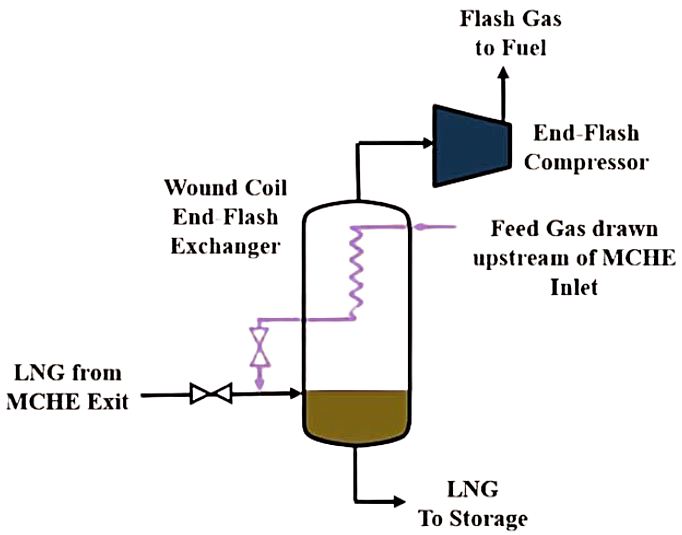
  • LNG end-flash drum — light ends flashed from LNG after the main cryogenic heat exchanger
  • Storage tank vapours — low-pressure flash from condensate or NGL storage tanks

Typical Composition

Component Range (mol%)
Methane (C₁) 70–90
Ethane (C₂) 5–15
Propane (C₃) 2–8
i/n-Butane (C₄) 1–4
C₅⁺ <1
N₂ / CO₂ / H₂S Variable (source-dependent)

Properties

Field Value
Molecular Weight indicative average ~18–25 g/mol
Sulfur Content Variable; may contain H₂S if sourced from amine flash drum
Specific Gravity ~0.6–0.8 relative to air (gas phase)
Calorific value (gross) ~35–45 MJ/Nm³

Typical Dispositions

  • Routed to plant fuel gas system
  • Recompressed into sales gas export stream where economically justified
  • Routed to flare if composition (e.g. H₂S content from amine flash) precludes fuel use
  • Recovered as refrigerant makeup in cryogenic units (LNG end-flash)

Note on H₂S-Containing Flash Gas

Flash gas from the amine flash drum may contain H₂S stripped from the rich amine. This stream requires special handling — it cannot be routed directly to fuel gas or atmosphere and is typically sent to the acid gas flare or recycled to the AGR absorber inlet.


Insight Articles
Your insights will be shown here

Flash gas flashed from LNG after a wound coil end-flash exchanger | Source: PalladianPublications (2021) https://issuu.com/palladianpublications/docs/hydrocarbonengineering_may_2021/s/12220499
Identifiers

No Identifiers defined

Chemical Data

Chemical Formula

predominantly C1–C2 mixture

Molecular Weight (g/mol)
22
Specific Gravity
0.70
Crude Data

API Gravity
70.64
Country
Product Settings

Default
Status
A
Content provided by
Transaction Name Date
Modified by UserPic   Kokel, Nicolas 3/21/2026 9:03 AM
Added by UserPic   Kokel, Nicolas 3/21/2026 8:41 AM