
Product
Aluminium Trihydroxide
Names
Aluminium Hydroxide; Trihydroxidoaluminium; Aluminic acid; Alumanetriol; Aluminium(III) Hydroxide; Aluminic Hydroxide; Aluminium Trihydroxide; Hydrated Alumina; Orthoaluminic Acid
Insight Articles
#PS754
Main Product
Aluminium Hydroxides
Segment
Chemicals
Main-Family
Inorganics
Sub-Family
Inorganic Hydroxides
Physical State

Solid

Description

Aluminium trihydroxide is the most important and commercially dominant member of the aluminium hydroxides group, serving simultaneously as a key industrial intermediate, a functional chemical in its own right, and the direct precursor to alumina and a broad range of downstream aluminium compounds. Its naturally occuring mineral form is Gibbsite (also known as hydrargillite). In its pure form, it is a white, odourless crystalline powder that decomposes at ~300°C (does not melt), and that is practically insoluble in water (~0.001 g/100 mL).

Chemical Behaviour

Aluminium trihydroxide is a classic amphoteric compound, reacting with both acids and bases:

  • With acids (acting as a base):
    Al(OH)₃ + 3HCl → AlCl₃ + 3H₂O

  • With bases (acting as an acid):
    Al(OH)₃ + NaOH → NaAl(OH)₄

Upon heating, it undergoes stepwise dehydration:

  • At ~180–300°C → boehmite (AlO(OH)) + H₂O
  • At ~400–600°C → transition aluminas (γ-Al₂O₃)
  • At >1,000°C → stable α-alumina (corundum, Al₂O₃)

Production

Aluminium trihydroxide is produced industrially on an enormous scale as the central intermediate of the Bayer Process. After bauxite has been digested in hot caustic soda and the resulting sodium aluminate liquor clarified, the supersaturated pregnant liquor is cooled and seeded with fine Al(OH)₃ crystals. The aluminium hydroxide precipitates out and is separated, washed, and classified by particle size. A portion is calcined to produce alumina; the remainder is marketed directly as ATH for non-metallurgical applications.

Grades & Forms

Grade Description
Smelter grade Calcined to alumina for Hall–Héroult smelting
Fine ground ATH Flame retardant filler; median particle size 1–100 µm
Coarse crystalline Glass and ceramics applications
Precipitated ATH Pharmaceutical and food-grade applications
Ultra-fine ATH High-performance polymer composites


Applications

Aluminium trihydroxide's commercial importance extends well beyond alumina production:

  • Flame retardant & smoke suppressant — the single largest non-metallurgical use; ATH releases chemically bound water upon heating (endothermic decomposition at ~180–300°C), cooling the combustion zone and diluting combustible gases; used extensively in cable insulation, conveyor belts, roofing membranes, and polymer composites
  • Alumina production — calcined at ~1,000°C to yield smelter-grade and speciality aluminas
  • Pharmaceutical antacid — neutralises excess stomach acid; active ingredient in numerous over-the-counter antacid preparations
  • Paper filler & coating — improves brightness, opacity, and printability
  • Glass & ceramics — source of Al₂O₃ in glass formulations; improves chemical durability
  • Rubber & polymer filler — improves mechanical properties and fire resistance
  • Aluminium chemicals — precursor to aluminium sulfate, aluminium chloride, aluminium nitrate, and other compounds
  • Water treatment — aluminium sulfate derived from ATH is used as a coagulant in drinking water purification


References

  1. Wikipedia. Aluminium hydroxide (Page version Oct 31, 2025) 
  2. National Center for Biotechnology Information (PubChem). Aluminum hydroxide (Page version Feb 21, 2026)
  3. ScienceDirect. Aluminum Trihydroxide (Accessed Feb 26, 2026)
  4. Sibelco. (2022, January 20). Aluminium trihydrate (ATH) (Accessed Feb 26, 2026)
  5. Merlin Chemicals. (2020, March 31). What is aluminum hydroxide (ATH) flame retardant? (Accessed Feb 26, 2026)
  6. Quarzwerke Group. HYRDAFIL® — our fire retardant specialist (Accessed Feb 26, 2026)
  7. Huber Advanced Materials. Aluminum hydroxide (Accessed Feb 26, 2026) 
  8. Banlan Chem. Aluminum hydroxide uses: Applications, benefits, and industrial roles (Dec 31, 2025)
  9. CLAM Desarrollo. Aluminum Trihydrate (Mar 5, 2015)
  10. SATHEE, The Ministry of Education. Chemistry: Auminium hydroxide (Accessed Feb 26, 2026)​

Insight Articles
Your insights will be shown here

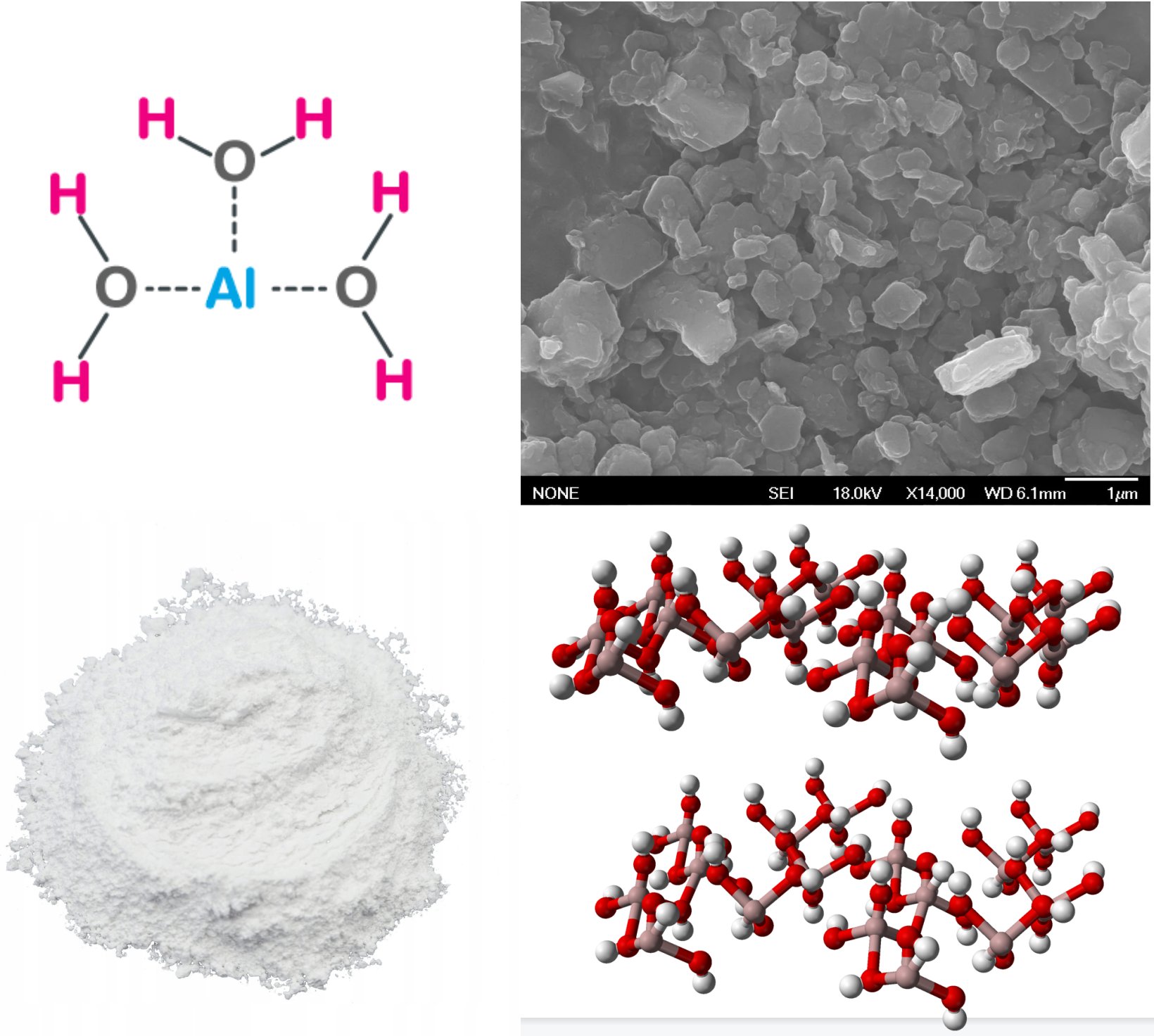
Aluminium trioxide: molecule (top left), powder (bottom left), double layers of hydroxyl groups with intercalated aluminium ions (bottom right), SEM of aerosol samples (top right) | Various sources
Identifiers

logo CAS Number
21645-51-2
logo EC Number
244-492-7
logo ECHA InfoCard
100.040.433
logo IUPAC Name
Aluminium Hydroxide
logo PubChem ID
10176082
Chemical Data

Chemical Formula

    Al(OH)3

Molecular Weight (g/mol)
78
Sulfur Content (wt%)
0
Specific Gravity
2.42
Crude Data

API Gravity
-73.03
Country
Product Settings

Default
Status
A
Content provided by
Transaction Name Date
Modified by UserPic   Kokel, Nicolas 2/26/2026 1:24 PM
Added by UserPic   Kokel, Nicolas 2/26/2026 12:27 PM