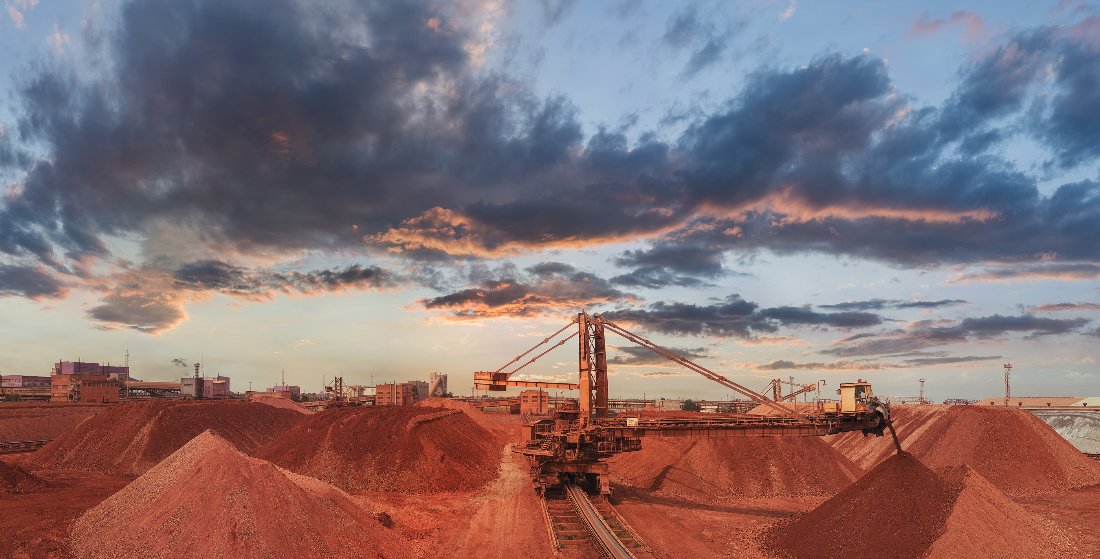

Bauxite is the world's primary source of aluminium and one of the most strategically important industrial minerals globally. It is not a single mineral but a heterogeneous sedimentary rock composed predominantly of aluminium hydroxide minerals, formed by the intense weathering (lateritisation) of aluminium-rich source rocks in tropical and subtropical climates.
Mineralogical Composition
Bauxite consists of a mixture of three principal aluminium-bearing minerals in varying proportions:
- Gibbsite — Al(OH)₃; the most easily processed phase, dominant in tropical lateritic deposits
- Boehmite — γ-AlO(OH); requires higher processing temperatures than gibbsite
- Diaspore — α-AlO(OH); the hardest to process, common in deposits in China, Greece, and Turkey
These are accompanied by accessory minerals including iron oxides (goethite, hematite), silica, titanium dioxide, and clay minerals, which constitute the impurity fraction.
Key Physical Properties
| Property |
Value |
| Appearance |
Reddish-brown to cream, porous rock |
| Al₂O₃ content |
40–60 wt% |
| SiO₂ content (reactive) |
1–10 wt% |
| Fe₂O₃ content |
2–25 wt% |
| Hardness (Mohs) |
1–3 |
| Density |
2.0–2.6 g/cm³ |
| Moisture content |
5–30 wt% |
Geological Classification
Bauxite deposits are classified by their geological origin into two main types:
- Lateritic bauxite — formed by deep weathering of silicate rocks (basalt, granite, gneiss) in tropical regions; accounts for ~90% of world reserves; typically gibbsite-dominant; found in Australia, Guinea, Brazil, Jamaica, and India
- Karst bauxite — formed on carbonate (limestone/dolomite) bedrock; typically boehmite or diaspore-dominant; found in Mediterranean countries (Greece, Croatia), China, and the Caribbean
Production & Processing
Bauxite is processed almost exclusively via the Bayer Process to produce alumina (Al₂O₃), which is then smelted to primary aluminium via the Hall–Héroult Process. The Bayer Process involves digesting crushed bauxite in hot caustic soda (NaOH) under pressure, separating the resulting sodium aluminate liquor from the insoluble residue (red mud), and precipitating aluminium hydroxide which is then calcined to yield alumina. Approximately 4–5 tonnes of bauxite are required to produce 2 tonnes of alumina, which in turn yields 1 tonne of aluminium metal.
Commercial Grades
| Grade |
Primary Use |
Metallurgical
(Met-grade) |
Bayer Process → alumina → aluminium smelting
(~90% of consumption) |
| Chemical grade |
Production of aluminium chemicals and speciality aluminas |
| Refractory grade |
High-temperature refractory bricks, castables, and kiln furniture |
| Abrasive grade |
Fused alumina abrasives for grinding wheels and sandpaper |
| Cement grade |
High-alumina (calcium aluminate) cement production |
World Reserves & Production
Guinea holds the world's largest bauxite reserves (~26% of global total), followed by Australia, Vietnam, Brazil, and Jamaica. World mine production exceeds 400 million tonnes per year, with the majority destined for metallurgical-grade alumina production. Australia's major deposits at Weipa and Amrun in Queensland are among the world's highest-grade, averaging 49–53% Al₂O₃.
References
- The Aluminium Association. Bauxite 101 (Accessed Feb 24, 2026)
- Britannica. aluminium processing > ores (page version: Sep 19, 2018)
- Wikipedia. Bauxite (page version: Dec 31, 2025)
- Arkansas Geological Survey. Bauxite (Accessed Feb 24, 2026)
- European Commission, Joint Research Centre (2020). Aluminium and Bauxite: Critical Raw Materials Factsheet
- Geoscience Australia. (Dec 18, 2023). Bauxite
- Geology.com. Bauxite (Accessed Feb 24, 2026)
- The Bauxite Index (Jan 23, 2020). Bauxite 101
- U.S. Geological Survey (USGS). Bauxite and alumina statistics and information (Accessed Feb 24, 2026)
- ScienceDirect Topics. Bauxite deposits (Accessed Feb 24, 2026)