
Product
Wet Gas
Names
Rich Gas; Casinghead Gas; Associated Gas; Raw Natural Gas; Unprocessed Natural Gas
Link
https://www.britannica.com/science/wet-gas
Insight Articles
#PS163
wetgas naturalgas richgas casingheadgas associatedgas rawnaturalgas unprocessednaturalgas
Main Product
Natural Gas
Segment
Extractive Industry Products
Main-Family
Fossil Hydrocarbons
Sub-Family
Gaseous Feedstock
Physical State

Gas

Description

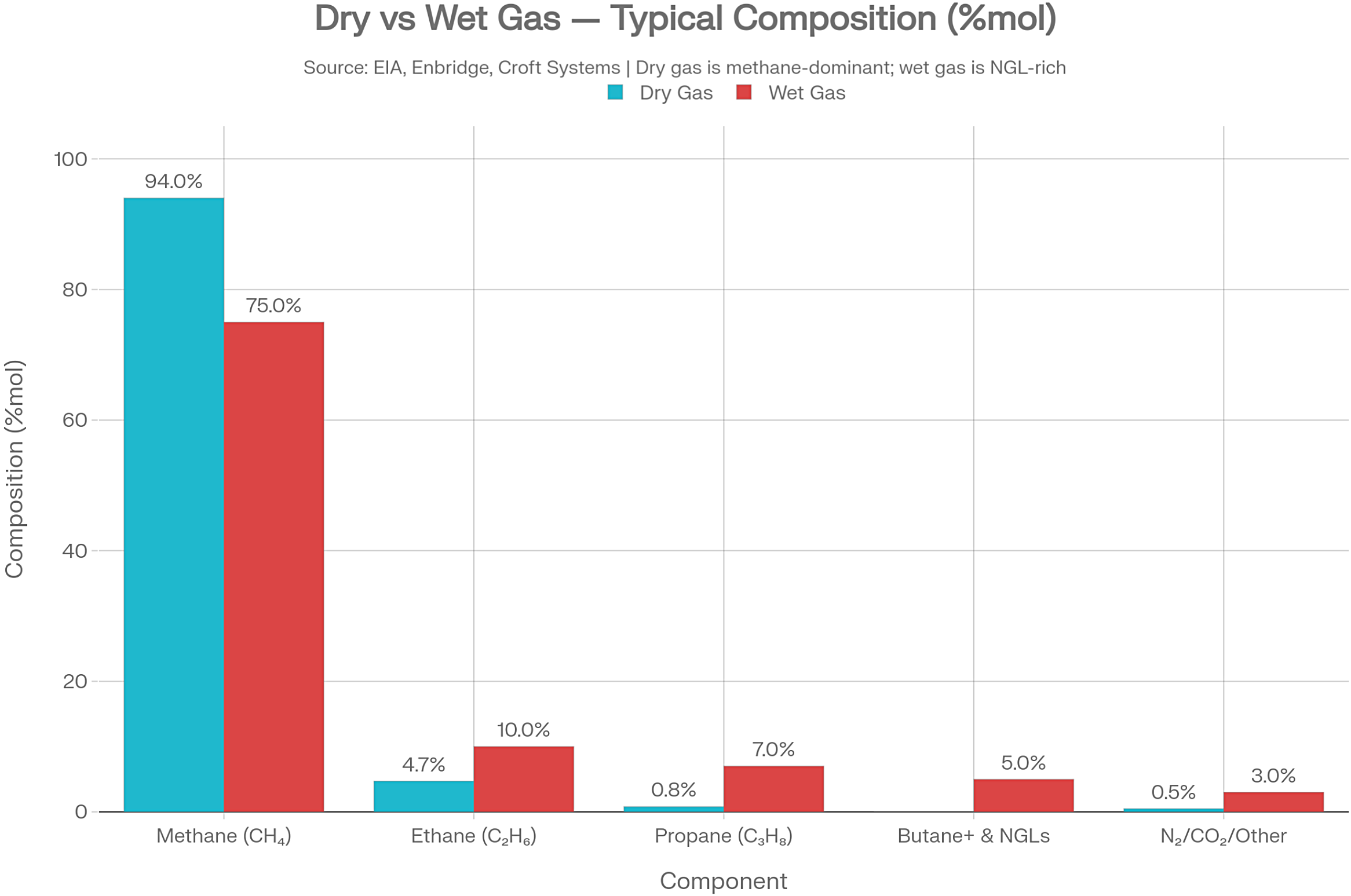
Wet Gas is a naturally occurring mixture of hydrocarbon compounds in which methane (CH₄) is the dominant component, but which contains an appreciable proportion of heavier hydrocarbons — principally ethane (C₂H₆), propane (C₃H₈), butane (C₄H₁₀), and pentanes (C₅H₁₂) — as well as non-hydrocarbon impurities such as water vapor, CO₂H₂S, and nitrogen.


Component Typical Content (%mol)
Methane (CH₄) 70–85% ​
Ethane (C₂H₆) 5–10% ​
Propane (C₃H₈) 3–7% ​
Butane (C₄H₁₀) 1–5% ​
Pentane+ / NGLs 1–3% ​
N₂, CO₂, H₂S Trace to minor ​

Wet gas typically contains less than 85% methane by volume, with the remaining fraction comprising Natural Gas Liquids (NGLs) that are condensable at surface conditions of temperature and pressure. In the United States, a gas is formally classified as wet if it contains more than 0.1 gallon of condensables per 1,000 cubic feet of produced gas. Producing gas-to-condensate ratios are typically above 10,000 v/v (50,000 scf/STB), distinguishing wet gas from both dry gas (GOR > 100,000 scf/STB) and gas condensate.


Property Value
NGL content > 0.1 gal per 1,000 scf of gas ​
Gas-to-Condensate Ratio > 10,000 v/v (50,000 scf/STB) ​
Condensate colour Typically water-white, low specific gravity ​
Reservoir phase Single-phase gas in reservoir;
liquid dropout occurs at surface ​
Lockhart–Martinelli parameter (χ) 0 < χ < 0.3 (distinguishes wet gas
from multiphase flow) ​
Standard conditions 15°C (59°F), 750 mmHg 

In the reservoir, wet gas exists entirely in the gaseous phase and does not drop out condensate during depletion; however, separator conditions at the surface fall within the phase envelope, yielding liquid condensate and NGLs upon production. The condensate produced is typically water-white with a low specific gravity. Wet gas reservoirs are commonly produced by simple blow-down, similar to dry gas reservoirs.​

After field processing, the extracted NGLs — ethane, propane, butane, and natural gasoline — are separated and marketed independently as petrochemical feedstocks, LPG, or gasoline blending components, while the residual lean gas (essentially dry gas) is delivered to the consumer pipeline grid.


References

  1. U.S. Energy Information Administration (eia). Glossary: Wet natural gas (Accessed Mar 22, 2026)
  2. Britannica. wet gas (Page version: Nov 30, 2017)
  3. ScienceDirect. WetGas (Accessed Mar 22, 2026)
  4. Schlumberger Limited (slb). Energy Glossary: wet gas (Accessed Mar 22, 2026)
  5. Welker. Wet Natural Gas (Accessed Mar 22, 2026)
  6. UtilitySmarts (Dec 4, 2021). What Is Wet Natural Gas?

Insight Articles
Your insights will be shown here

  Product Communicator
Identifiers

logo CAS Number
68410-63-9
Chemical Data

Molecular Weight (g/mol)
21.8
Specific Gravity
0.75
Crude Data

API Gravity
56.42
Country
Product Settings

Default
Status
A
Content provided by
Transaction Name Date
Modified by UserPic   Kokel, Nicolas 3/22/2026 10:13 AM
Added by UserPic   Kokel, Nicolas 9/28/2021 9:58 AM