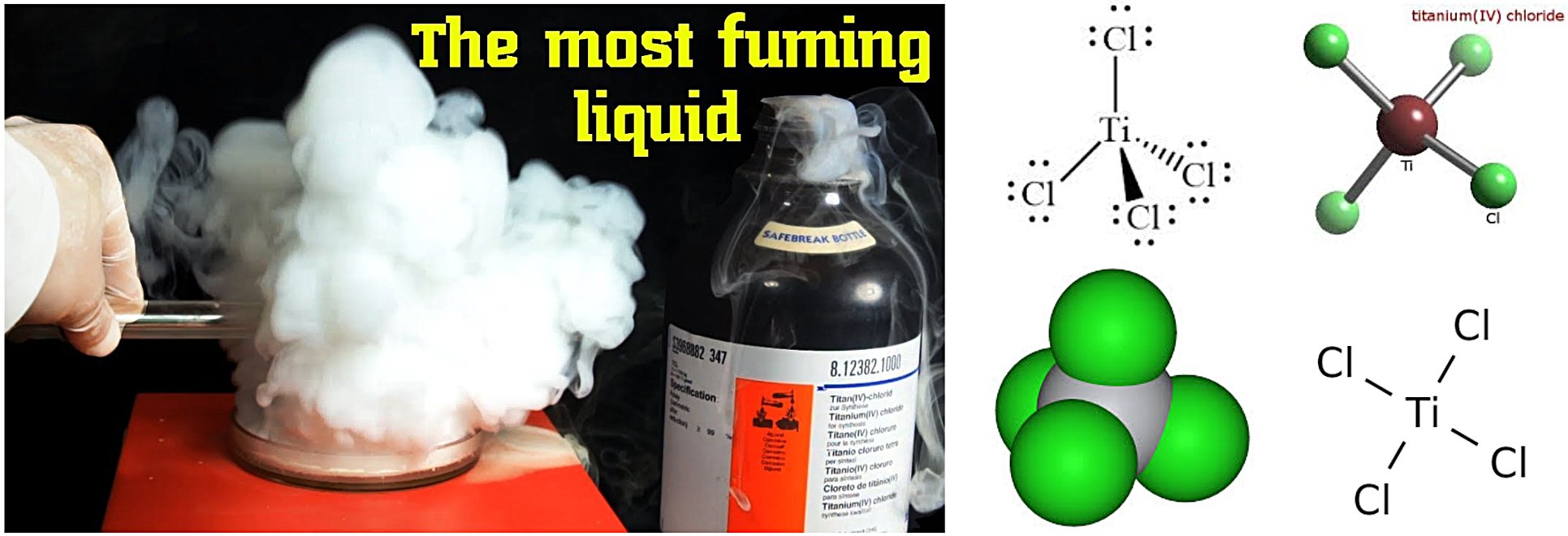
Titanium tetrachloride (TiCl₄) is a colorless to light yellow, volatile liquid with a penetrating acidic odor and a molecular weight of 189.68 g/mol. It possesses a melting point of -25°C, a boiling point of 135-136°C at atmospheric pressure, and a density of 1.73 g/mL at 20°C. The compound has a refractive index of 1.61, a dielectric constant of 40.0, critical temperature of 464.8°C, and critical pressure of 46.6 atm. TiCl₄ is extremely moisture-sensitive and reacts vigorously with humid air, producing dense white fumes composed of titanium dioxide and hydrogen chloride. It is soluble in ethanol and functions as a strong Lewis acid.
Production of TiCl₄
Titanium tetrachloride is primarily produced through the carbochlorination of titanium-bearing ores such as rutile (TiO₂), ilmenite (FeTiO₃), or titanium slag. The process involves reacting the titanium ore with chlorine gas in the presence of a solid carbon reducing agent at elevated temperatures according to the reaction:
TiO₂ + 2Cl₂ + C → TiCl₄ + CO₂
The chlorination is typically performed in a fluid-bed reactor at temperatures between 800-1000°C, where the ore is mixed with petroleum coke or other carbonaceous materials. Natural rutile (approximately 95% TiO₂) is the preferred feedstock due to its high titanium content, while ilmenite requires beneficiation to increase titanium concentration before chlorination.
Production of Titanium Metal
Titanium tetrachloride serves as the critical intermediate in producing the world's supply in excess of 250,000 tonnes per year of titanium metal in 2023. The conversion is accomplished through the Kroll process, where TiCl₄ is reduced with magnesium metal according to the reaction:
2 Mg + TiCl₄ → 2 MgCl₂ + Ti
An alternative Hunter process uses liquid sodium as the reducing agent. This titanium metal is subsequently processed into lightweight, corrosion-resistant alloys used extensively in aerospace applications for aircraft frames, engine parts, and defense equipment.
Titanium Dioxide Pigment Manufacturing
TiCl₄ is a key raw material in manufacturing titanium dioxide (TiO₂) pigments through the chloride process. The process involves converting TiCl₄ into high-purity titanium dioxide through oxidation:
TiCl₄ + O₂ + heat → TiO₂ + 2 Cl₂
This white pigment is used extensively in paints, coatings, plastics, paper, and automotive applications, where it enhances durability, brightness, opacity, weather resistance, and aesthetic appeal. The pigment production sector represents one of the largest industrial uses of titanium tetrachloride.
Catalysis and Chemical Synthesis
Titanium tetrachloride functions as a catalyst in various chemical reactions, capitalizing on its Lewis acidity, oxophilicity, and electron-transfer properties. It is employed in Ziegler-Natta polymerization for producing polyolefins such as polyethylene and polypropylene, where it accelerates reactions while reducing energy consumption and increasing yields. In organic synthesis, TiCl₄ is used in Lewis acid-catalyzed aldol additions and Friedel-Crafts alkylation reactions. Key to these applications is TiCl₄'s tendency to activate aldehydes through formation of adducts such as (RCHO)TiCl₄OC(H)R.
Specialty Applications
TiCl₄ finds use in producing artificial pearls and iridescent glass, where it creates colored glass effects. In the textile industry, it serves as a mordant or dye-fixing agent that improves color fastness and durability of dyed fabrics. The compound is utilized in chemical vapor deposition (CVD) processes to deposit thin films of titanium dioxide or titanium nitride onto substrates for electronics, optics, and coatings applications. In water treatment, titanium compounds derived from TiCl₄ are employed in filtration membrane synthesis to remove contaminants and improve water quality.
Military and Smoke Generation
Historically, titanium tetrachloride has been used by the military to produce smoke screens. When dispersed in air, it reacts with atmospheric moisture to generate dense white smoke composed of titanium dioxide and hydrogen chloride, effectively obscuring visibility.
Sources: Gov.uk, Wikipedia (TiCl₄), Linkedin, Qinhuangdao Polytech Industrial Products Co., Ltd, Chemical Book, Riverland Trading, turito, TDMA, Merck, Canyon Components, US EPA, Polyolefins Journal, US Patent US3261664A, Wikipedia (Chloride process)