Tuapse Refinery: Battleground, Bottleneck, and Geopolitical Flashpoint


Tuapse Sea Port | Source: RestGeo
Market Insights | ppPLUS Intelligence Series • Geopolitics & Supply Chains | May 2026
The Attack Chronology: Four Strikes in Sixteen Days
The Tuapse refinery has endured a continuous series of Ukrainian drone strikes since 16 April 2026, in what stands as the most intense and sustained campaign against a single Russian energy facility since the war began.
| Date | Strike | Confirmed Damage |
|---|---|---|
| 16 April 2026 | Strike 1 | Refinery pier and power plant damaged; CDU-12 shutdown; fire burns four days |
| 20 April 2026 | Strike 2 | 24 storage tanks destroyed, 4 more damaged; massive fire reignited |
| 28 April 2026 | Strike 3 | Tank farm fire; residential evacuations ordered; oil spill into Black Sea |
| 1 May 2026 | Strike 4 | Sea terminal reignited within 24 hours of MChS declaring fires extinguished; further tank fires confirmed |
Russian Deputy Prime Minister Alexander Novak confirmed on 29 April that the full extent of the damage had not yet been assessed and that restoration timelines remained unknown: "It is quite a complex situation there — once the firefighting is finished, specialists will need to assess the situation, the extent of the damage, and the possible timeline for restoration." The fourth strike on 1 May rendered that assessment moot before it could begin, as fires that had just been declared extinguished were reignited.
The cumulative toll is severe. Beyond the 24 confirmed destroyed storage tanks and associated infrastructure, the strikes triggered a major fuel oil spill stretching over 10,000 square metres of Black Sea surface, prompting local environmental emergency declarations. Residents reported "black rain" — oily combustion residue coating buildings, vehicles, and streets — and air quality alerts were issued for benzene and xylene. Three civilians, including a 14-year-old girl, have lost their lives.
Ukraine's Security Service confirmed the operations were carried out by its Special Operations Centre Alpha, in coordination with Defence Intelligence and the Unmanned Systems Forces, framing the strikes as targeting infrastructure that directly finances Russia's military operations.
Modernisation Frozen: Phase 3 Deferred Indefinitely
The attacks find a refinery already structurally incomplete. Rosneft's three-phase modernisation programme — designed to transform Tuapse from one of Russia's least complex refineries into a world-class deep-conversion facility — has stalled at Phase 2.
| Phase | Scope | Status |
| Phase 1 | ELOU-AVT-12 crude distillation unit (12 Mt/yr) | ✅ Commissioned October 2013 |
| Phase 2 | VGO hydrocracking, diesel hydrofining, sulfur recovery, catalytic reforming, isomerization |
✅ Substantially complete |
| Phase 3 | Flexicoking™ unit — heavy residue conversion (50 kb/d, ExxonMobil licence) |
⛔ Not started — deferred indefinitely |
The Flexicoking™ unit was the centrepiece of the upgrade: a licensed ExxonMobil process that would have converted the refinery's vacuum residue into high-value distillates and fuel gas, raising the Nelson Complexity Index from 3.2 to 9 and refining depth to 98.7% and would also have made Tuapse the only Flexicoking unit in Russia.
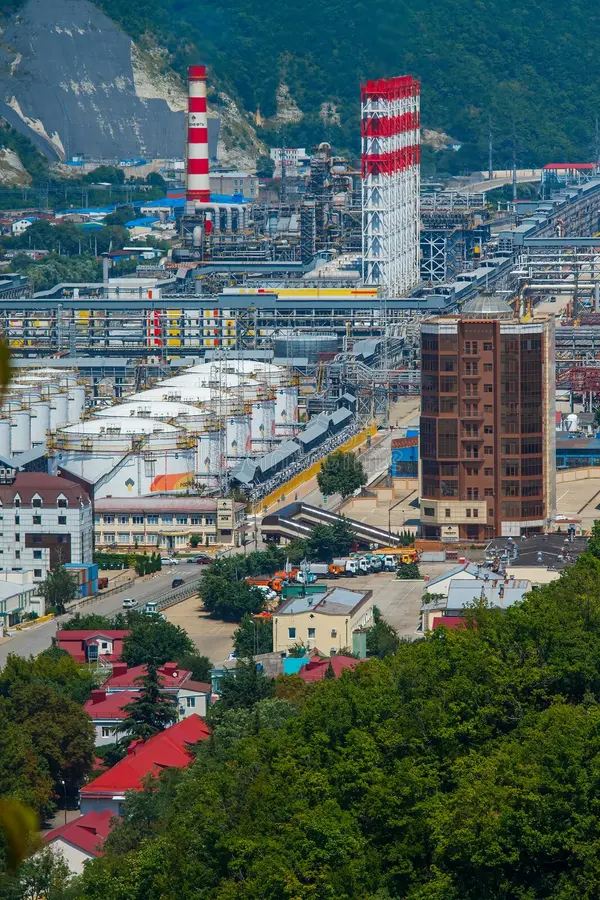
Russia Tuapse Oil Refinery | Dreamstime (Jul 7, 2022)
Phase 3 never broke ground. Successive Western sanctions packages following the conflict outbreak in February 2022 progressively restricted technology transfer, engineering services, equipment supply, and project financing. The EU designation of LLC RN-Tuapse Oil Refinery under its Ukraine sanctions regime on 23 April 2026 — announced in the middle of the April attack sequence — extinguished any remaining prospect of near-term progress. With Western technology licensors bound by Western export controls and unable to service the licence, Phase 3 is not merely delayed but structurally impossible under the current geopolitical architecture.
As has become a pattern across Russia's sanctioned industrial sectors, Rosneft will inevitably be evaluating alternative resid conversion technologies outside the reach of Western export controls — most likely from Chinese licensors or through domestically developed processes.
The Tuapse Infrastructure Complex: Russian-Owned, Internationally Entangled
A critical dimension rarely acknowledged in media coverage is that the broader Tuapse energy corridor is not exclusively Russian. The port and pipeline infrastructure serving the Black Sea coast hosts flows that matter directly to Western interests.
The Caspian Pipeline Consortium (CPC) operates a 1,510 km pipeline transporting Kazakh crude oil from the Tengiz and Kashagan fields to its Yuzhnaya Ozereevka marine terminal near Novorossiysk — some 80 km from Tuapse — where the oil is loaded onto export tankers for international markets. This pipeline carries approximately 80% of Kazakhstan's total crude oil exports, representing roughly 1.5% of global oil supply.
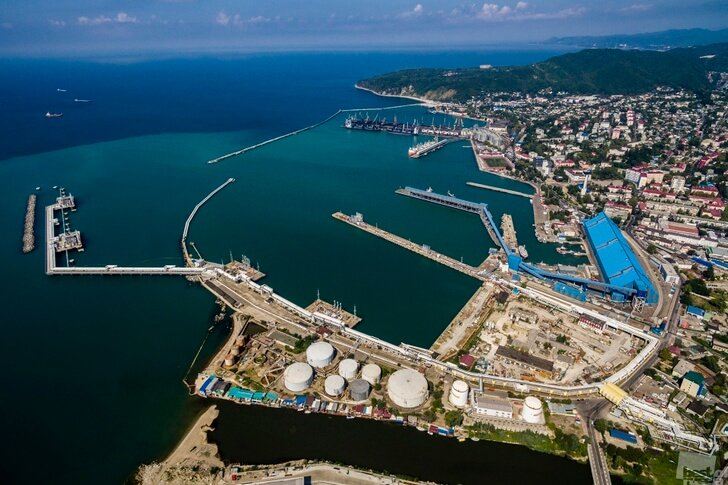
Tuapse Sea Port | Source: RestGeo
The CPC's shareholder structure is notably Western-weighted:
| Shareholder | Stake |
| Russian government (via Transneft/CPC-R) | 24.0% |
| Chevron Caspian Pipeline Consortium Company | 15.0% |
| LUKARCO B.V. (LUKoil) | 12.5% |
| Mobil Caspian Pipeline Company (ExxonMobil affiliate) | 7.5% |
| Rosneft-Shell Caspian Ventures | 7.5% |
| BG Overseas Holdings (Shell) | 2.0% |
| Kazakhstan (KazMunayGas affiliates) | ~20.75% |
| Other | ~10.75% |
Chevron holds a 50% stake in the Tengiz field and ExxonMobil holds 25%, meaning US oil majors have direct upstream and pipeline equity interests in the crude that flows through this Black Sea corridor. Ukraine struck the CPC terminal at Novorossiysk on 6 April 2026, prompting Russia's Defence Ministry to accuse Kyiv of "intentionally attacking the infrastructure of the Caspian Pipeline Consortium to inflict maximum economic harm on its largest shareholders — energy firms from the United States and Kazakhstan."
Kazakhstan's government was sufficiently alarmed to issue a formal diplomatic statement warning Ukraine against attacking what it characterised as "purely civilian infrastructure," and began rerouting crude exports to mitigate the disruption.
The Druzhba Dimension: Kazakh Oil, German Fuel, and a New Weapon
A parallel and directly related development has transformed the geopolitical calculus around the Tuapse corridor. Since 2023, and accelerating through 2025, Kazakhstan has been using the northern branch of the Druzhba pipeline — which runs through Russia, Belarus, and Poland to the PCK Schwedt refinery near Berlin — as a route to supply German refineries with Kazakh crude, providing Germany with a replacement for Russian oil following its post-invasion embargo.
Kazakhstan's exports to Germany via Druzhba grew from approximately 1 million tonnes in 2023 to 2.146 million tonnes per year (43,000 bpd) in 2025, a 44% year-on-year increase, and plans had been announced to expand this to 2.5 million tonnes in 2026. The PCK Schwedt refinery — Germany's largest, supplying the majority of Berlin's fuel — had come to rely on Kazakh crude for approximately 17–25% of its total intake.
On 22 April 2026, Deputy Prime Minister Novak stated that Russia planned to halt all Kazakh oil transit to Germany via Druzhba from 1 May: "Starting from May 1, volumes of Kazakh oil previously supplied via the Druzhba pipeline to Germany will be redirected to other available logistics routes. The Germans have given up on Russian oil, so they are doing fine."
Russia framed this as a "technical" redirection, but the timing — simultaneous with the April attack campaign on Tuapse and the related CPC Novorossiysk terminal strikes — makes the geopolitical signalling unmistakable. The Kazakh oil will now be redirected to tanker loading via the Black Sea ports, including Tuapse and Novorossiysk, increasing the strategic importance of these terminals precisely as they come under drone attack.
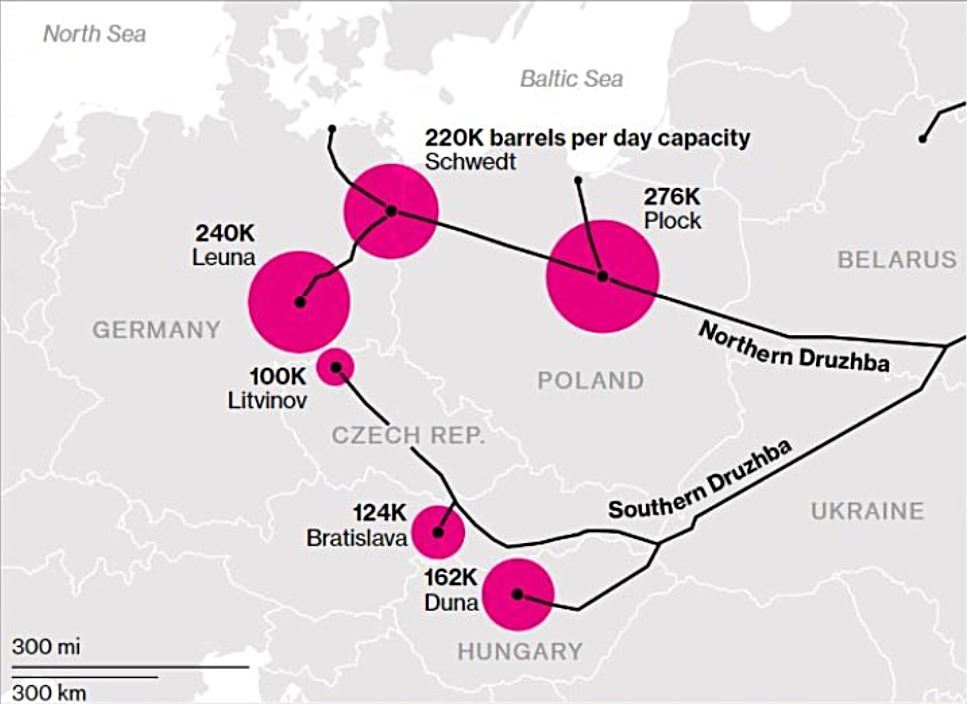
Germany's eastern refineries depend on pipeline crude from Kazakhstan routed through Russia
The German government stated that supply security was "not at risk" given alternative routing options via Gdansk and Rostock, but Brandenburg politicians described the situation as "serious, even dramatic" for the Schwedt refinery. The PCK Schwedt refinery, it should be noted, is partially owned by Rosneft Deutschland — subject to German state trusteeship since September 2022 — adding a further layer of entanglement between Russian state energy assets and European supply infrastructure.
Western Pressure: The Signal Ukraine Received
By early April 2026, the frequency of Ukrainian strikes on Russian oil infrastructure had become a source of direct friction between Kyiv and its Western backers. Multiple Western governments communicated — through official and informal channels — that sustained attacks on Russian export refineries and port terminals were contributing to global oil price inflation at a moment already destabilised by Middle East supply disruptions.
Ukraine publicly acknowledged receiving these signals, while maintaining that its targeting decisions reflected its own strategic imperatives. Despite the defiant public posture, the diplomatic subtext was clear: Western appetite for authorising continued strikes on Black Sea energy infrastructure was diminishing, in part because the same corridor serves the financial interests of US and European energy majors invested in the Caspian Pipeline Consortium.
The convergence of Western restraint signals, active US-Russia ceasefire diplomacy, and direct Western equity exposure in the Novorossiysk–Tuapse corridor creates a coherent, if unspoken, logic for a reduction in attacks on Black Sea energy infrastructure — one that Ukraine's military command would find difficult to ignore indefinitely, regardless of its public position.
Repair and Recovery: An Uncertain Timeline
With fires reignited on 1 May before any formal damage assessment had begun, the recovery timeline for Tuapse remains entirely open-ended. Historical precedent from the refinery's own recent experience provides some benchmark:
-
January 2024 strike: CDU-12 shutdown; repairs completed by end of April 2024 — approximately three months for primary unit restoration
-
May 2024 strike: Minor damage; unit technically ready to restart but held idle until mid-June due to poor export economics for refined products vs. crude
-
November 2025 strike: Operations suspended; tankers rerouted to Novorossiysk
The April–May 2026 campaign is categorically more severe than any prior episode: 24 storage tanks confirmed destroyed, pier infrastructure damaged, power plant affected, and environmental contamination requiring active remediation. A conservative estimate for partial operational restoration — assuming no further strikes — would be six to twelve months. Full recovery, including tank farm reconstruction, would likely extend to eighteen months or beyond, assuming sanctions do not prevent procurement of replacement equipment.
Meanwhile, Rosneft has been diverting crude originally destined for Tuapse to other Black Sea facilities, including its own Novorossiysk terminal, as the port remains non-operational for tanker loading.
Strategic Synthesis: A Node Under Permanent Pressure
The Tuapse refinery's predicament reflects a broader structural shift in how energy infrastructure functions as a strategic asset in a prolonged industrial conflict. Several converging dynamics are now permanent features of the Tuapse situation:
-
Physical vulnerability: Four strikes in sixteen days against a single facility underscore the evolving asymmetry between long-range drone strike capabilities and the practical limits of point-defence systems protecting dispersed energy infrastructure across an extended coastline.
-
Sanctions-induced capability gap: Phase 3 modernisation is indefinitely frozen — the Flexicoking unit that would have made Tuapse a world-class facility will not be built under current geopolitical conditions, encouraging the pursuit of technological independence or reliance on alternative technologies outside the reach of Western export controls.
-
Multi-party entanglement: The same Black Sea corridor serves Kazakh crude (backed by Chevron and ExxonMobil equity), German fuel supply (via the PCK Schwedt pipeline), and Russian export revenues simultaneously — creating powerful incentives for Western restraint on Ukrainian strike authorisations
-
Druzhba as leverage: Russia's decision to halt Kazakh oil transit to Germany via Druzhba from May 2026 signals a willingness to use energy corridor access as a geopolitical instrument, with tanker rerouting through Black Sea ports as the alternative — increasing the strategic value of Tuapse's port infrastructure
-
Oil price transmission: Each successful strike on Black Sea export infrastructure tightens global product supply, increases insurance and freight costs, and adds a risk premium to crude prices, while simultaneously damaging Western consumers' fuel costs
Note: ppPLUS strategic assessments are our own. This article builds upon: Reuters, BBC News, Al Jazeera, EFE, Radio Free Europe / Radio Liberty, ABC News Australia, TASS, Hydrocarbon Processing, Hellenic Shipping News, Marine Insight, Global Energy Flow, Caspian Post, Baird Maritime, OilPrice.com, The Diplomat, The Moscow Times, Brussels Signal, Astana Times, UNN, Kyiv Independent, Pravda Ukraine, ICIJ, Business & Human Rights Resource Centre, Rosneft, EU Sanctions Tracker, OpenSanctions.