Podcast Part 3 of the Indian Dream Refinery Project - Technology Selection & Project Front-End Engineering
Podcast Part 3 of the Indian Dream Refinery Project - Technology Selection & Project Front-End Engineering
Podcast Part 3 of the Indian Dream Refinery Project - Technology Selection & Project Front-End Engineering
Podcast Part 3 of the Indian Dream Refinery Project - Technology Selection & Project Front-End Engineering
Podcast Part 3 of the Indian Dream Refinery Project - Technology Selection & Project Front-End Engineering
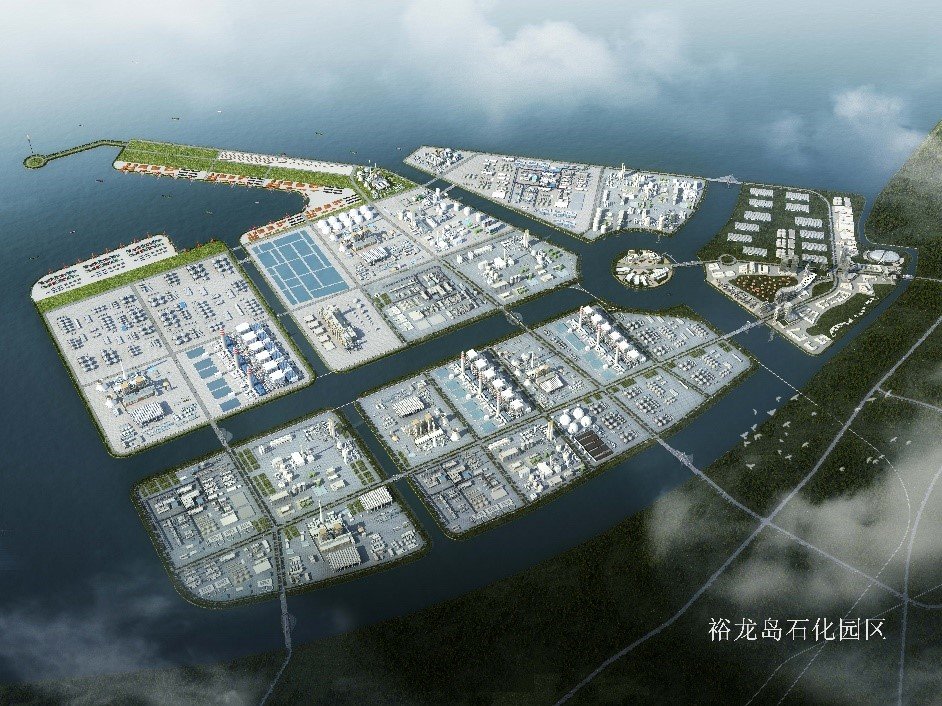
Yulong Island Petrochemical Park | Source: Tialoc Group (March 2024)
The Yulong Island Refining and Chemical Integration Project was born not from a single corporate vision but from a state-directed industrial rationalisation imperative. Shandong Province — historically China's largest concentration of independent or "teapot" refineries — operated over 130 million tonnes per year of fragmented, inefficient, and environmentally substandard refining capacity spread across dozens of small operators. The Yulong project was conceived as a consolidation instrument: a single world-scale complex that would absorb and replace 26.96 million tonnes per year of this dispersed capacity, eliminating 11 independent refineries and reducing provincial coal consumption by 750,000 t/y and CO₂ emissions by 4–5 million tonnes annually.
The project was formally included in China's 14th Five-Year Plan (2021–2025) as a key national productivity layout project, elevating it from a provincial initiative to a strategic national priority. Construction commenced on October 24, 2020, with a declared Phase I investment of approximately RMB 116.8 billion (~USD 16 billion) and an optimistic 24-month construction target — a timeline that ultimately proved unrealistic, with meaningful production only commencing in late 2024.
The shareholding structure of Shandong Yulong Petrochemical Co., Ltd. is itself a policy statement:
| Shareholder | Stake | Nature |
|---|---|---|
| Nanshan Group Co., Ltd. | 51.0% | Private (aluminium, textiles, aviation) |
| Shandong Energy Group Co., Ltd. | 46.1% | State-owned (coal mining, energy) |
| Wanhua Industrial Group + Hualu Holding Group | 2.9% | State-linked enterprises |
Source: Nanshan Group SSE Bond Prospectus, filed 7 March 2025
The lead investor Nanshan Group is a privately-owned conglomerate from Longkou City — the same municipality where Yulong Island is located — with no prior experience in petroleum refining. The second-largest shareholder Shandong Energy Group is a Shandong provincial state-owned enterprise 70% owned by the Shandong SASAC — its presence in the ownership structure is neither incidental nor passive. Shandong Energy is also the co-developer — together with East China University of Science and Technology (ECUST) — of the OMB CWS multi-nozzle opposed coal gasification technology deployed within the complex itself, creating a direct shareholder-technology nexus that is unique among the world's major refinery projects. The "mixed ownership" model — private lead investor, dominant state co-investor, provincial government direction — was explicitly cited as one of the project's defining structural characteristics, allowing Yulong to operate with quasi state-enterprise status, accessing financing and institutional relationships unavailable to purely private teapot refiners.
The original 2020 Environmental Impact Assessment (EIA) document defined a Phase I scope of extraordinary breadth, organised around a 20 Mt/y crude oil refining backbone feeding an exceptionally deep petrochemical integration. The headline capacities:image.jpg+2
Crude distillation: 2 × 10 Mt/y (atmospheric + vacuum)
Ethylene: 2 × 1.5 Mt/y steam crackers = 3.0 Mt/y
Mixed xylenes / PX: 3.0 Mt/y aromatics complex
Polyethylene: 2.25 Mt/y (7 lines across multiple technologies)
Polypropylene: 2.1 Mt/y (5 lines across 3 technologies)
DCC-plus catalytic cracking: 4.0 Mt/y
The scope was subsequently expanded by a 2022 supplementary EIA to include an additional 450,000 t/y HDPE unit, synthetic rubber complex (SSBR, BR), and additional downstream units, pushing Phase I nameplate petrochemical capacity well beyond the original plan and total investment to approximately RMB 127.4 billion.
A comparison with early announcements reveals systematic scaling of original figures: the 2020 EIA stated the EVA/LDPE tubular line at 400,000 t/y; the contracted LyondellBasell Lupotech T licence was signed for 300,000 t/y. Several units originally designated for domestic Chinese technology such as (EO/EG, aromatics complex) were subsequently relicensed to international technology providers — reflecting a post-EIA optimisation phase common to China's mega-projects.
Most headline analyses of Yulong focus on its crude oil processing capacity. This misses what is arguably the project's most distinctive structural feature: its deliberate dual-feed architecture combining crude oil and coal as a parallel hydrogen source.
The coal-based infrastructure at Yulong is substantial in its own right:
3 × ECUST OMB CWS coal gasification units, each processing 3,000 TPD coal at 6.5 MPa — commissioned September 1, 2024
22,000 Nm³/h coal-based hydrogen production with associated shift conversion, low-temperature methanol wash (Rectisol), and PSA purification
6 PSA hydrogen purification units in total, described as the world's largest single-site PSA hydrogen production group
4 × 150,000 t/y sulphur recovery trains (600,000 t/y total capacity), processing H₂S from both crude oil-derived and coal gasification streams
The coal gasification trains supply a significant portion of the hydrogen demand for the complex's extensive hydroprocessing units — including 3 × 260,000 t/y residue hydroprocessing units, a 340,000 t/y diesel hydroprocessing unit, a 360,000 t/y diesel hydrocracking unit, and a 200,000 t/y wax oil hydrocracker. This is not a cosmetic addition: by covering hydrogen supply through coal rather than steam reforming of natural gas or hydrogen purchased externally, Yulong secures feedstock independence for its refinery operations within a province that has abundant coal but limited natural gas infrastructure.
Yulong represents the deepest crude-to-chemicals integration in China's refining history, explicitly targeting a chemicals yield of up to 67.3% of crude throughput — a figure derived from RIPP's own DCC-plus research benchmarking. The product slate spans virtually every major petrochemical chain:
Olefins chain: Ethylene (3.0 Mt/y from steam crackers + ~224,000 t/y from DCC-plus) → polyethylene (2.25 Mt/y across LLDPE/HDPE/FDPE/UHMWPE), EVA/LDPE (0.5 Mt/y), ethylene oxide / ethylene glycol (1.02 Mt/y MEG), ethylbenzene / styrene (0,5 Mt/y).
Propylene chain: DCC-plus (~820,000 t/y) + steam cracker propylene (> 1,2Mt/y) → polypropylene (2.1 Mt/y across 5 lines), acrylonitrile (130,000 t/y).
Aromatics chain: UOP aromatics suite (3.0 Mt/y PX/mixed xylenes), benzene, toluene
C4 chain: Butadiene extraction (2 × 220,000 t/y), MTBE/butene-1, synthetic rubber (SBR, BR)
Specialties: UHMWPE (100,000 t/y), ABS (600,000 t/y), SSBR
This breadth is extraordinary: no single refinery complex in China simultaneously produces ethylene glycol, acrylonitrile, UHMWPE, ABS, EVA, and Styrene at this scale from a single crude oil feedstock.
One of the most analytically interesting aspects of the Yulong project is its rejection of any single technology licensor's ecosystem in favour of best-in-class selection across all process units. The technology selection map reads as a comprehensive survey of the global petrochemical licensing landscape:
Western licensors confirmed:
Honeywell UOP — CCR Platforming, complete aromatics suite (Sulfolane, Isomar, Tatoray, ORP), naphtha hydrotreating
Lummus Technology — 2 steam crackers, EB/SM (EBOne + Classic SM), 2 PP lines (2× Novolen), master licensor scope
LyondellBasell — Lupotech T EVA/LDPE tubular (300,000 t/y)
Scientific Design (SABIC/Clariant JV) — EO/EG units
JPP (Japan Polypropylene Corporation) — 1 PP line (Horizone technology)
Univation — 2 × Unipol LLDPE/HDPE swing lines
Chinese domestic technologies confirmed:
RIPP DCC-PLUS — 4.0 Mt/y catalytic cracking
RIPP MIP-CGP — 300,000 t/y gasoline-mode catalytic reforming
RIPP MHUG — 340,000 t/y diesel hydroprocessing
ECUST OMB CWS — 3 × coal gasification units
Sinopec S-Zorb — gasoline desulfurisation
Sinopec ST-PP-II — 2 PP lines
Hangzhou Shuang'an Technology Three-Loop Slurry HDPE Process — 450,000 t/y HDPE line
This pluralism is deliberate policy: it prevents over-reliance on any single licensor, enables benchmarking across competing technologies, and aligns with China's national technology strategy of pairing international best-in-class with domestic alternatives to accelerate technology absorption.
Yulong's crude oil strategy was designed around Middle Eastern heavy crude, consistent with its extensive residue hydroprocessing infrastructure (3 × 260,000 t/y residue hydroprocessing units plus 120,000 t/y solvent deasphalting). Saudi Aramco signed an MoU for potential equity investment and crude supply in October 2023, under which Aramco would supply "crude oil and other feedstock" — a supply relationship that would have anchored Yulong's Middle Eastern crude strategy and potentially given Aramco a production-to-chemicals foothold in one of the world's newest mega-complexes.
That strategy was fundamentally disrupted on October 15, 2025, when the United Kingdom imposed sanctions on Shandong Yulong Petrochemical for engaging in Russian oil transactions, with the European Union following one week later. Neither the EU nor UK alleged breach of the G7 price cap — the sanctions targeted the volume of Russian oil flowing through Yulong as part of a broader effort to reduce Moscow's oil revenues. The consequences were immediate and severe: non-Russian crude suppliers cancelled contracts, Western banks withdrew from financing and payment facilitation, and international clients created distance. By late 2025, Russian crude already constituted approximately half of Yulong's total supply, a share that has likely increased further since sanctions took effect.
The Aramco equity and supply relationship — never formally concluded — became effectively untenable in this sanctions environment. Yulong, designed for Arabian Heavy crude, now operates primarily on Russian ESPO and Urals grades, creating a structural mismatch between the complex's hydroprocessing design basis (medium-to-heavy, high-sulphur Middle Eastern crudes) and its actual feedstock (lighter, lower-sulphur Russian grades). The operational and economic implications of this mismatch are significant and ongoing.
Phase II as originally conceived would replicate the Phase I refining backbone — an additional 2 × 10 Mt/y CDU trains bringing total crude capacity to 40 Mt/y (800,000 bpd) — making Yulong the largest single-site refinery complex in the world by crude distillation capacity, surpassing both Reliance's Jamnagar complex (India) and Adnoc's Ruwais (UAE). Phase II would add a further 1.5 Mt/y ethylene cracker and associated downstream units.
In parallel, a downstream and extended industrial chain project with a total investment of RMB 117.8 billion entered the sea use approval process in July 2025. This project — structured as 56 production facilities focusing on high-value petrochemical new materials — would transform Yulong from a commodity chemicals producer into a specialty chemicals and advanced materials base, extending the industrial chain from basic petrochemical feedstocks into engineering plastics, electronic chemicals, high-performance fibres, and speciality elastomers.
The July 2025 downstream project was explicitly described as relying on "chemical basic raw materials provided by the Yulong Island Refining and Chemical Integration Project Phase I" — confirming that Phase I operations are now sufficiently stable to support downstream capital commitment.
Yulong is both a product and a driver of the most consequential structural shift in China's refining industry in two decades: the consolidation of Shandong's teapot refinery sector. The 11 independent refineries absorbed by Yulong represent approximately 27 Mt/y of capacity elimination — inefficient, high-emission, single-product operations replaced by one integrated complex producing the full spectrum of petrochemical value. By 2027, Shandong Province plans to phase out over 50 Mt/y of outdated capacity using energy intensity thresholds of ≤12 kg standard oil per tonne crude and carbon intensity of ≤0.8 tCO₂/tonne crude — benchmarks that Yulong is designed to meet comfortably.
Beyond Shandong, Yulong represents China's answer to a fundamental challenge: how to compete with Middle Eastern crude-to-chemicals mega-complexes (Saudi Aramco/SABIC, ADNOC/Borouge) that enjoy sovereign crude access and massive scale advantages. China's response — demonstrated at Yulong — is to combine international best-in-class process technology with domestic technology alternatives, integrate coal-based hydrogen to decouple from natural gas pricing, and deploy Chinese engineering and construction capability at cost and speed that no Western operator could replicate. The RMB 116.8 billion Phase I was constructed in approximately 48 months from groundbreaking to first production — a timeline that would require a decade or more in most OECD jurisdictions.
The sanctions imposed in October 2025 introduce a structural uncertainty that no amount of engineering excellence can resolve internally. Yulong's ability to realise its full potential as a world-class chemical-type refinery depends critically on stable access to appropriate crude grades, international financial systems, and the Western technology licensor relationships — all of which are now under varying degrees of pressure. Whether the downstream RMB 117.8 billion Phase investment proceeds on schedule, and whether Phase II crude units are sanctioned, will be determined as much by geopolitics as by economics.
This insight draws on the following sources: technology providers press releases, Saudi Aramco, Reuters, Enerdata, Yicai Global, Oil & Gas Journal, Hydrocarbon Engineering, OilChem, Commoplast, Denuo Legal, SunSirs, Seetao, Nanshan Group, ECUST, SINOPEC RIPP, China Ministry of Ecology and Environment (MEE), Yulong Island Phase I Environmental Impact Assessment
#yulongisland #shandongyulong #refining #gasification #petrochemicals #yulongrefinery #chemicalintegration

Communicator
Add Message