China's Oldest Refinery Faces the Wrecking Ball — and That's the Point

- Site
- Yongping Refinery

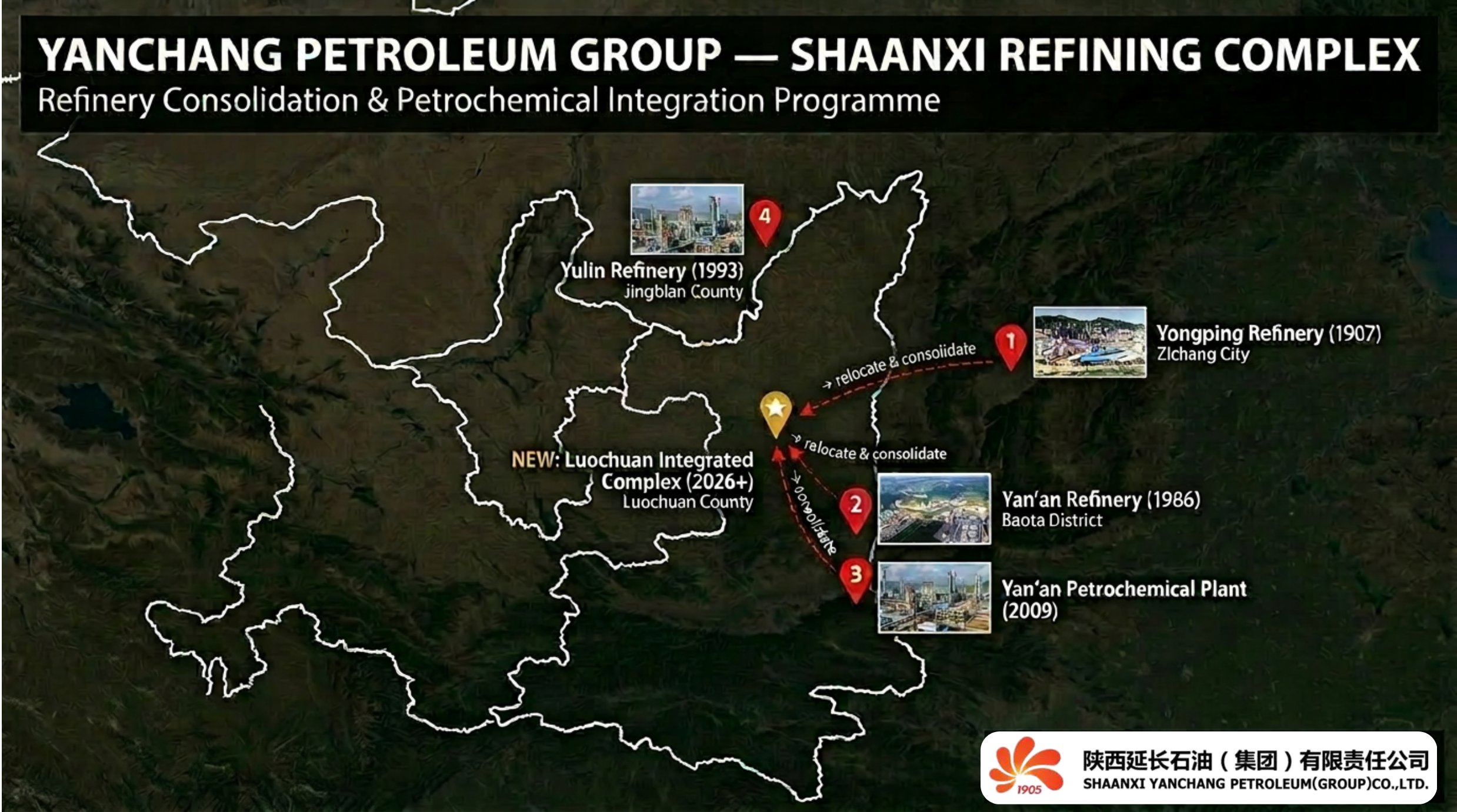
A RMB 80 billion bet on chemicals self-sufficiency signals a structural turning point for Chinese refining
By ppPLUS Market Intelligence | April 2026
In the loess highlands of Shaanxi Province, a refinery that has been processing crude oil since 1907 is preparing to go dark. The Yongping Refinery (永坪炼油厂), operated by the Yanchang Petroleum Refining & Chemical Company in Zichang City, Yan'an, holds the distinction of being China's oldest continuously operating oil processing installation — predating the founding of the People's Republic by four decades. Its planned decommissioning is not a story of decline. It is, paradoxically, a story of ambition.
A Province-Level "Number One Project"
Yanchang Petroleum Group, a Shaanxi provincial state-owned enterprise (SOE) controlling over 20 million tonnes per year of integrated oil and gas production, has staked its industrial future on a single transformative project: the Yan'an 10 million mt/yr Integrated Refining & Petrochemical Project (延安1000万吨/年炼化一体化转型升级项目), with a total investment of RMB 80.29 billion (approximately USD 11 billion). The project has been designated the "Number One Project" in Shaanxi Province's 14th Five-Year Plan for energy and chemical industry development.
The environmental impact assessment was submitted to regulators in early 2026, with the group targeting construction commencement within the year. The new complex will be sited at Luochuan Industrial Park, Luochuan County, Yan'an — squarely within the geographic heartland of Yanchang's century-old petroleum territory.
Three Old Plants, One New Vision
To make way for the new, three existing facilities will be shut down and their capacities consolidated: the Yan'an Refinery (5.6 Mt/yr CDU, est. 1986), the Yan'an Petrochemical Plant (commissioned 2009), and the historic Yongping Refinery (4.6 Mt/yr CDU). The combined retirement of these facilities represents an aggregate crude distillation capacity of over 10 million mt/yr (200,000 bpd) being taken offline — replaced on a strict "equal capacity substitution" (等量置换) basis by the new integrated complex.
The new complex will include a 10 million mt/yr atmospheric/vacuum distillation unit (ADU/VDU), a 1.2 million mt/yr steam cracker, and 15 additional refining process units alongside 14 chemical process units. The project's operating principle is captured in an eight-character Chinese industrial slogan: 整合产能、等量置换、减油增化、节能降碳 — "consolidate capacity, substitute on equal terms, reduce fuels and increase chemicals, save energy and reduce carbon".
The Strategic Imperative: From Fuel Seller to Chemical Maker
The Yanchang project is a microcosm of a national strategic reorientation now playing out across the Chinese refining industry. With actual installed capacity already at approximately 961 million mt/yr (~19.3 million bpd) in 2024 — around 18% of global refining capacity — China has been the world's largest refiner since 2022, and is fast approaching the government-mandated ceiling of one billion tonnes per year beyond which no net capacity additions will be approved.
Yet this formidable refining base is increasingly misaligned with demand: domestic fuel consumption is being eroded by the rapid electrification of road transport and the proliferation of LNG-powered heavy trucks, generating a mounting structural oversupply of motor fuels at a time when China still imports significant volumes of key petrochemicals.
The national policy framework is explicit on this point. A joint directive issued in October 2023 by the National Development and Reform Commission (NDRC) and the National Energy Administration (NEA) called for refining enterprises to pursue "oil-to-chemicals conversion" (油转化) and "oil-to-specialties conversion" (油转特) as their primary strategic direction — shifting production away from gasoline and diesel toward naphtha, olefins, aromatics, and specialty materials. The directive explicitly supports the consolidation of new refining projects into integrated petrochemical base clusters linked to ethylene and paraxylene (PX) production.
By 2025, the share of refined fuel products in China's total refinery output had already fallen from 63% to 56%, while fuel output dropped by 4.4% compared to 2021 levels. The trajectory is unmistakable.
Closing a Chemicals Import Gap
The chemical self-sufficiency dimension is particularly acute for China. Despite being the world's largest petrochemicals consumer, the country still faces significant import dependence in key building-block chemicals. A 2023 industry analysis projected a 1.2 million tonne gap in ethylene equivalent demand for 2025. A Sinopec industry report projected that China would approach self-sufficiency in polypropylene (PP), polyethylene (PE), paraxylene (PX), and ethylene glycol only by around 2030 — precisely the horizon that these new integrated complexes are designed to address.
For Yanchang specifically, the shift from a 9:1 fuels-to-chemicals ratio to 5:5 represents a doubling of chemical output as a share of production. The new ethylene plant alone — at 1.2 million mt/yr — would establish Yanchang as a significant player in China's domestic ethylene market, where the company currently has no presence.
A National Wave of Old Plant Retirements
The Yanchang project is not an isolated case. China's Ministry of Industry and Information Technology (MIIT), together with six co-issuing agencies, published in April 2026 a new "Action Plan for Accelerating the Upgrade and Renovation of Old Petrochemical and Chemical Installations (2026–2029)", targeting the full completion by 2029 of all renovation tasks identified in 2025. A national survey of facilities over 20 years old had already identified over 1,600 ageing installations across the country, of which more than 600 require upgrade or replacement.
PetroChina separately announced plans to permanently retire 19 ageing refining and chemical units, including some operating beyond their safe design life, as part of Beijing's broader campaign to rationalise overcapacity and improve downstream efficiency.
The Weight of History
The Yongping Refinery's story is inseparable from China's modern industrial identity. The site in Zichang County (then Yongping Town) processed the first commercially refined Chinese crude oil in 1907 — a milestone that preceded the Daqing oilfield era by half a century and the founding of CNPC by nearly eight decades. In 2019, the refinery earned another distinction when it became the first local enterprise in China to receive an official commercial aviation fuel production certificate, a sign that the old plant was still capable of innovation even in its final years.
Its closure, when it comes, will mark the end of 118 years of continuous operation on the same site. But in the logic of China's "减油增化" strategic transformation, it also marks the beginning of something considerably larger — a provincial SOE's attempt to leap from the margins of Chinese refining into the integrated chemicals value chain that will define the industry's next chapter.
This article draws on the following sources: Yanchang Petroleum Group bond prospectus (SSE, 2025); China NDRC/NEA Joint Directive on Promoting Green and Innovative High-Quality Development of the Refining Industry, 发改能源〔2023〕1364号; Yanchang 1000 Mt/yr EIA Public Notice (2024); China Daily (2019); Sohu Finance (2026); Lianhe Zaobao (2026); People's Daily (2026); Sinopec News Network (2025); China Petroleum Enterprise Magazine (2025); S&P Global Commodity Insights — China refining capacity forecast (2024); NDRC/NEA 1 billion tonne refining capacity cap confirmation (2023); WifiTalents Global Refining Industry Data (2026).
#yanchangpetroleum #shaanxiyanchang #china #yongpin #yanan #yulin #shaanxi #refinery #refiningcomplex #crudetochemicals #refineryintegration #petrochina #sinopec #cnpc #aviationfuel