Venezuela's Oil Production Under Pressure as US Naval Actions Disrupt Exports

- Entity
- Petróleos de Venezuela, S.A.

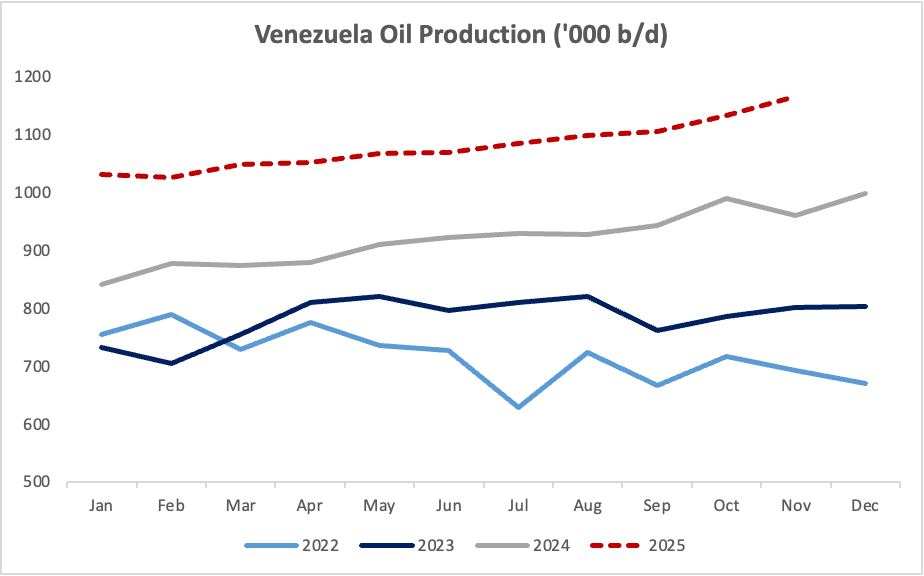
Production Cuts in the Orinoco Belt
PDVSA has started shutting in wells in the Orinoco Belt amid rising onshore inventories and limited access to export outlets. According to market reports, the company plans to cut Orinoco output by at least 25% to about 500,000 b/d, which could remove on the order of 15% of Venezuela's total liquids production. The first curtailments are targeting the heaviest extra-heavy crude streams in areas such as Junín, while lighter fields that use less diluent are being kept online as long as possible.
These moves reverse the upward production trend seen through most of 2025, when new logistics and crude-for-goods arrangements with Asian buyers had underpinned gradual growth. The combination of storage constraints, more difficult tanker logistics, and legal risks around shipping has now become a central constraint for PDVSA's operations.
Tanker Chases and Disputed Seizures
The tightening environment at sea has been illustrated by several high-profile tanker incidents in December. One vessel pursued by US forces drew global attention when its crew painted a Russian flag on the hull while under chase, apparently seeking to complicate any attempt to board or seize the ship. Other tankers linked to Venezuelan crude have been detained or diverted in recent weeks, adding to uncertainty for shipowners, insurers, and buyers.
A critical point in the emerging narrative is that the seized VLCC Centuries, boarded by US forces on December 19, was carrying Venezuelan crude associated with a well-established Chinese oil trader that regularly transports Venezuelan crude to Chinese refineries. Sources within Venezuela's oil industry confirmed the cargo was destined for China, raising fundamental questions from Beijing's perspective about the security of energy trade when cargoes are intercepted in international waters after commercial title has transferred. China strongly condemned the seizure, viewing it as interference with legitimate commercial transactions.
The "Shadow Fleet" and Alternative Insurance Markets
Much of Venezuela's crude is now transported on older tankers operating outside traditional Western maritime service ecosystems. In Western commentary these vessels are frequently described as a "shadow fleet," with concerns raised over safety standards and transparency of ownership. However, many non-OECD governments and companies view this fleet primarily as an alternative logistics system that allows sanctioned producers and willing buyers to continue trading outside US and EU jurisdiction.
Critically, research confirms that these vessels are increasingly insured by Russian and Asian insurance companies rather than Western Protection and Indemnity (P&I) clubs. Russian state-backed insurers have stepped in to provide P&I coverage for sanctioned trades, though global reinsurers do not support these policies. Asian insurance markets in Singapore, Hong Kong, and Tokyo face mounting pressure regarding exposure to these shipping structures, but the insurance coverage itself is legitimate within the jurisdictions issuing it. The characterization of this fleet and its insurance arrangements as illegitimate reflects Western regulatory perspectives rather than a universal legal consensus.
Rising BRICS and Global South Pushback
The latest US maritime actions around Venezuela have prompted increasingly vocal reactions from BRICS states and other Global South countries. China has criticized recent tanker seizures and interdictions as unilateral and lacking United Nations authorization, especially in cases where Chinese-owned cargoes are involved. Russia has also condemned the operations and signaled political support for Venezuela in international forums, emphasizing freedom of navigation and respect for flag-state jurisdiction.
Within the broader BRICS framework, several members have framed these developments as evidence of the need to reduce exposure to US-controlled financial and maritime systems. Discussions about expanding non-dollar settlement mechanisms, strengthening South-South energy trade, and coordinating diplomatic responses to sanctions have gained prominence. This growing opposition does not yet eliminate the practical impact of US actions, but it underscores how Venezuela's oil production and export challenges have become a focal point in a wider geopolitical contest over control of energy flows and maritime enforcement.
US Strategic Objectives Beyond Counter-Narcotics
While Washington frames its Caribbean military buildup and Venezuelan operations in terms of counter-narcotics efforts, the Trump administration's latest national security strategy reveals broader territorial and resource ambitions. The strategy document explicitly states Washington's intention to "restore American pre-eminence" across the Western Hemisphere, effectively asserting a sphere of influence doctrine over the Americas.
Regarding Venezuela specifically, analysts note this likely involves positioning for eventual access to Venezuela's oil and gas resources—the largest proven petroleum reserves in the world, five times greater than US reserves—for American oil refiners and producers. This context suggests the naval blockade and pressure campaign extend beyond stated counter-narcotics justifications to encompass broader strategic resource control objectives in a region Washington considers its natural sphere of influence.
Venezuela's Production at the Center
Through all these developments, Venezuela's production profile remains central. Onshore and upgrader bottlenecks, not geological limits, are driving current reductions, meaning output is highly sensitive to shifts in sanctions enforcement, storage capacity, and tanker availability. If export routes remain constrained and more tankers are detained or deterred, deeper cuts to Orinoco operations and heavier crude streams are likely. Conversely, any easing of maritime pressure or new logistics solutions supported by BRICS partners could once again allow PDVSA to move closer to the higher production levels reached in late 2025.
In this sense, Venezuela's oil sector sits at the intersection of sanctions policy, maritime law, hemispheric resource control, and emerging multipolar energy politics, with each new tanker chase or policy statement directly shaping the barrels that can reach the market.
Note: This article draws on reporting from Bloomberg News, Reuters, S&P Global, Lloyd's List, CNBC, The New York Times, BBC News, Anadolu Agency, Asia Sentinel, Rosa Luxemburg Stiftung, Charter97, Yeni Şafak, Chosun Biz, AOL News, The Wall Street Journal, and Energy News Today, as well as production data from Oil Price and the Venezuela oil production chart provided. These sources provided coverage of PDVSA's Orinoco Belt production cuts, US Coast Guard tanker seizures, the Centuries VLCC incident involving Chinese-owned cargo, shadow fleet insurance arrangements with Russian and Asian insurers, BRICS diplomatic responses, Trump administration hemispheric strategy documents, and the broader geopolitical dynamics affecting Venezuela's crude export capabilities. The interpretation and strategic framing presented in this article reflect our own analytical perspective on these developments.
#venezuela #pdvsa #oiltanker #shadowfleet #orinocobelt #nationalsecuritystrategy #sphereofinfluence #brics #china #russia