Major Analysts Shift Hydrocarbon Outlook, Confirming Our Original, Contrarian Demand Scenario


Our Scenario: Linear Energy Demand Growth vs. Global Population Size and Persistent Fossil Dominance
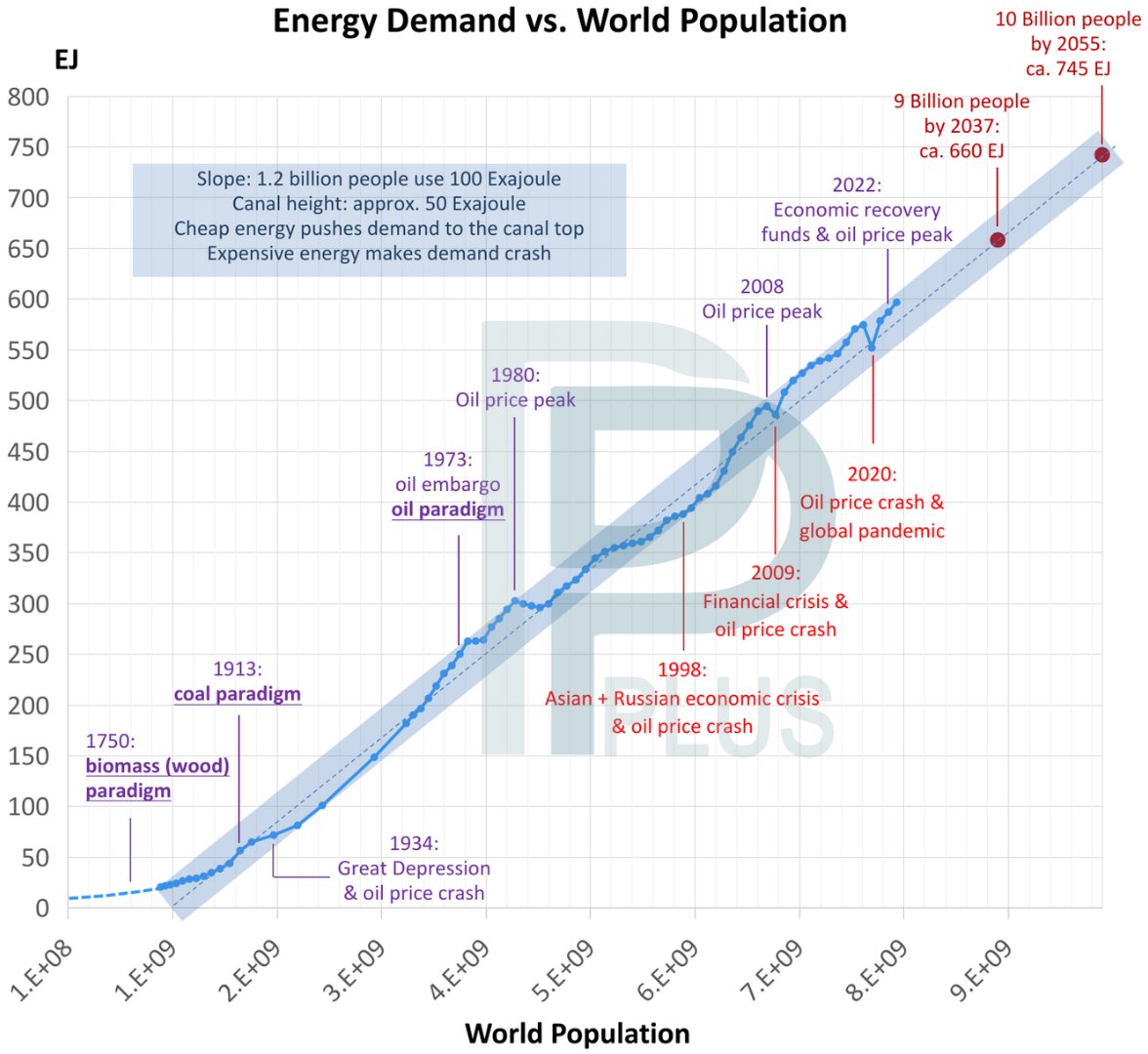
Three years ago, with our piece 'Energy Transitions Reboot', we challenged the consensus outlook from major agencies like the IEA and top consultancies. Drawing on historical data and a rigorous population-energy demand correlation, we forecast that global energy demand would continue rising linearly with population growth, not exponentially, but also not plateauing as rapidly as mainstream predictions suggested.
Key assertions from that original piece included:
-
Energy demand would rise from approximately 167,000 TWh in 2021 to over 215,000 TWh by 2050, tracking with global population trends—not being mitigated as much by efficiency or renewables as often claimed.
-
Fossil fuels would continue to meet the vast majority of energy needs—falling only modestly from 86% in 2021 to about 78% by 2050.
-
Solar and wind, despite rapid early expansion, would see their growth rates slow, making only incremental contributions to the total energy mix, never dominating or even approaching a 50% share.
-
Nuclear and hydro were forecasted to grow, especially nuclear, which was predicted to experience a “renaissance” in the face of realistic energy transition capabilities.
-
The oft-claimed “energy transition”—involving rapid, transformative decarbonization by 2050—was, in our view, unlikely and unsupported by supply chain realities and the energy density advantage of hydrocarbons.
Updates and reinforcement of our scenario (2023-2024)
An updated chart version of the energy demand vs. population size with data points to 2023 is shown here below:
Subsequent market developments forced a reassessment across the industry:
-
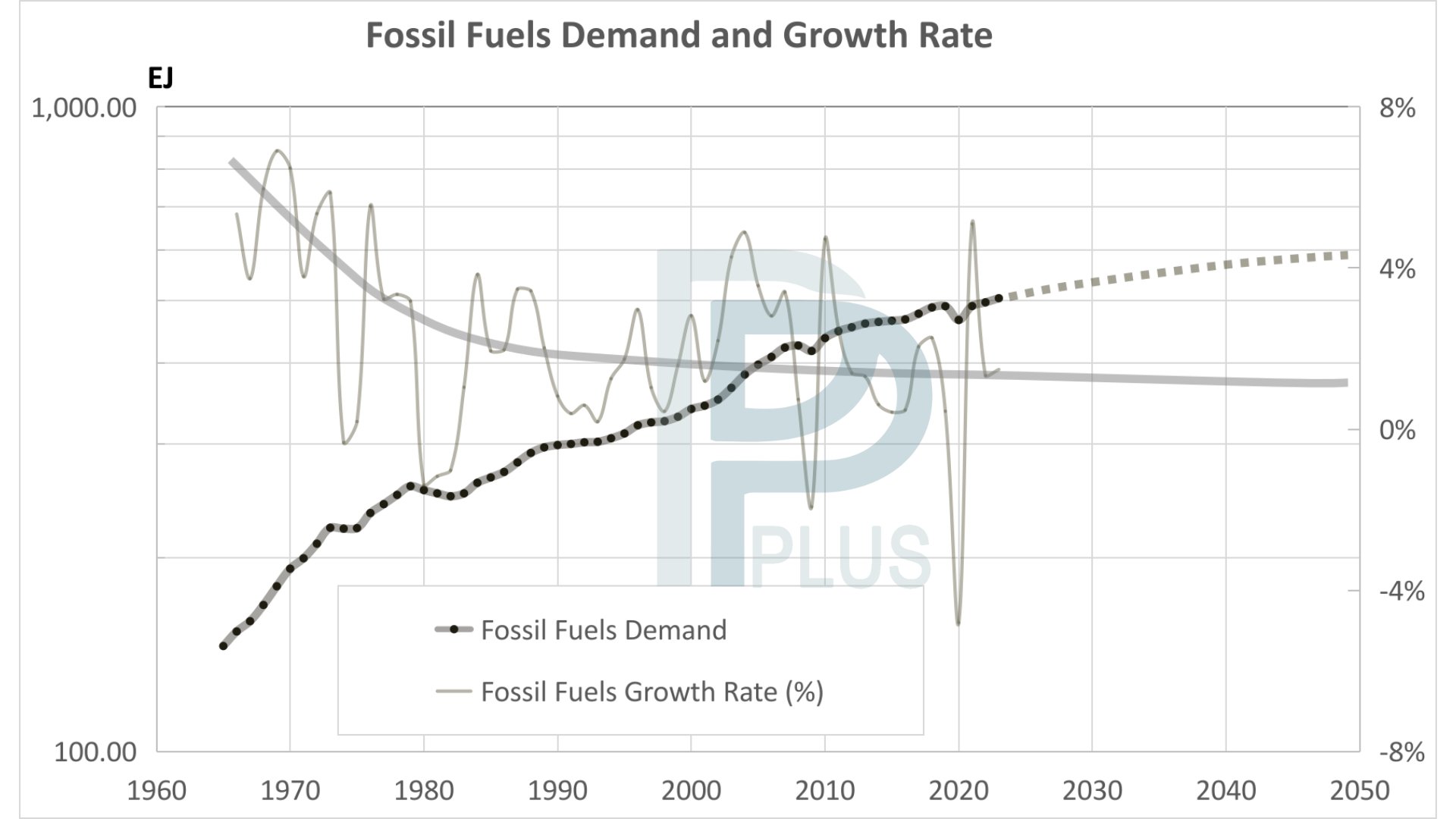
Our subsequent updates in August 2023 (World oil demand is scaling record highs says IEA, exactly as per our forecast) and June 2024 (OPEC: Peak oil demand not on the horizon) confirmed that the pace of renewables’ growth, while historic, was not translating into the overall magnitude required to dethrone fossil fuels. Global disruptions, rising energy prices, the need for secure baseload power, and lagging investment in alternatives reinforced the persistence and resurgence of crude oil, natural gas, and coal demand at a global level.
-
The following chart presents our compounded hydrocarbons demand and growth rate scenario with updated figures to 2023:
IEA’s 2025 Outlook: A Major Shift Toward Realism
The IEA’s 2025 World Energy Outlook marks a distinct departure from its previous narrative
-
The IEA now features scenarios where oil demand continues growing into 2050 under current policies, projecting up to 113 million barrels per day by mid-century—substantially above previous projections.
-
Even their more optimistic “stated policies scenario” merely predicts a peak around 2030 with a lengthy plateau, not a sharp drop.
-
Natural gas: Instead of peaking soon, global gas demand is anticipated to keep increasing until at least 2035, with ultimate demand in 2050 potentially 31% higher than current levels if governments follow only established (rather than aspirational) policies.
-
Hydrocarbons overall are projected to retain a large share of the global energy mix, with renewables growing robustly but not displacing fossil fuels at the scale previously suggested.
-
Nuclear power is highlighted as an essential contributor, predicted to rise 39% by 2035 and possibly double by 2050, again mirroring the expectations in our early scenario.
-
The IEA report notes that oil and gas investments are rising and that assumptions regarding imminent "peak oil" are now being openly reevaluated by the agency itself as well as major industry groups and political actors.
Industry and Policy Context
This turn from the IEA and other analysts is not merely an academic matter. It reflects hard realities:
-
Policy shifts, energy security concerns, episodic price spikes, and technological bottlenecks have diminished the credibility of projections based on uninterrupted renewables growth.
-
The data now clearly shows a “grinding higher” of fossil fuel demand, especially for oil and gas, alongside slowing installation rates for new wind and solar capacity.
-
Even under scenarios with accelerated renewables uptake and electrification, hydrocarbons remain indispensable for industrial, transportation, and developing economy needs, underpinning global economic resilience.
Our Oil Demand Scenario
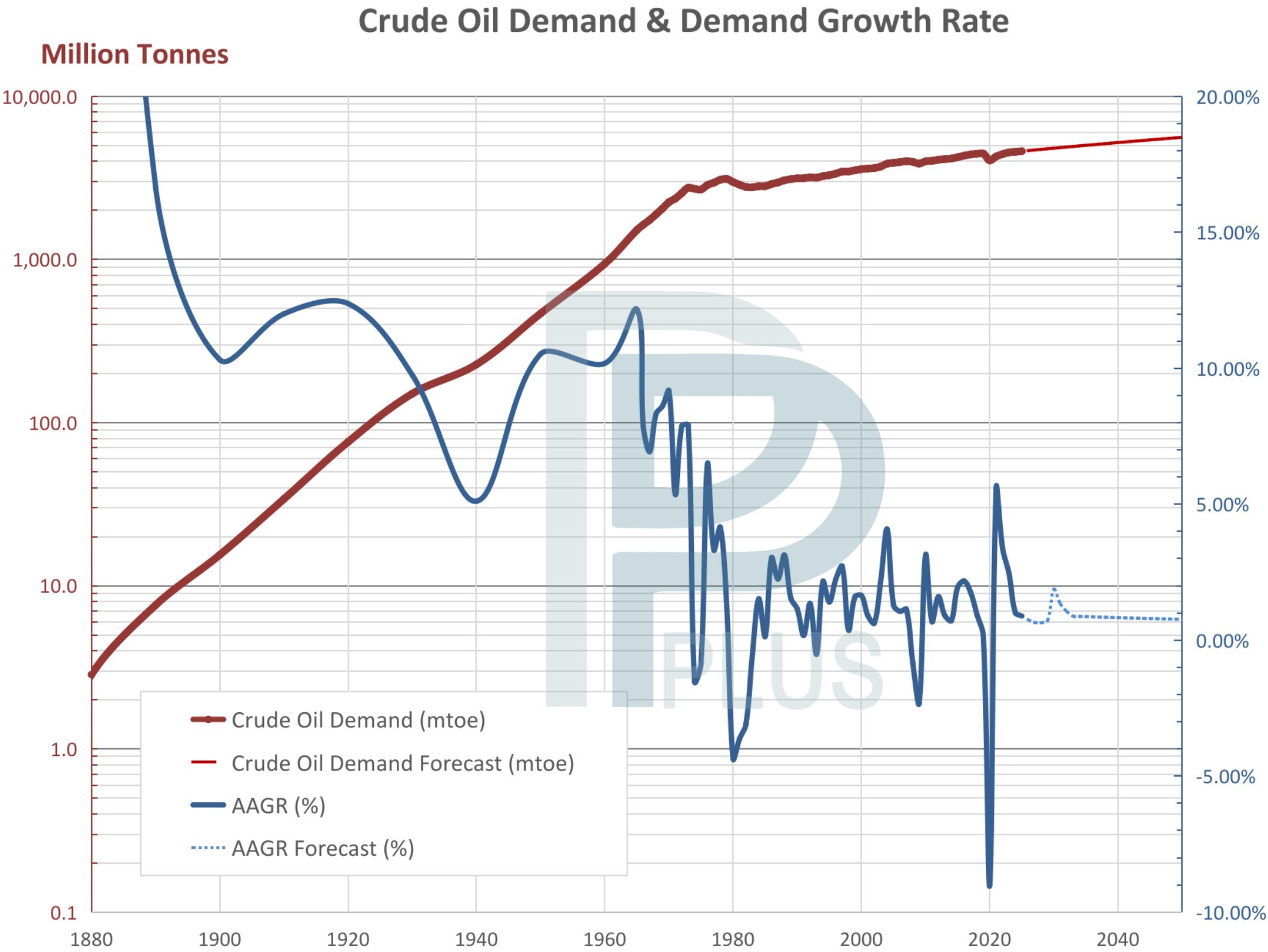
Our scenario remains more ambitious than even the most optimistic version of the revised IEA forecast as we do not envision a delayed peak demand by 2030 followed by a subsequent plateauing demand. The following chart shows actual data to 2024 and a forecast from 2024 to 2050 accounting for the addition of 0.8 million bpd annually. Constant volume of oil demand added year after year is accounting for a diminishung population growth rate and ageing (as energy demand decreases when population gets older), translating into slow attrition of the oil demand growth rate.
Under this scenario, crude oil demand will increase from 4530 mtoe (million tonnes of oil equivalent) in 2023 to 5606 mtoe in 2050, corresponding to the addition of 108 mtoe (roughly 22 million barrels of oil per day) in the time interval from 2024 to 2050, or a 19% growth versus 2023.
Outlook
Three years on, major forecasters and policymakers—one after the other—aligning their forecasts, however with great retraint, with the scenario first outlined here—a scenario based on historical, demographic, and technical fundamentals, not wishful thinking . Predictions of an abrupt, near-term decline in global hydrocarbon demand now appear misplaced.
The IEA’s latest public statements represent an acknowledgement that energy transitions are incremental, contested, and contingent on complex global realities—not merely shaped by policy ambitions. As we stated in our 2022 piece:
"There is no true energy transition in the making, just a slow and steady evolution of the global energy mix."
Hydrocarbons’ enduring role is now central to mainstream expectations for the decades ahead, confirming a contrarian assessment that prioritized rigorous analysis over prevailing narratives.
#fossilfuels #hydrocarbons #crudeoil #naturalgas #coal #oildemand #energydemand #demographics #populationgrowth #peakoil